About
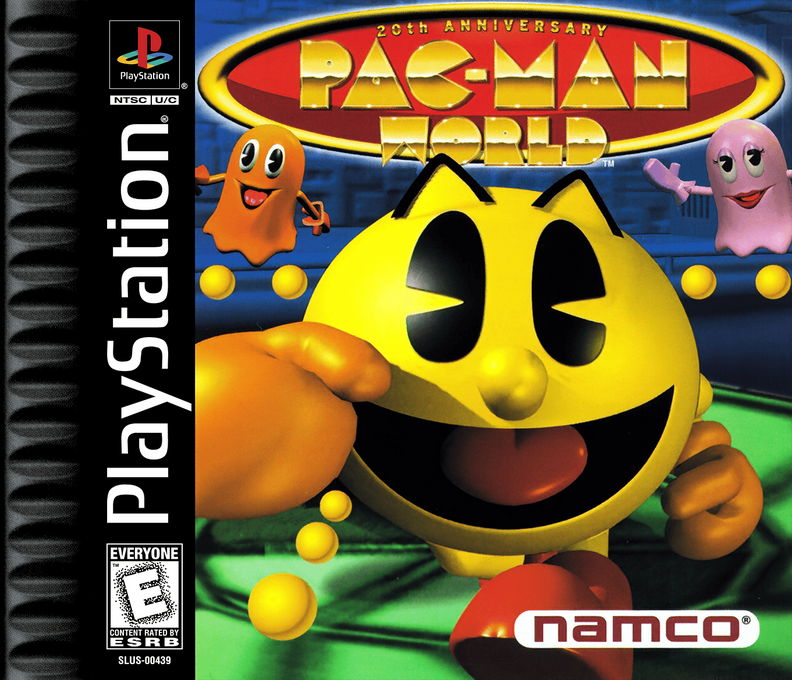
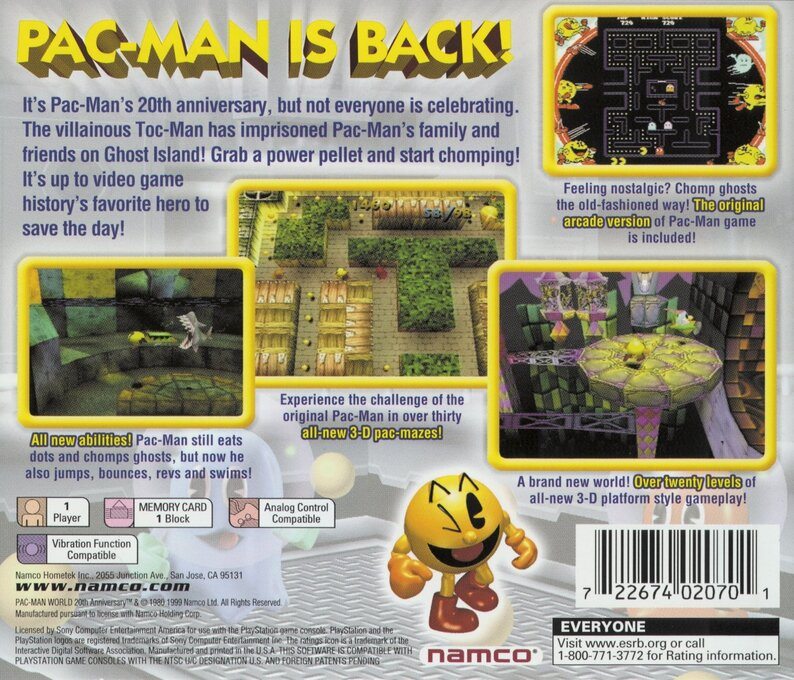
Pac-Man World for PlayStation brings Namco’s arcade icon into a 3D action-platform adventure made for Pac-Man’s 20th anniversary. Released in 1999, this PlayStation game casts Pac-Man as the hero of a rescue mission after Toc-Man and his ghostly followers crash his birthday celebration and abduct the guests. With his home suddenly empty, Pac-Man sets out for Ghost Island to recover his family and friends, including Ms. Pac-Man, Pac Jr., Baby Pac, Professor Pac, Pooka, and Chomp-Chomp. The result combines the recognizable dots, fruit, ghosts, and bright personality of the arcade original with a larger single-player journey built around stages, hazards, puzzles, and bosses.
Quest Mode is the main adventure. Pac-Man travels through themed areas of Ghost Island, moving through 3D spaces with a camera that generally presents the action from the side. Reaching an exit is only part of each stage: players search routes for collectibles, open the way forward, and look for the items and switches that reveal additional paths. Keys are particularly important because they free the captured characters, while fruit, Pac-Dots, crates, and other pickups reward exploration. Levels balance ordinary platform jumps with moving obstacles, environmental dangers, doors, and detours, giving the familiar yellow hero a more involved set of objectives than simply clearing a maze.
Pac-Man’s move set turns his round shape into the basis for both traversal and combat. He can jump, use a Butt-Bounce to slam down on enemies or objects, and charge a Rev Roll to build speed for ramps, long gaps, and certain mechanisms. Pac-Dots can also be used as projectiles, so players must decide when to spend them rather than simply collect them. Power Pellets retain their classic role in confrontations with the ghost gang, briefly letting Pac-Man turn the tables. The adventure also introduces situational equipment and environmental devices, including objects that help solve a route or change how Pac-Man moves through an area.
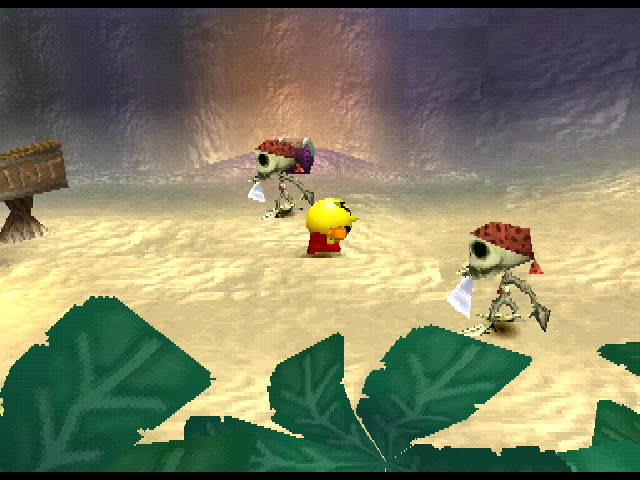
The game’s worlds give the quest a tour-like rhythm, with distinct settings such as pirate-themed territory and ancient ruins. Stages lead to boss encounters and eventually toward Toc-Man, whose scheme centers on presenting himself as the real Pac-Man. Along the way, the game turns its mascot’s arcade history into optional challenges. Hidden Galaxian markers open 3D maze stages that preserve the essential rule of eating every dot while avoiding ghosts. Finding and completing these mazes expands what is available from the menu, while letter pickups spelling PACMAN can lead to additional bonus content. This structure encourages return visits for players aiming to uncover more than the direct route to the finish.
Pac-Man World also offers modes beyond the main quest. Classic Mode presents the original Pac-Man experience, while Maze Mode reframes maze-chasing gameplay in a three-dimensional setting. Their inclusion makes the PlayStation release feel like both a platform game and a celebration of the character’s arcade roots. That anniversary focus was explicit in Japan, where Namco marketed Pac-Man World: 20th Anniversary as a PlayStation 3D action-adventure release, twenty years after Pac-Man’s 1980 arcade debut. The Japanese version arrived in November 1999; the game had already reached North America that October, where Sony Computer Entertainment published the PlayStation edition.
As an early 3D chapter in the broader Pac-Man series, Pac-Man World is notable for adapting a character best known for compact, score-driven mazes into a level-based console adventure without abandoning its visual vocabulary. Its ghosts, pellets, fruit, and maze challenges are folded into a campaign about exploration and rescue rather than treated as a separate nostalgia feature. The PlayStation original later became the starting point for the Pac-Man World series, followed by Pac-Man World 2 and Pac-Man World 3, while its core adventure was revisited years later in the remake Pac-Man World Re-Pac. For players exploring the PlayStation library, it remains a distinctly late-1990s interpretation of one of gaming’s most enduring characters.
Gallery
Details
- Developer
- Namco
- Publisher
- Sony Computer Entertainment
- Genre
- Platformer
- Players
- 1
- Release Date
- October 12, 1999
- System
- PS1