About
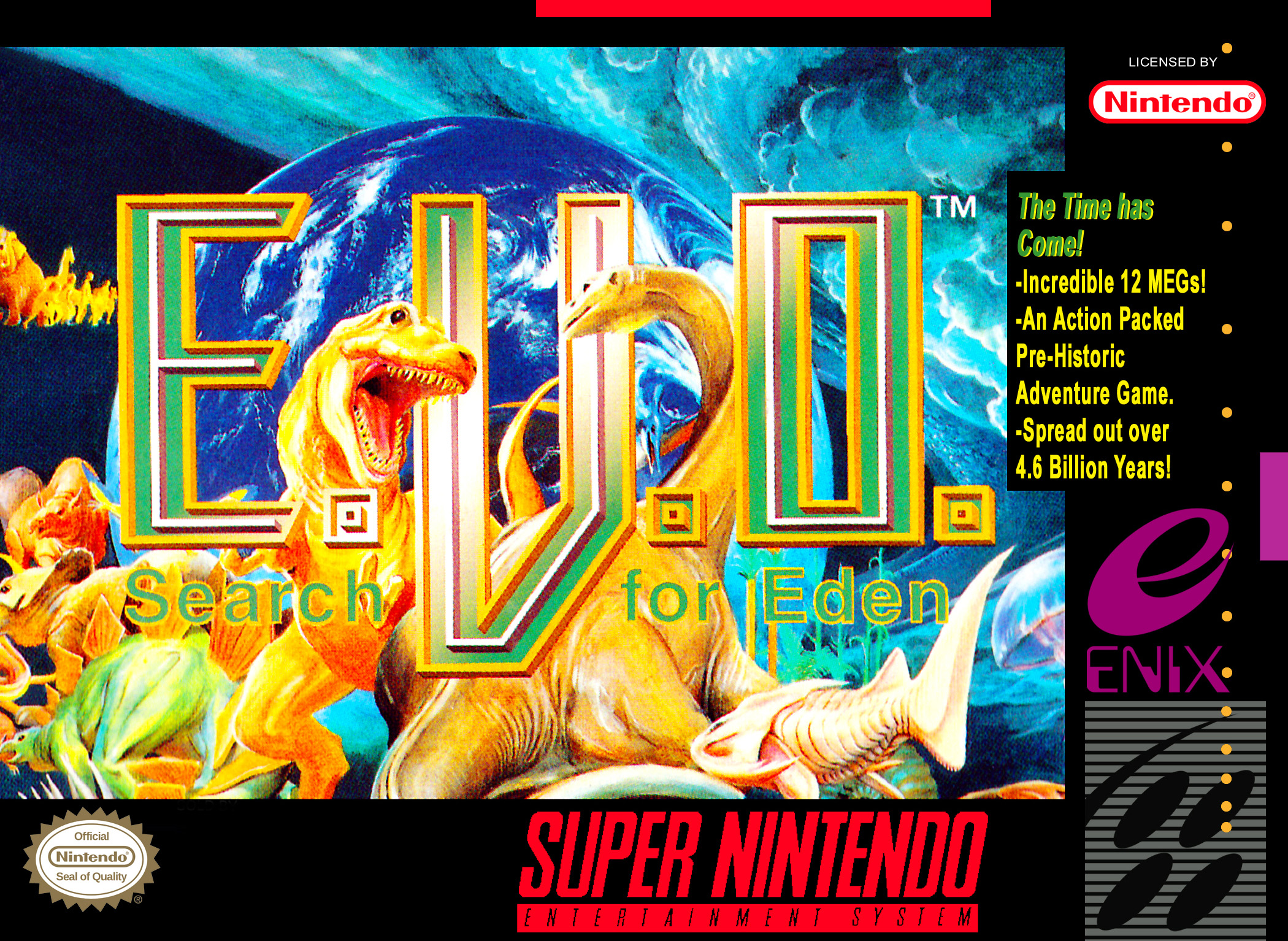
E.V.O.: Search for Eden is an unusual Super NES action role-playing game that turns evolution into the player’s central tool. Developed by Almanic Corporation and published by Enix, the North American release arrived in 1993 after the Japanese Super Famicom edition, 46 Okunen Monogatari: Harukanaru Eden e, in late 1992. It draws on Almanic’s earlier Japanese computer game 46 Okunen Monogatari: The Shinka Ron, but reshapes that premise into a single-player, side-scrolling adventure built for Nintendo’s 16-bit console.
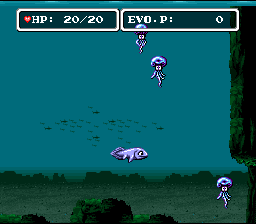
The journey begins in prehistoric seas, where the player controls a small fish chosen by Gaia, a personification of Earth. Gaia promises that the lifeform best able to advance through the ages may reach Eden. That mythic framing makes clear that the game is fantasy rather than a scientific simulation: geological eras, dinosaurs, early humans, heavenly imagery, and strange alien crystals coexist in a deliberately imaginative version of natural history.
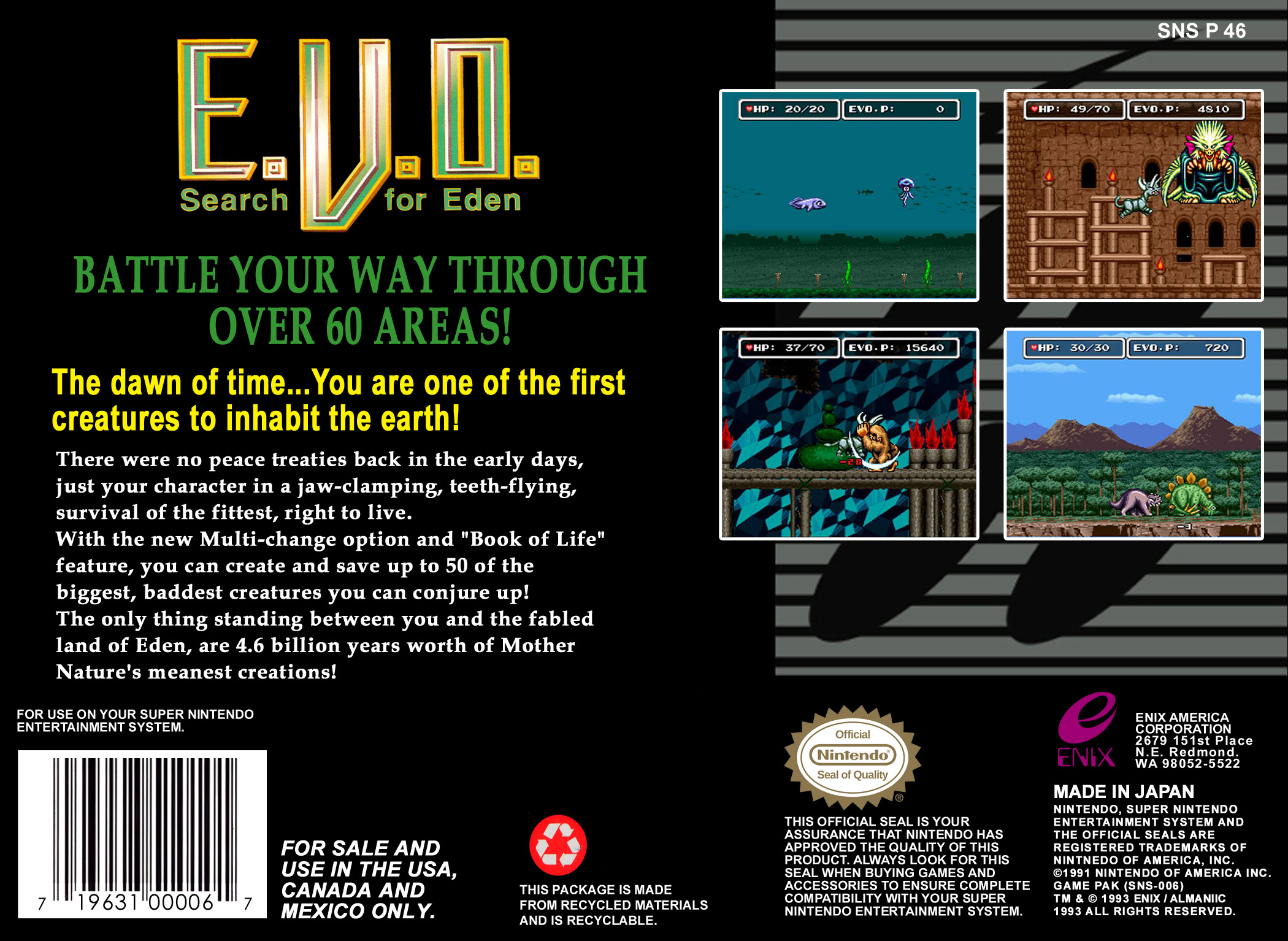
Its five chapters move from an ocean world through early land life, the age of dinosaurs, an ice age, and an early-human era. Each era has an overworld map connecting side-scrolling stages, and enemies, hazards, and bosses make the changing environments feel materially different. The game combines familiar platform-game movement with an RPG-like loop of fighting, collecting resources, and deciding how to improve a character for the next challenge.
Defeated creatures leave meat, which restores health and serves as the source of Evolution Points. Players spend those points on individual body parts, changing a fish or land animal’s jaws, body, tail, legs, horns, and other features. These purchases affect visible appearance as well as practical strengths such as attack power, speed, swimming, jumping, and survivability. Because points are limited at any moment, choosing a specialized build can matter as much as simple reflexes in combat.
The transformations are the game’s signature appeal. A player may pursue a powerful bite, a fast aquatic form, a horned animal, or another path that better suits an era’s enemies and terrain. Special crystals can offer guidance, grant a large cache of points, or temporarily transform the creature. Losing all health does not end the adventure outright; Gaia returns the creature to the map while taking away part of its saved points, encouraging another attempt without a conventional game-over screen.
E.V.O. also includes a battery-backed save system and its Book of Life feature, which stores previously created creatures for later recall at designated crystals. That system complements the design’s interest in experimentation, allowing players to preserve notable evolutionary forms rather than treating every change as disposable. Boss encounters at the ends of stages test those choices more sharply than ordinary fights, while the story gradually reveals that crystal-altered creatures are disrupting Gaia’s intended order.
Takashi Yoneda directed the Super NES game, with Keizo Mochizuki producing it and Motoaki Takenouchi adapting music associated with the earlier 46 Okunen Monogatari project. The game’s mix of platform action, character growth, customizable anatomy, and an eccentric creation myth made it stand out in the SNES library. Contemporary criticism often praised that originality while finding parts of the movement and repetition slow, but its distinctive evolutionary progression has kept E.V.O.: Search for Eden a memorable cult favorite for players seeking an unconventional 16-bit adventure.
Gallery

Details
- Developer
- Enix
- Publisher
- Enix
- Genre
- JRPG
- Players
- 1
- Release Date
- July 1, 1993
- System
- SNES