About
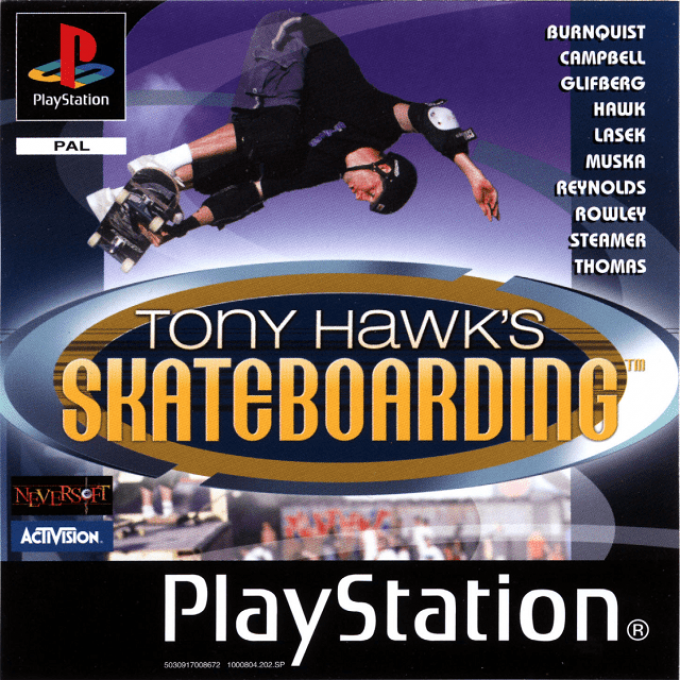
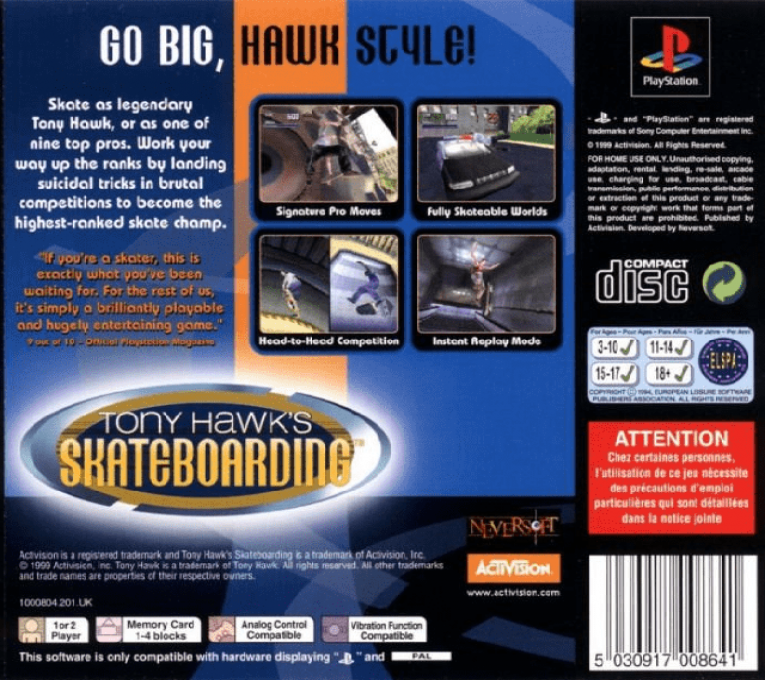
Tony Hawk’s Skateboarding is the European title for the 1999 PlayStation original released elsewhere as Tony Hawk’s Pro Skater. Developed by Neversoft and published by Activision, it turns a skateboard video game into a fast, score-driven tour of ramps, rails and improvised lines. Choose Tony Hawk or one of nine other professional skaters, drop into a compact 3D park, and make every two-minute run count. Its immediate appeal is simple: find a route, build speed, take air and turn a risky sequence of tricks into a score before a bail wipes the current combo away.
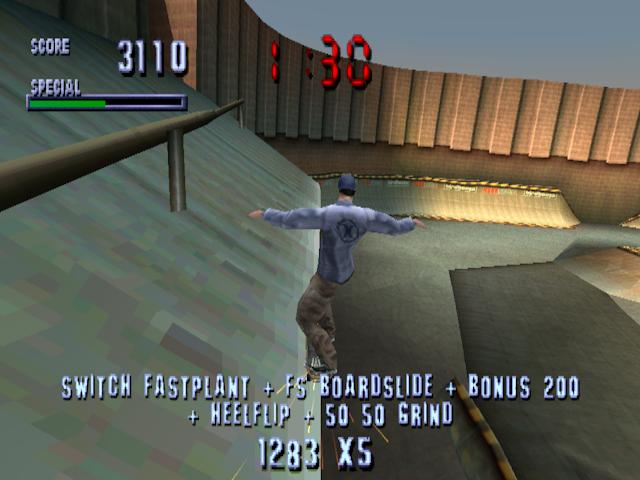
The PlayStation version is built around an accessible four-button vocabulary. Steering is handled with the D-pad or analogue stick, while dedicated buttons cover the ollie, grabs, flip tricks and grinds. Directional inputs shape the trick selected, so the same basic controls steadily open into a larger move set. Every skater has eight grabs, eight flips and eight grinds, plus a signature special trick that becomes available when the Special meter is filled. Repeating tricks is worth less, encouraging variety, timing and a feel for when to bank points instead of pushing a run too far.
Career Mode gives the game its sharpest structure. Most stages present five objectives as VHS tapes within a two-minute session, and completed goals stay complete even when the rest must wait for another attempt. High-score targets, the letters of SKATE, a hidden tape and stage-specific destruction tasks turn each venue into a small playground with a practical reason to explore every rail, ramp and shortcut. Progress opens more locations and equipment, while earned cash can be used to improve skater statistics. Three competition stages change the format to judged runs across three one-minute rounds, where a medal depends on the final score.
The locations range from the opening Warehouse to a School, Mall, Skate Park, Downtown, Downhill Jam, Burnside, Streets and Roswell. They are not realistic simulations of particular spots so much as readable skating spaces packed with useful geometry: quarter-pipes for air, rails for grinds, banks for linking routes and unexpected objects that invite experimentation. The camera stays behind the skater, keeping the next landing and the next possible line in view. That design makes the game easy to understand on a first run but rewarding once a player starts recognizing where one move can flow into another.
Outside the career, Single Session offers a straight two-minute high-score chase using unlocked stages and skaters, while Free Skate removes the clock for unhurried practice and exploration. Local two-player split-screen adds Graffiti, Trick Attack and HORSE. Graffiti turns level features into territory claimed by each player’s tricks; Trick Attack is a direct contest for the best chained score; and HORSE makes players answer one another’s short trick attempts. These modes give the original disc a strong social side without confusing it with the online features or expanded systems of much later releases.
The roster includes Tony Hawk, Bob Burnquist, Bucky Lasek, Chad Muska, Elissa Steamer, Geoff Rowley, Jamie Thomas, Kareem Campbell, Andrew Reynolds and Rune Glifberg, with Officer Dick and Private Carrera available as unlockable characters. The professionals bring distinct statistics and special moves, but the central challenge remains the same: use the stage well, vary the tricks and keep control when the score is on the line. A punk and ska-punk soundtrack gives the action its restless late-1990s energy and helps make even a failed run feel worth immediately restarting.
This is the foundation rather than a later sequel or modern remake. The original PlayStation game does not include manuals, the balancing move introduced in Tony Hawk’s Pro Skater 2, so its biggest combos are shaped by air, grinds and the available terrain instead. It also should not be mistaken for the later Nintendo 64, Dreamcast, Game Boy Color or N-Gage versions, nor for the 2020 Tony Hawk’s Pro Skater 1 + 2 remake. For players returning to the PS1, Tony Hawk’s Skateboarding remains a focused arcade skateboarding classic: compact sessions, clear goals, memorable parks and a score system that still makes one more run hard to resist.
Gallery
Details
- Developer
- Neversoft
- Publisher
- Activision
- Genre
- Extreme Sports
- Players
- 1-2
- Release Date
- August 31, 1999
- System
- PS1