About
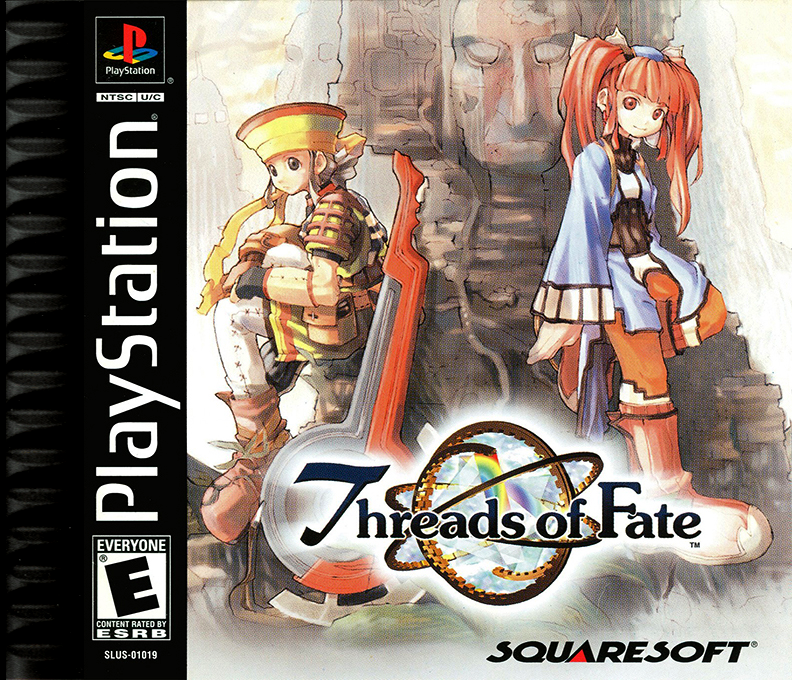
Threads of Fate for PlayStation is Square’s single-player action role-playing game, released in Japan in 1999 as Dewprism and in North America in 2000. Rather than telling one fixed adventure, it lets players begin as either Rue or Mint, two very different protagonists pursuing the same legendary Relic. The ancient artifact is said to grant any wish, making it the focus of two parallel journeys through a colorful fantasy world. Square developed the game for the original PlayStation, combining real-time combat, exploration, light platforming, and story scenes rendered in 3D.
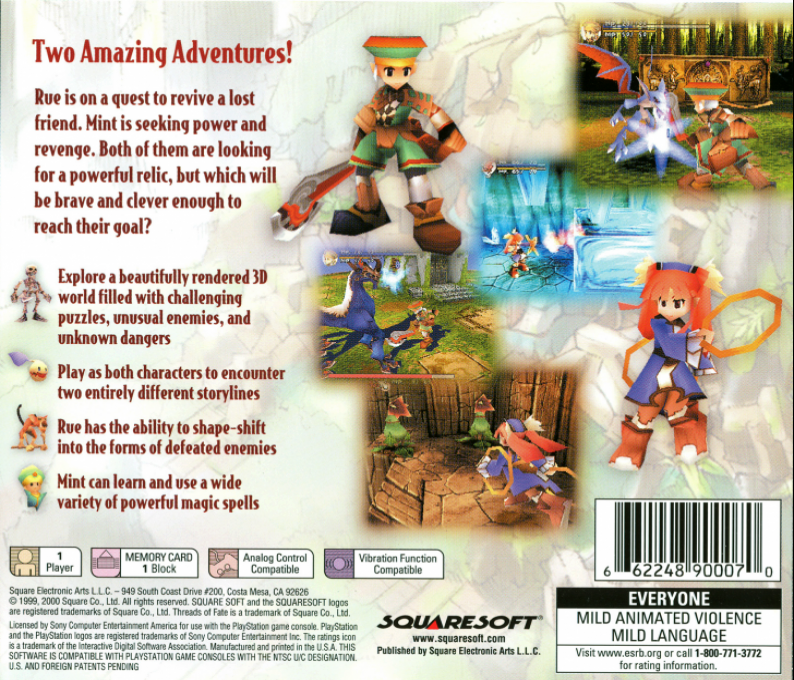
Rue’s route follows a quiet young man determined to bring back Claire, the friend he lost. Mint’s campaign stars the outspoken princess of East Heaven Kingdom, who has been forced from her position by her younger sister Maya and dreams of taking the throne back. Their motives, personalities, and dialogue give the two stories sharply different tones, even when they bring the characters to the same town, ruins, and dungeons. Selecting one hero at the beginning therefore changes more than the script: it determines the abilities used in battle and the ways many obstacles are approached.
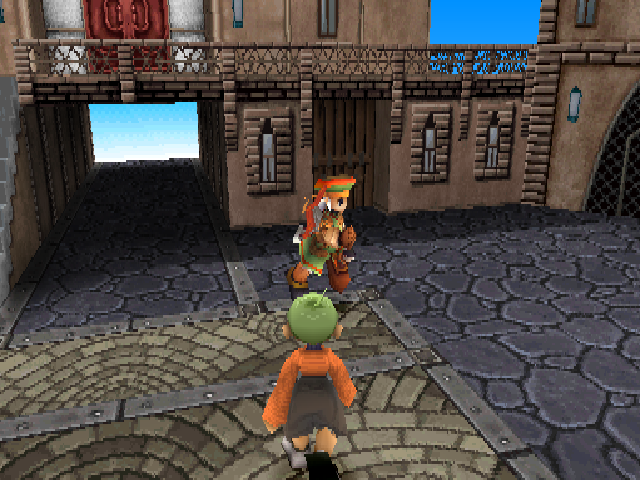
The central base is the town of Carona, where players can recover, save their progress, buy supplies, and prepare before setting out. Beyond town, the adventure moves through connected areas and dungeon-like stages packed with enemies, switches, hazards, and jumping challenges. Battles happen directly in the environment rather than through separate turn-based encounters. Each hero can move, jump, and use attack actions, while health and magic resources must be managed on the way through an area. Defeated enemies can leave behind useful items and coins, giving exploration practical rewards alongside story advancement.
Rue’s defining mechanic is transformation. By collecting coins from defeated monsters, he can take on their forms and use their particular traits, turning enemy encounters into a source of new ways to fight and solve character-specific problems. Mint has a contrasting style built around her rings and magic. Her attacks work at close range and as projectiles, while her spell options bring elemental effects into combat and puzzles. The two systems make the paired campaigns feel distinct: Rue changes shape to borrow monster abilities, while Mint builds her approach around spells and ranged offense.
Threads of Fate uses action instead of a conventional experience-point leveling structure. The characters’ maximum health and magic capacity grow through use: taking damage contributes to health growth, while repeatedly using magic develops magic capacity. This design keeps progression closely tied to play rather than to grinding for levels. Carona’s facilities and the supplies found or purchased during the adventure support that loop, and the game also offers different ways to continue after defeat, including returning to town or spending a special Coin of Life for an immediate restart.
Known as Dewprism in Japan, Threads of Fate is a compact example of Square’s late-1990s PlayStation output outside its best-known role-playing series. Its two-protagonist structure, fully 3D presentation, and contrasting transformation and magic systems distinguish it from more traditional menu-driven RPGs of its era. Completing a campaign unlocks further replay opportunities, including carryover features and hidden content, encouraging players to see both Rue’s and Mint’s perspectives on the search for the Relic.
Gallery
Details
- Developer
- Squaresoft
- Publisher
- Squaresoft
- Genre
- JRPG
- Players
- 1
- Release Date
- July 19, 2000
- System
- PS1