About
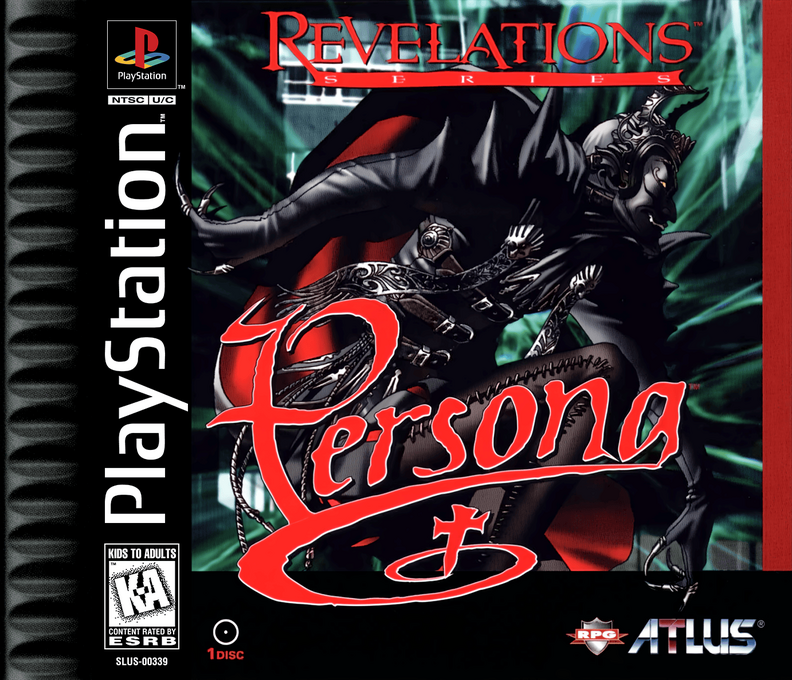
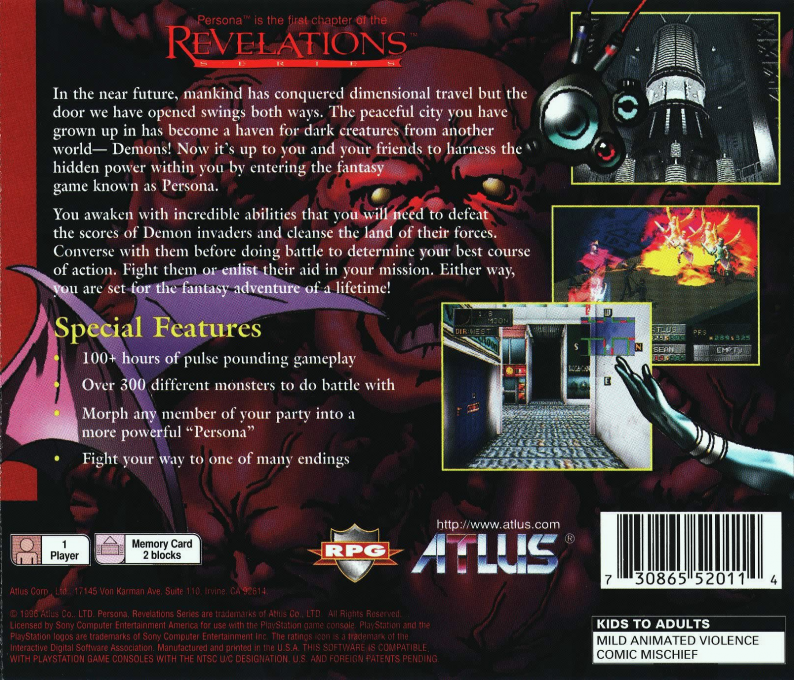
Revelations: Persona is the North American PlayStation release of Atlus’s 1996 role-playing game, the opening chapter of the Persona series. Known in Japan as Megami Ibunroku Persona, it trades medieval kingdoms for an unnervingly familiar high-school world, then tears that world open with occult rituals, hostile demons, and a crisis that reaches far beyond the classroom. A group of students at St. Hermelin High discovers that the game called Persona is more than a rumor. After it awakens the hidden power within them, their ordinary town of Lunarvale becomes a place where danger waits behind every hospital door, city street, and shadowed corridor.
The adventure follows a silent student protagonist and a changing circle of classmates as they search for answers amid a supernatural disaster. Atlus builds the tension from small-scale details: school friends with their own insecurities, unsettling changes to places that should feel safe, and the mounting realization that inner fears can take physical form. The result is a compact, strange RPG with a modern-day setting that still feels distinctive. Its drama is driven as much by identity, trust, and the characters’ hidden sides as by the threat of demons.
Its central idea is the Persona itself: a supernatural manifestation of a character’s hidden qualities. Equipping the right Persona turns each party member into a flexible combatant with spells, resistances, and specialized roles, while using those powers spends SP. Personas develop through battle and can be swapped to reshape a party’s options. The system encourages preparation without asking every character to fill only one fixed job, making the choice of which Personas to bring feel important before stepping into a dangerous area.
The Velvet Room is the game’s workshop for that customization. There, Igor helps turn spell cards acquired from demons into new Personas through fusion. The process rewards players who pay attention to possible results, stock limits, and each character’s ability to handle stronger summoned allies. It is a satisfying loop of experimentation: encounter demons, earn the means to create a new Persona, then return to the Velvet Room with a fresh tactical answer to a difficult fight.
Battles use a turn-based, grid-oriented format in which party position matters. Alongside weapons, firearms, items, defense, and Persona skills, the game gives demons a more unusual role than simple targets. Before committing to a fight, the party can contact them. Successful conversations may yield spell cards, money, jewels, items, or a way out of the encounter; a poor approach can make the situation worse. Demon negotiation gives fights an unpredictable social edge and makes the moon phase, which affects demon behavior and moods, part of the game’s rhythm.
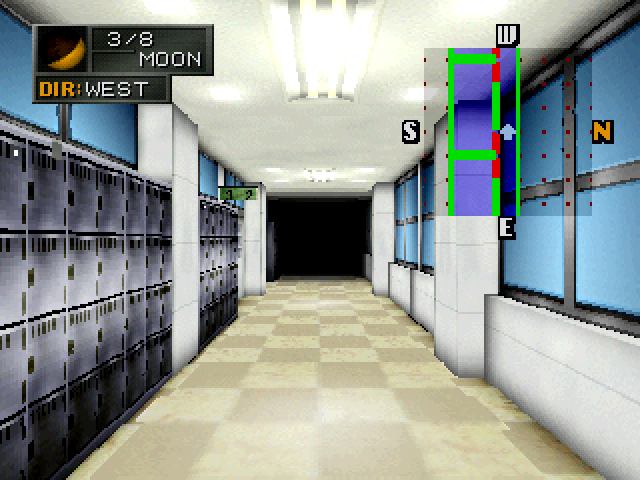
Exploration shifts among an overhead town map, adventure-style location screens, and first-person dungeon corridors. That changing perspective gives Revelations: Persona an old-school PlayStation identity: towns are navigated broadly, story spaces are approached directly, and dungeons demand careful mapping. Shops, healing facilities, save points, hidden mechanisms, and the occasional diversion such as the Judgment 1999 casino make Lunarvale feel like a connected place rather than a string of battle arenas. The game rewards talking to people, checking suspicious walls, and preparing before a long descent.
This is specifically the original North American PlayStation version, not a substitute for the Japanese Megami Ibunroku Persona release or the later PSP remake. Its English localization renamed and recast elements of the Japanese game, including people and the town, and its available story content is limited to the main SEBEC path. The Japanese original also includes the alternate Snow Queen scenario, which was not part of this 1996 North American PS1 release. Later editions revised the English presentation and restored that route, so the distinction matters for anyone seeking a particular version.
For players interested in where Persona began, Revelations: Persona offers a fascinating blend of school-life drama, demon negotiation, fusion-driven character building, and psychological fantasy. Its interface and dungeon style belong firmly to its era, but the foundations are already here: a group of young people confronting supernatural forces through the power of their own selves, a Velvet Room full of possibilities, and choices in battle that go beyond attacking. It is both a historical starting point for the series and a demanding RPG with an atmosphere all its own.
Gallery
Details
- Developer
- Atlus
- Publisher
- Atlus
- Genre
- JRPG
- Players
- 1
- Release Date
- November 1, 1996
- System
- PS1