About
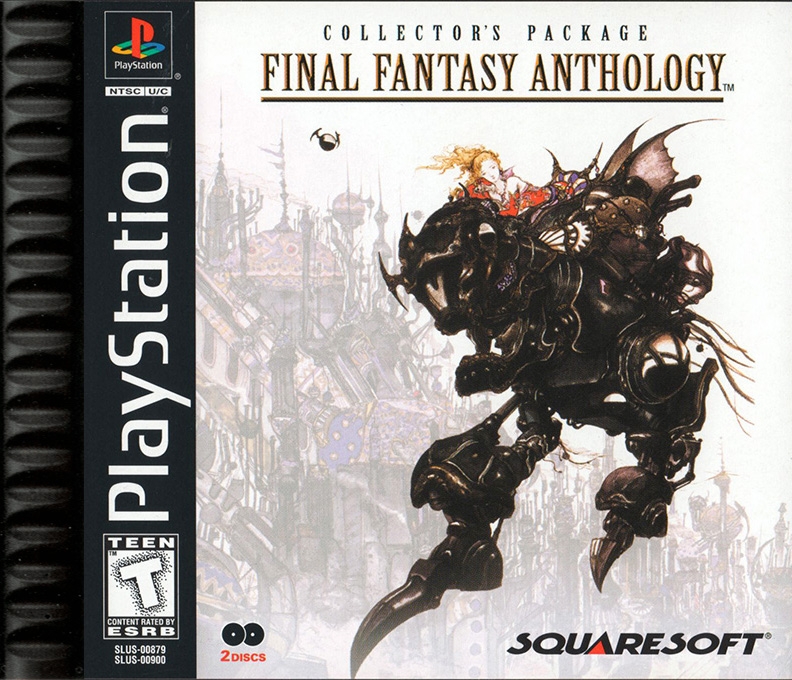
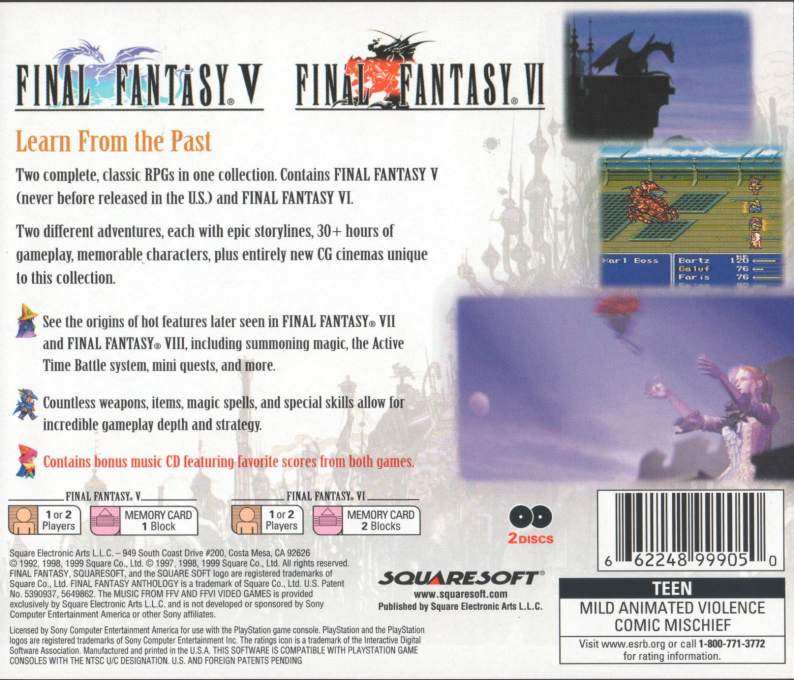
Final Fantasy Anthology: Final Fantasy V is the PlayStation disc containing Final Fantasy V from Square’s 1999 North American anthology. It is not a new numbered sequel, a remake, or a compilation menu standing in for several games: this entry is the complete Final Fantasy V adventure, issued alongside a separate Final Fantasy VI disc in the North American package. For players in the region, the anthology marked the game’s first official English release, bringing a Super Famicom-era role-playing adventure to PlayStation while preserving its party-building focus and broad world-spanning quest.
The journey begins when the elemental Crystals that sustain wind, water, fire, and earth begin to fail. A meteor crash draws the wandering hero Butz into the crisis, where he meets Princess Reina, the amnesiac Galuf, and the pirate captain Faris. Their search for answers carries them through kingdoms, ruins, caves, towers, and far more unexpected destinations as a threat connected to the Crystals grows larger. Final Fantasy V balances a colorful, adventurous tone with moments of loss and danger, and its cast develops through the changing bonds of a long expedition rather than through a single fixed hero’s story.
Combat uses the series’ Active Time Battle system. Party members act when their gauges fill, so choosing commands, magic, items, or defensive moves requires attention to both turn order and the enemy’s pressure. Random encounters, boss fights, equipment, status effects, summons, and healing all draw on familiar Final Fantasy foundations, but the game’s defining strength is how freely those tools can be combined. A difficult encounter is often an invitation to rethink a party instead of merely raise its level.
That flexibility comes from the Job system. Characters can change among a wide range of jobs, from physical roles such as Knight, Monk, Thief, and Ninja to spellcasting paths such as White Mage, Black Mage, Time Mage, Summoner, and Blue Mage. Each job supplies its own command set, equipment options, and statistics, while battles earn Ability Points that unlock skills. Once learned, many abilities can be carried into another job, allowing a player to shape fighters, casters, and hybrids around a preferred strategy.
The result is a remarkably hands-on form of character customization. A physical job can borrow a magic command, a mage can gain a useful passive ability, and a character’s equipped job need not define every action available in battle. Experimenting with these pairings matters throughout the campaign, especially when bosses reward a particular element, status defense, movement trick, or support spell. The system is approachable enough to use in simple ways, yet it gives returning players plenty of room to try radically different party setups.
Outside battle, Final Fantasy V unfolds across an overworld with towns to visit, dungeons to map, secrets to uncover, and multiple forms of travel that gradually open new routes. Its progression turns exploration into part of the adventure: vehicles and companions make distant places reachable, while the search for the Crystals gives the journey a clear purpose. The PlayStation release presents the classic 2D game as a full-length RPG, with the emphasis on its original quest, turn-based battles, job development, and discovery rather than on the conventions of later versions.
This disc uses the 1999 PlayStation English localization. Its character names and phrasing belong to that release, including Butz as the protagonist and Reina as the princess, which distinguishes it from later English editions that use Bartz and Lenna. That difference is more than a database label: dialogue, terminology, and the names encountered during play identify this as the anthology-era version. Players looking for the specific first official North American presentation of Final Fantasy V should expect that historical script rather than a later retranslation.
It is also important not to confuse this PlayStation entry with the original 1992 Super Famicom release, Final Fantasy V Advance for Game Boy Advance, or the modern Final Fantasy V Pixel Remaster. The Super Famicom version was Japanese-only at launch; the Game Boy Advance edition added new jobs and postgame material alongside a revised English script; and Pixel Remaster is a later presentation with redesigned pixel art, updated interface features, and its own convenience options. Final Fantasy Anthology: Final Fantasy V remains the PlayStation port and the North American anthology component: a landmark English release of the original job-driven adventure, paired physically with Final Fantasy VI and a bonus soundtrack CD in its original package.
Gallery
Details
- Developer
- TOSE
- Publisher
- Sony Computer Entertainment
- Genre
- JRPG
- Players
- 1
- Release Date
- September 30, 1999
- System
- PS1