About
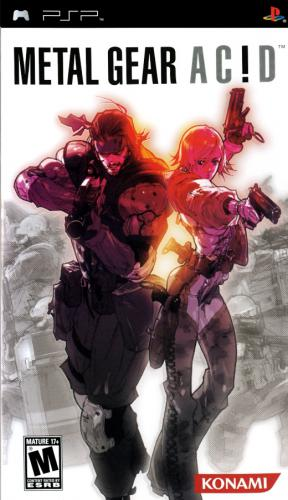
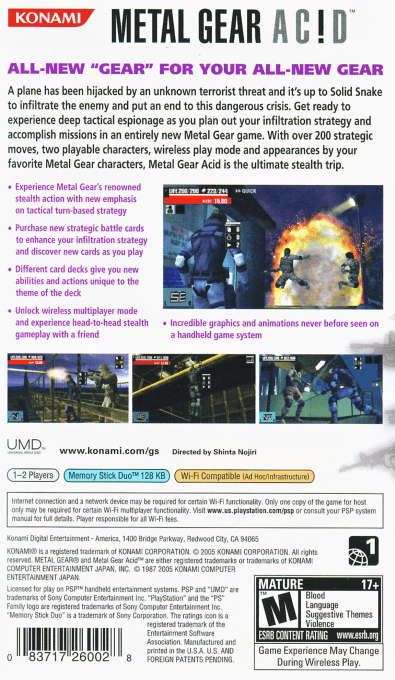
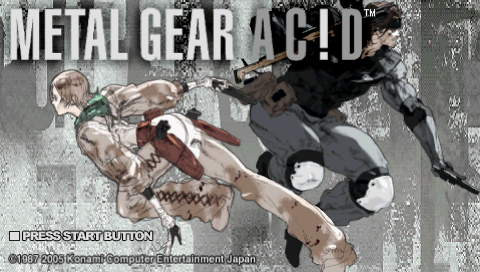
Metal Gear Ac!d for PSP is Konami’s 2004–2005 handheld spin on its stealth-action series, developed by Konami Computer Entertainment Japan and published by Konami. Rather than adapting the real-time approach of the Metal Gear Solid games, it turns infiltration into a tactical, turn-based card game. First released in Japan in December 2004, it arrived around the North American PSP launch in March 2005 and reached Europe later that year. The stylized exclamation mark is part of the title, while “AC!D” refers to Active Command Intelligence Duel, a fitting name for its blend of planning, positioning, and card-driven espionage.
The story places Solid Snake in 2016 after terrorists hijack a passenger jet carrying U.S. senator Viggo Hach. Their demand concerns Pythagoras, a secret research project connected to the Moloni Republic in southern Africa. With conventional forces already repelled, Snake is sent to the Lobito Physics and Chemistry Laboratory to uncover what Pythagoras is, recover the hostage, and survive an operation full of shifting identities and competing agendas. It is a self-contained Metal Gear scenario with familiar series ingredients—covert missions, radio contacts, guards, advanced weapons, and the looming possibility of a new Metal Gear—rather than a continuation of the main numbered games.
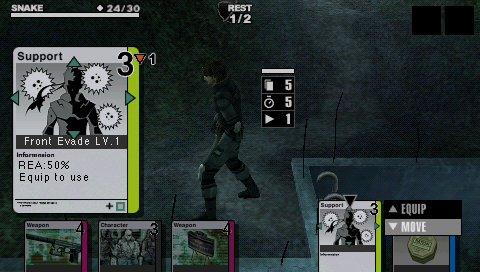
Each mission unfolds on a grid-based battlefield viewed from an angled perspective. Snake and later ally Teliko Friedman take turns with enemy soldiers, but actions are governed by the cards in hand. Weapon, item, equipment, action, and character cards draw on people and hardware from across Metal Gear history. A card may let a character move, fire a weapon, use an item, or establish an ability; movement itself can require a card, so choosing a route is as important as deciding when to attack. Missions still reward the caution associated with Metal Gear, as line of sight, patrols, cover, and the consequences of alerting guards all shape a player’s options.
The game’s key system is Cost. Playing a card adds its cost to the active character, and turn order advances according to that accumulated value. Powerful attacks and elaborate maneuvers can produce a decisive result, but they may also leave Snake waiting while opponents act. Low-cost choices keep a character moving sooner, creating a constant tradeoff between immediate force and future initiative. Cards can also be combined in practical ways: weapons need compatible ammunition, equipment can improve a loadout, and a player’s selected deck determines which tactical answers are likely to appear during an operation.
Between missions, Metal Gear Ac!d encourages deck building instead of treating its cards as random collectibles sold separately. Players assemble a deck from cards earned during the game, expand their available choices through progress, and adjust their approach for a particular map or obstacle. The limited hand size makes every draw meaningful, while the steadily broader deck capacity supports experimentation with weapons, movement tools, support effects, and character abilities. This structure gives the PSP game a deliberate pace that suits short tactical decisions as well as longer mission planning.
Metal Gear Ac!d also uses the PSP’s wireless ad-hoc capability for Link Battle, a two-player “sneak-off” in which opponents race to collect diskettes while trying to evade or steal from one another. That mode reinforces the game’s focus on information and positioning rather than simple elimination. Its illustrated card art, turn order mechanics, and tactical role-playing framework made it a conspicuous departure for the series and established the Ac!d branch on Sony’s first handheld. Konami followed it with Metal Gear Ac!d 2 for PSP in 2005, but this original game remains the entry that introduced Snake’s card-based covert operations.
Gallery
Details
- Developer
- Konami
- Publisher
- Konami
- Genre
- Card & Casino
- Players
- 1-2
- Release Date
- March 22, 2005
- System
- PSP