About
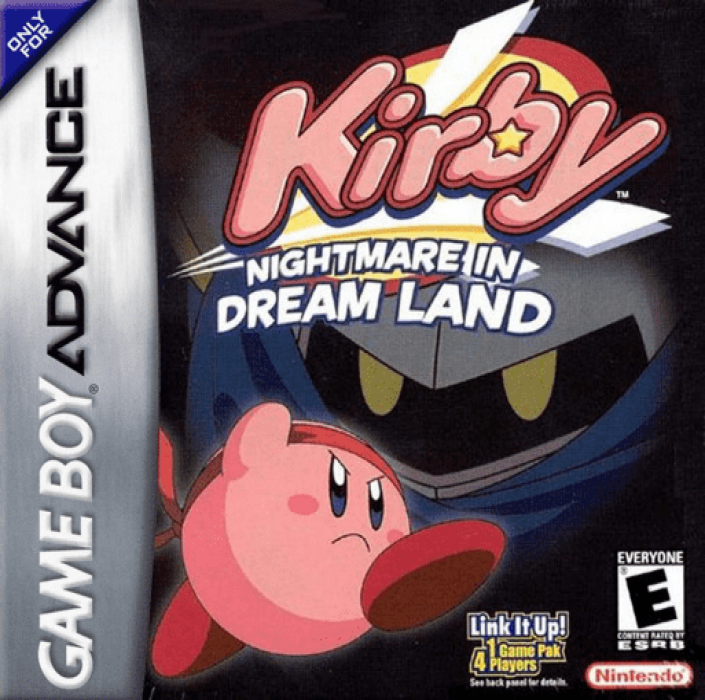
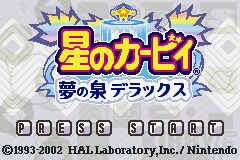
Kirby: Nightmare in Dream Land for Game Boy Advance is HAL Laboratory and Nintendo’s colorful 2002 remake of the 1993 NES platformer Kirby’s Adventure. Released in Japan in October 2002 and in North America that December, it brings Kirby’s quest through Dream Land to Nintendo’s handheld with newly drawn graphics, redone sound, and added modes while preserving the original adventure’s side-scrolling structure. The Japanese release is titled Hoshi no Kirby: Yume no Izumi Deluxe, or Kirby of the Stars: The Fountain of Dreams Deluxe. It is a single-player action-platform game at its core, built around Kirby’s unusual ability to inhale enemies and take on their powers.
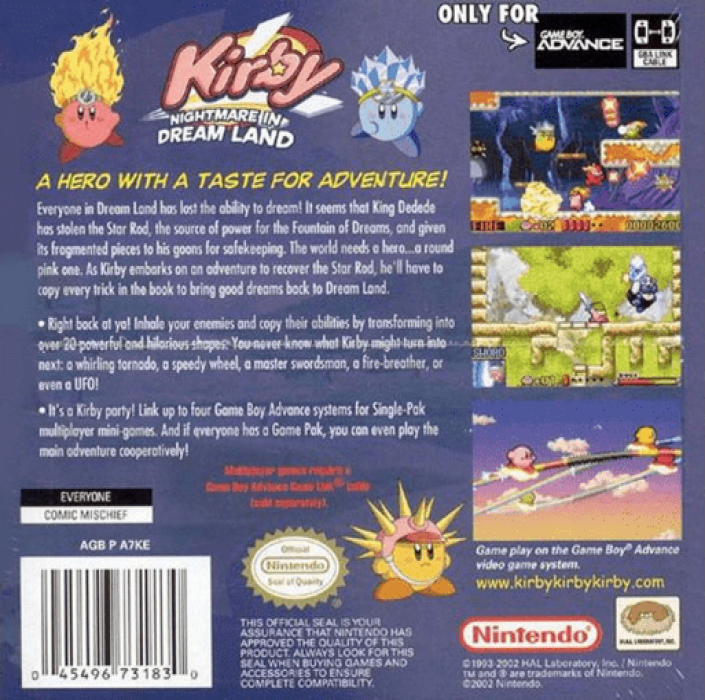
Dream Land’s Fountain of Dreams has stopped working after King Dedede takes the Star Rod that sustains it and divides the rod into pieces. With the kingdom unable to sleep peacefully, Kirby sets out to recover the fragments. The journey initially casts Dedede as the problem, but the story develops beyond that first assumption as Kirby pushes toward the source of Dream Land’s nightmares. The game sends him across themed worlds filled with doors to individual stages, boss encounters, secret routes, and occasional detours. Reaching a stage’s exit advances the adventure, while careful exploration can uncover hidden areas and collectible rewards.
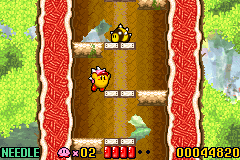
Kirby’s basic moves make the GBA game approachable but flexible. He walks, runs, jumps, crouches, climbs ladders, slides, and inflates himself to fly over gaps or dangerous terrain. He can inhale enemies and objects, then either spit them out as damaging stars or swallow certain foes to gain a Copy Ability. These borrowed skills reshape how players approach enemies and obstacles: abilities can provide attacks such as fire, beams, boomerangs, or spikes, and some help reveal routes that are otherwise hard to reach. Kirby can abandon a current ability, but taking damage may also knock it loose, creating a brief chance to inhale it again before it disappears. Food restores health, and losing all of Kirby’s health or falling from the playfield costs a life.
Nightmare in Dream Land follows the level layouts and broad progression of Kirby’s Adventure, but it is not simply the NES game on a smaller screen. The remake redraws its characters and environments and revises its presentation for Game Boy Advance hardware. It also includes a selection of sub-games, including Bomb Rally and Kirby’s Air Grind, that use simple controls and can be played with multiple people on compatible Game Boy Advance systems. The main campaign remains a one-player journey, while the additional multiplayer options give the cartridge a separate party-game dimension. An unlockable Meta Knightmare mode lets players take control of Meta Knight, offering a distinct way to revisit the game after opening it.
As a remake, Kirby: Nightmare in Dream Land occupies an important place in the series’ handheld history. It revisits the game that established Copy Abilities as a defining Kirby mechanic, carrying that idea into a later portable format rather than replacing the original adventure with a new story. The result combines a clear goal, short self-contained stages, boss battles, and opportunities to experiment with different powers. Its later Wii U Virtual Console release preserved the Game Boy Advance adventure for digital play, though Nintendo noted that the original cartridge’s link-based communication features were not available in that version. For Game Boy Advance players, Nightmare in Dream Land remains the enhanced handheld interpretation of Kirby’s early Dream Land quest.
Gallery
Details
- Developer
- HAL Laboratory
- Publisher
- Nintendo
- Genre
- Action RPG
- Players
- 1-4
- Release Date
- December 2, 2002
- System
- GBA