About
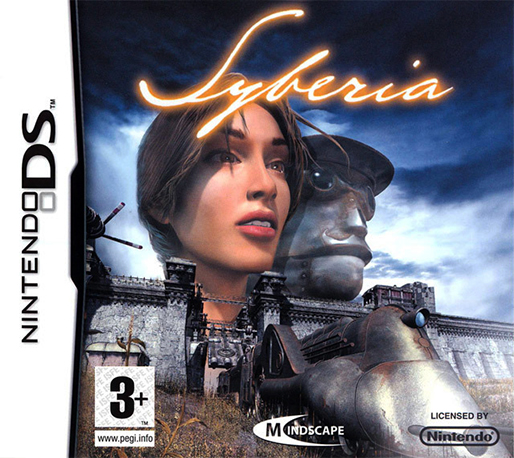
Syberia for Nintendo DS is a single-player graphic adventure that brings Benoît Sokal’s 2002 story of lawyer Kate Walker to Nintendo’s dual-screen handheld. This version was adapted by Tetraedge Games and released in 2008; in North America it arrived on November 25 through DreamCatcher Games. Kate begins in the fictional French village of Valadilène, where she has been sent by her New York law firm to complete the purchase of the Voralberg family’s aging automaton factory for the Universal Toy Company. Anna Voralberg’s death and a newly discovered letter overturn that routine assignment: her brother Hans, presumed dead for decades, is alive and must approve the sale.
The search for Hans turns Syberia into a journey across a stylized Europe and Russia, built around clockwork machines, remote towns, and clues from the Voralberg family’s past. Kate learns that Hans was a gifted designer of automatons whose childhood fascination with mammoths never left him. His wish to reach the legendary island of Syberia gives the game its larger destination, while the immediate task is much more practical: find the missing heir and obtain his signature. Along the way, Kate is accompanied by Oscar, a formal, mechanical train operator whose needs and rules are often central to the puzzles.
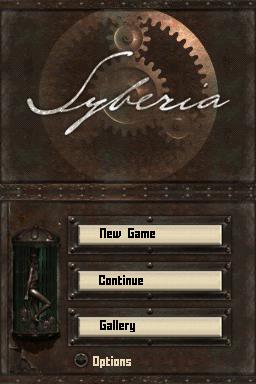
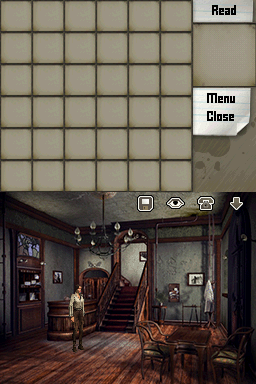
On Nintendo DS, the adventure is controlled with the stylus. Players tap the scenery to move Kate, inspect objects and people, collect useful items, and choose how to use them. The touch interface also includes an on-screen eye for locating interactive points; its changing symbol helps distinguish directions, characters, and mechanisms. Conversations, documents, inventory puzzles, and mechanical devices provide the means to advance, so progress comes from observing each location, following leads, and working out how the game’s unusual machinery fits together. Save access and Kate’s telephone are also available from the interface.
Kate’s route takes her from Valadilène to the university town of Barrockstadt, the industrial complex of Komkolzgrad, and the spa at Aralbad. Each stop introduces its own inhabitants, problems, and pieces of Hans’s history. A stranded train, an automaton’s missing hands, an aging opera singer, and inventions such as a clockwork flying machine all become part of the investigation. These episodes retain the game’s emphasis on character encounters and self-contained puzzle sequences rather than action or combat, with the player steadily opening the way for the train to continue east.
The Nintendo DS edition is a portable adaptation of the first Syberia, not a sequel or remake. Its reduced screens and stylus-led presentation reshape a game originally designed around computer point-and-click play, while keeping the central storyline and its fixed-camera exploration structure. It is one of several later versions of the 2002 game, following releases for computers and home consoles. The DS release is therefore a handheld route into the opening chapter of Kate Walker’s story, with the interface tailored to the system’s touchscreen rather than a mouse or controller.
Syberia also sits in the fictional world previously used by Sokal’s Amerzone, though Kate’s adventure has its own cast and objective. The original game led directly to Syberia II, which continues the train journey and Kate’s pursuit of Hans’s dream. For the Nintendo DS player, this first installment ends after Kate’s business mission has changed into a personal decision to remain on the journey. That ending makes the game both a complete mystery-driven trek through a world of elaborate automatons and the first half of a larger two-part story.
Gallery

Details
- Developer
- Mindscape
- Publisher
- Tetraedge Games
- Genre
- Other Adventure
- Players
- 1
- Release Date
- November 25, 2008
- System
- NDS