About
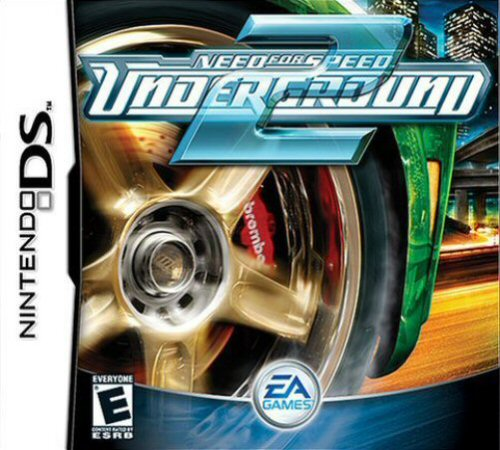
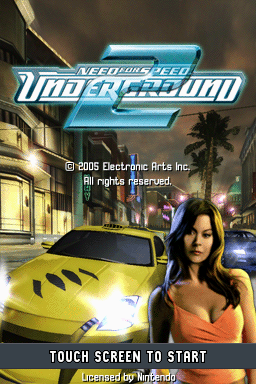
Need for Speed: Underground 2 on Nintendo DS is a purpose-built handheld street racer, not a scaled-down trip through the console game's free-roaming Bayview. Developed by Pocketeers and published by Electronic Arts, this DS edition arrived in North America on May 10, 2005. It brings the import-tuner theme of Underground 2 to Nintendo's dual-screen system with a focused, event-based structure: choose a car, race through a ladder of challenges, and turn accumulated winnings into a faster or flashier garage. It was the series' first appearance on the Nintendo DS, and its design is shaped as much by the hardware's second screen and stylus as by the late-night racing premise.
The main progression mode, Go Underground, organizes the campaign as linked racing events rather than an explorable city. Winning an event opens the next one in its category and pays points that can be spent on parts or additional cars; stronger vehicles become available as progress is made, so the player starts with one of two modest licensed machines and builds upward. Race Now provides quicker standalone competition, with options to set up a race rather than follow the campaign. This makes the DS game a compact sequence of tracks and unlocks, with the tuning loop and escalating vehicle choices carrying the sense of advancement instead of the console versions' drives between Bayview events.
Its race selection includes conventional circuit contests and straight-line drag races, plus time trials, free runs, lap knockout events, and the DS-specific Own the Zone format. In Own the Zone, a circuit is divided into sections and racers compete to post the best time through each segment; control of the most zones at the finish decides the winner. Drag events emphasize shifts and traffic avoidance over cornering, while circuit variants mix racing rivals, clocks, and elimination rules. The result is a smaller-scale interpretation of Underground competition that values replayable individual events and car improvement over an open-world itinerary.
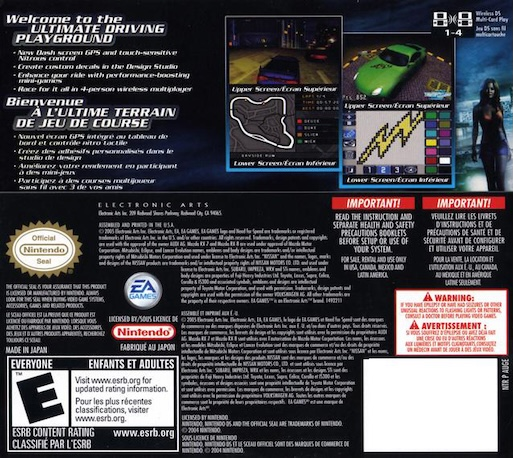
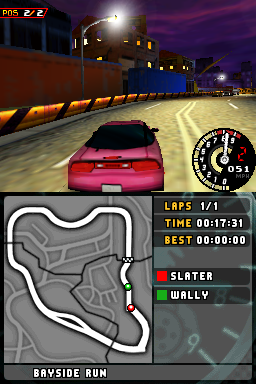
The two DS displays have distinct jobs during a race. Action is shown on the top screen, while the lower Dash screen supplies a circuit map, colored position markers, lap information, and times. Nitrous can be triggered through touch controls on that lower screen, although steering remains on the D-pad rather than being assigned to the stylus. That conventional steering is approachable but notably digital: careful taps are useful on tight courses, because sustained direction can lead to overcorrection. Menus can be operated with either buttons or the touch screen, letting the stylus support navigation and nitrous without replacing the basic driving controls.
Car ownership is central to the campaign. The DS game has 15 licensed cars and lets players unlock and buy replacements, then alter both appearance and performance. Paint, decals, vinyls, body accessories, spoilers, hood scoops, rims, and tinted windows personalize a car visually, while upgrades cover areas such as engine, exhaust, drivetrain, and chassis. A dedicated Design Studio uses the stylus as a small paint program for making custom decals, one of the edition's clearest DS-only touches. Visual changes chiefly distinguish a vehicle from the field; mechanical purchases are the route to improved speed, acceleration, and handling.
Several touch-screen mini-games are folded into the upgrade system rather than the races themselves. An engine-tuning challenge asks the player to move a lower-screen lever and keep the engine-rev indicator within a shifting safe band; allowing it to rise into the red or fall into the blue damages the virtual engine. Completing these side activities can unlock special performance parts. This is a markedly different use of the handheld from the console game, where customization and tuning are presented through broader garage systems; on DS, the stylus becomes an occasional hands-on reward mechanism alongside its more practical map, menu, and nitrous duties.
The game also supports local wireless competition for up to four players, so its structured tracks can be used outside the single-player unlock path. Its smooth motion and strong sensation of speed were achieved with visual compromises, including less detailed environments and noticeable scenery pop-in, while the car models remain a relative strength. It should not be confused with either the 2004 Game Boy Advance release or the PC, PlayStation 2, Xbox, and GameCube versions. Those are separate adaptations: the home-console game is the Bayview open-world racer, and the GBA game has its own handheld content. The DS version stands on its own as Pocketeers' dual-screen, track-driven take on Underground 2.
Gallery
Details
- Developer
- Pocketeers
- Publisher
- Electronic Arts
- Genre
- Racing & Driving
- Players
- 1-4
- Release Date
- May 10, 2005
- System
- NDS