About
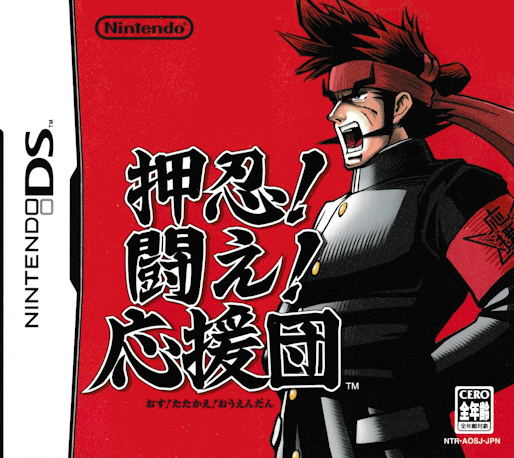
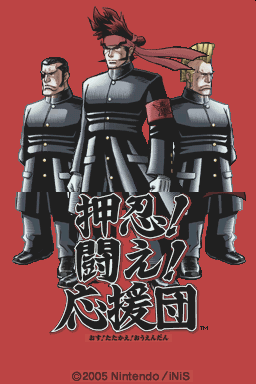
Osu! Tatakae! Ouendan for Nintendo DS is a Japanese rhythm game developed by iNiS and published by Nintendo in Japan on July 28, 2005. Its title is commonly shortened to Ouendan, a reference to a Japanese cheering squad, and that idea shapes both its exuberant presentation and its use of the DS hardware. Rather than playing a band or controlling a conventional hero, the player directs a squad of black-uniformed cheerleaders who arrive whenever somebody is on the brink of giving up. It was released only in Japan, making this the original Japanese game rather than the separately localized Elite Beat Agents.
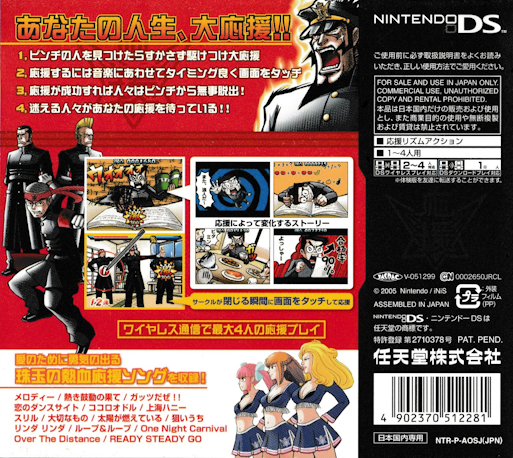
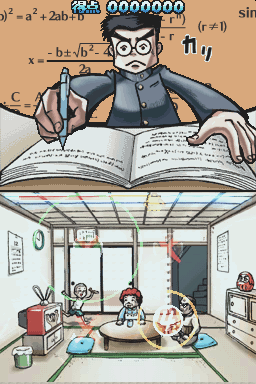
Each mission pairs a self-contained comic-style story with a Japanese pop song. A student facing entrance-exam pressure, an artist searching for inspiration, and other people in increasingly outlandish predicaments call for help; the Ouendan answer with whistles, poses, and relentless encouragement. The Nintendo DS’s upper screen advances the story while the touch screen turns that encouragement into rhythm action. Success lets the character overcome the current setback, while mistakes send the scene toward a less hopeful outcome. The linked stories have a playful manga sensibility, and recurring faces eventually give the campaign a larger finale.
The central challenge is reading the music through on-screen markers and responding with the stylus at the proper time. Players tap numbered hit markers as approach rings close in, rub rapidly across sequences, guide a marker along a displayed track, and spin a wheel-like device when prompted. Timing accuracy earns points and builds a combo, while missed or premature inputs drain the on-screen fighting-spirit meter. If that meter runs out, the mission ends and must be tried again. This makes every song a test of steady timing as well as rapid hand movement, particularly when a long chain of markers demands concentration.
Ouendan contains 15 music-driven missions arranged across acts. The initial difficulty settings use different squad leaders, and completing them opens tougher challenges. Higher levels increase the density and speed of the touch-screen patterns, requiring closer timing and more demanding stylus movement; the most extreme setting also reorients the play field for an additional spatial challenge. Stages can be replayed to improve a score and rank, so completing the campaign is only one part of pursuing cleaner runs and stronger timing results.
The game’s song selection is rooted in Japanese popular music, with stages built around songs associated with artists including The Blue Hearts, B'z, Orange Range, L'Arc-en-Ciel, and Morning Musume. The recorded versions used in the game are largely cover performances, but their pacing and character give each scenario its own momentum. That Japan-specific music and the equally local flavor of the cheer-squad concept help explain why Nintendo did not simply issue the same release overseas. Instead, iNiS and Nintendo reworked the formula for the 2006 Nintendo DS game Elite Beat Agents, replacing its cast, scenarios, and song list for Western audiences.
Osu! Tatakae! Ouendan established the core of a small iNiS and Nintendo rhythm-game line on DS. Its success as an import introduced many players outside Japan to its stylus-led approach, while Elite Beat Agents preserved the basic play system in a different setting. A direct Japanese follow-up, Moero! Nekketsu Rhythm Damashii Osu! Tatakae! Ouendan 2, arrived in 2007 with the original team and a rival squad. For players looking for the first entry’s particular mix of touch-screen rhythm play, comic storytelling, and Japanese pop culture, the 2005 Nintendo DS release remains the starting point.
Gallery
Details
- Developer
- iNiS
- Publisher
- Nintendo
- Genre
- Rhythm Game
- Players
- 1
- Release Date
- July 28, 2005
- System
- NDS