About
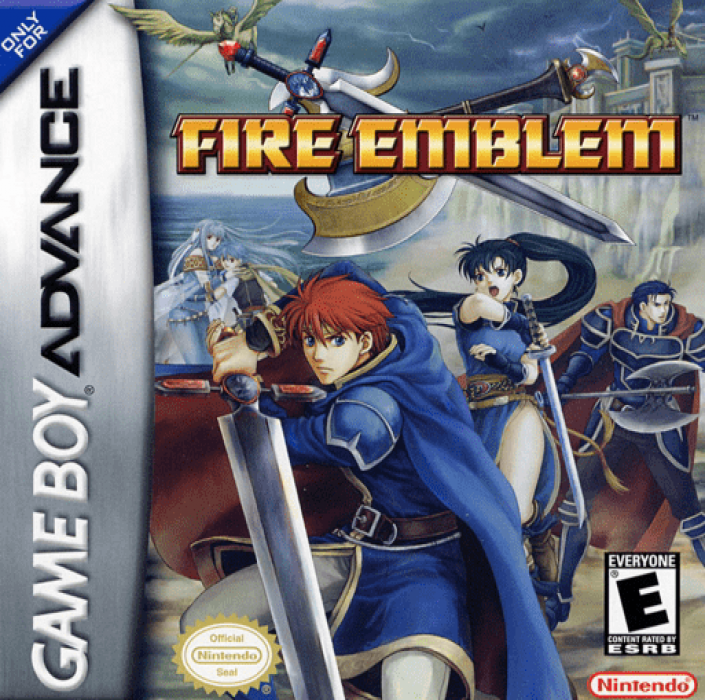
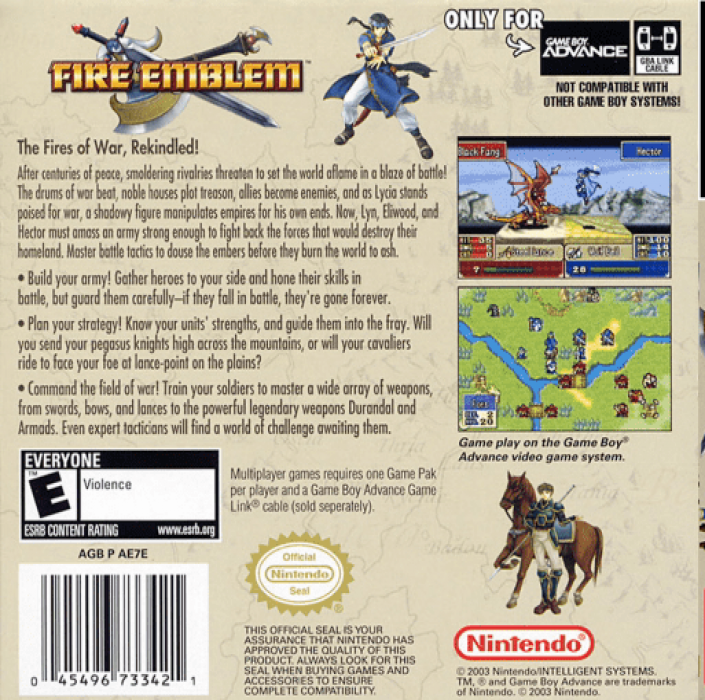
The Fire Emblem that reached Western Game Boy Advance players is Fire Emblem: The Blazing Blade, though its original release was titled simply Fire Emblem outside Japan. This is the Elibe adventure of Lyn, Eliwood, and Hector: three young nobles drawn into a crisis that begins with unrest in Lycia and grows into a conspiracy with the power to consume nations. It is not Fire Emblem: The Binding Blade, the earlier 2002 Japanese GBA entry; The Blazing Blade followed in 2003 and became the series’ first installment released beyond Japan. For many players, that plain Western title was an invitation into a tactical saga with an unusually immediate sense of consequence.
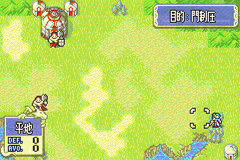
Every chapter is a compact battlefield puzzle. You position a hand-picked army on a grid, read the terrain, weigh movement ranges, and pursue objectives that can demand more than simply defeating every enemy. Forests, forts, mountains, rivers, choke points, and vulnerable allies all change the shape of a turn. The result is a strategy game where a powerful unit is not automatically the right answer: a cavalry charge may outrun its support, a flier may find a route no one else can take, and a careful rescue can matter more than one more attack.
Combat makes those choices readable but tense. Weapon types interact in a triangle of advantages, while each unit’s class, stats, equipment, and placement influence the odds of a clash. Swords, lances, axes, bows, magic, and staves give an army distinct jobs, from opening a path and guarding a healer to finding the precise strike that finishes a dangerous opponent. Weapons wear down with use, so managing supplies is part of winning a campaign. Experience steadily turns survivors into stronger specialists, and promotion opens new possibilities without removing the need to plan around each fighter’s role.
The stakes are sharpened by permanent loss. When a soldier falls in battle, that character is gone for the rest of the story, making each exposed position and risky calculation feel personal. The game does not treat its army as interchangeable pieces; recruits have individual portraits, dialogue, strengths, and relationships that make a successful escape or narrow victory memorable. Support conversations reward allies who fight near one another, adding character moments while encouraging formations that are useful on the map. A growing roster becomes a collection of hard-earned stories as much as a list of statistics.
Lyn’s opening chapters ease newcomers into the fundamentals through a story-led introduction, then the campaign expands around Eliwood and Hector. That structure explains why this Fire Emblem became such a natural Western starting point: it teaches movement, combat, terrain, items, and army management in context before asking for broader strategic judgment. The narrative moves between personal searches, noble rivalries, hidden motives, and escalating war, giving the tactical maps a clear sense of place. It also makes the three leads feel different, with Lyn’s directness, Eliwood’s resolve, and Hector’s forceful presence shaping the journey.
The original Game Boy Advance release also includes the Link Arena, letting players connect compatible systems with a Game Boy Advance Game Link Cable for battles built around their own trained forces. It is a fitting extra for a game so invested in army-building: the units raised through a campaign can become the heart of a separate contest. Whether played alone or linked with another player, the emphasis remains on understanding the limits and advantages of a small, carefully developed team rather than relying on reflexes alone.
Fire Emblem: The Blazing Blade endures because it balances approachable presentation with decisions that stay interesting long after the rules are familiar. Its colorful GBA sprites, dramatic battle animations, memorable cast, and focused maps give each chapter a distinct rhythm, while the campaign leaves room to experiment with different recruits and strategies. For tactical RPG fans, retro game collectors, and anyone curious about the Fire Emblem that introduced Lyn to the world, it remains a defining handheld strategy adventure: a journey where every deployment matters, every ally can become indispensable, and every victory carries the weight of the road taken to earn it.
Gallery
Details
- Developer
- Intelligent Systems
- Publisher
- Nintendo
- Genre
- Tactical RPG
- Players
- 1-4
- Release Date
- November 23, 2003
- System
- GBA