About
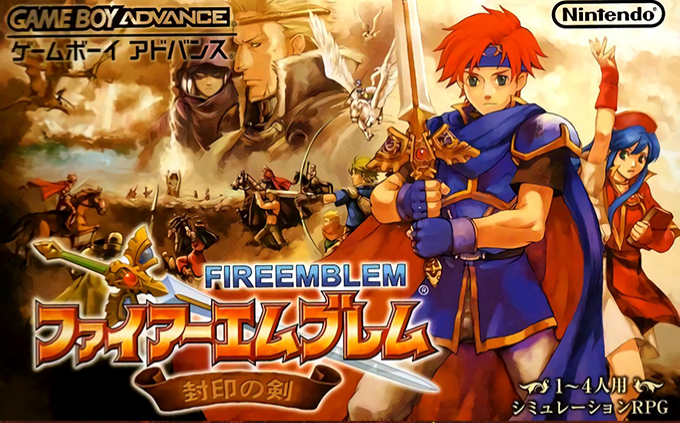
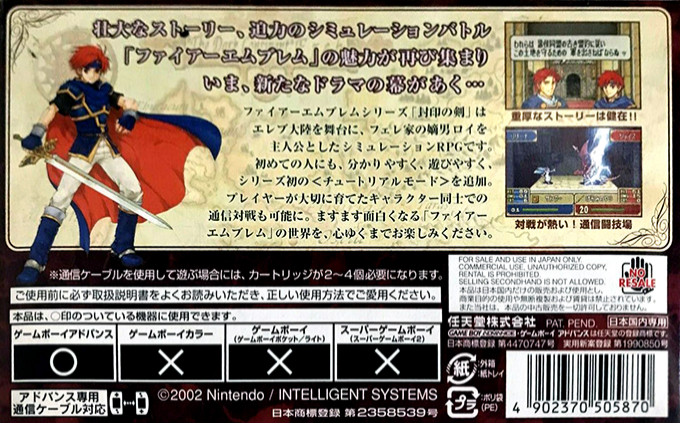
Fire Emblem: Fuuin no Tsurugi, commonly known in English as Fire Emblem: The Binding Blade, is a turn-based tactical RPG developed by Intelligent Systems and published by Nintendo for Game Boy Advance. It debuted in Japan on March 29, 2002, as the first Fire Emblem made for the handheld system. The original release remained Japan-only, making it a particularly important chapter for players tracing the series’ history before its wider international breakthrough.
The adventure takes place in Elibe, a continent still shaped by the distant Scouring, a war between humans and dragons. Roy, the young heir of the Lycian territory of Pherae, is drawn into a full-scale conflict when Bern begins its invasion. With his father Eliwood ill and unable to lead, Roy takes command of a growing allied force, protects Bern’s fugitive princess Guinivere, and confronts King Zephiel’s campaign to remake the continent.
Each chapter is a self-contained battlefield viewed from above. The player moves a limited army across square grids, considers terrain and enemy reach, and completes objectives such as defeating a commander or having Roy seize a throne or gate. Story scenes and recruitment opportunities give the maps a sense of a long military journey, while choices and specific battlefield requirements can affect routes, allies, and access to the game’s full conclusion.
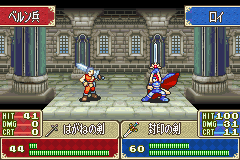
Combat is turn based but strongly positional. Every unit has a class that determines movement, weapon access, and typical strengths: armored knights absorb hits, cavaliers cover ground, pegasus knights fly over obstacles, archers attack from range, and magic users strike with tomes. Units gain experience, level up with variable stat increases, and can use promotion items to advance into more capable classes, so building a balanced army matters as much as winning an individual fight.
The familiar weapon triangle gives swords an edge over axes, axes an edge over lances, and lances an edge over swords. Weapon durability adds another layer of planning, since equipment wears out through use and valuable arms should be saved or replaced wisely. Rescue, trading, terrain bonuses, village visits, and the need to protect vulnerable allies make turns about logistics as well as direct attacks.
Defeat carries real weight because fallen allies are permanently lost for the rest of a playthrough. Roy’s loss ends the map immediately, but the death of any other named soldier can reshape a campaign’s available tactics and dialogue. The support system rewards characters who spend time beside one another with conversations and combat bonuses, creating practical reasons to consider partnerships as well as each unit’s raw numbers.
The Binding Blade is generally regarded as the sixth mainline Fire Emblem entry and begins the series’ Game Boy Advance era. Its Elibe setting later received a prequel, Fire Emblem: The Blazing Blade, which follows Roy’s father years earlier and became the first Fire Emblem released outside Japan under the simple title Fire Emblem. Roy’s appearance in Super Smash Bros. Melee also introduced many players outside Japan to a hero from this otherwise unlocalized original.
For strategy fans, Fuuin no Tsurugi is a focused campaign about reading maps, conserving resources, and keeping an irreplaceable roster alive. Its combination of chapter-based objectives, class growth, weapon matchups, branching possibilities, and a central quest for the legendary Binding Blade captures the foundations of Fire Emblem in a compact Game Boy Advance form.
Gallery
Details
- Developer
- Intelligent Systems
- Publisher
- Nintendo
- Genre
- Tactical RPG
- Players
- 1
- Release Date
- March 29, 2002
- System
- GBA