About
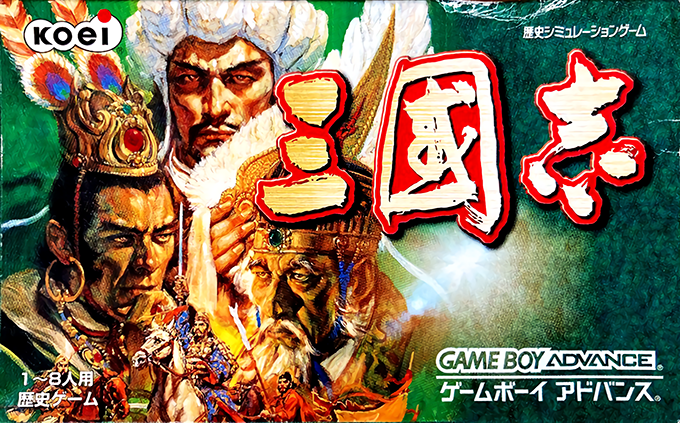
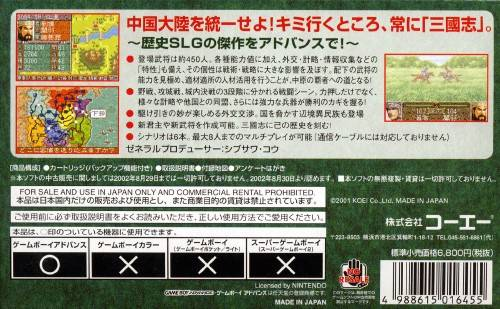
Sangokushi for Game Boy Advance is Koei's 2001 Japanese handheld adaptation of the historical strategy game known elsewhere as Romance of the Three Kingdoms IV: Wall of Fire. Released in Japan on November 30, 2001, it brings the fourth mainline entry in Koei's long-running Three Kingdoms simulation series to Nintendo's portable hardware. The game draws on the dramatic late Han and Three Kingdoms era familiar from the Chinese historical tradition and its later novelistic retelling, asking the player to take command of a ruler amid a fractured China.
Rather than following a single protagonist through a fixed campaign, Sangokushi is built around scenario-based rule. Each start places the player in control of a force with particular territory, officers, resources, and political pressures. The objective is to extend that power across the map through careful government, diplomacy, recruitment, and warfare, eventually unifying the land. Success depends on more than winning battles: a ruler must keep cities supplied, develop their strength, and make practical use of the officers available to the realm.
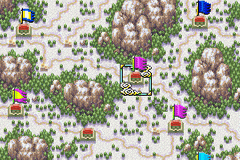
City management forms the foundation of play. Territories hold the money, provisions, population, and defensive potential that support a growing state, so domestic decisions have consequences when armies must be raised or a neighboring power becomes hostile. Officers are central to the simulation as well. Their abilities and loyalty affect what a faction can accomplish, whether the task involves administration, negotiations, military leadership, or attempts to bring new talent into service. The result is a turn-based strategy game in which planning between campaigns matters as much as the campaign itself.
The Game Boy Advance edition is based on Romance of the Three Kingdoms IV rather than a new numbered sequel. Its scenario selection spans major points in the period represented by the game, beginning with Dong Zhuo's seizure of control at Luoyang in AD 189 and continuing through conflicts associated with figures such as Lü Bu, Liu Bei, Zhuge Liang, Cao Cao, and the rival states that emerged after the Han dynasty's decline. Later scenarios reach the fall of the Han and the Wuzhang Plains period in AD 235, giving players several political situations from which to begin.
This structure makes the same historical setting play differently from scenario to scenario. A powerful ruler may begin with broad territory but face equally formidable rivals, while a smaller faction can demand patient diplomacy and selective expansion. The broader Romance of the Three Kingdoms series is known for treating personalities, cities, and statecraft as interconnected parts of a grand strategy contest, and Sangokushi carries that approach into a compact cartridge format. Its focus remains on commanding a realm rather than on action-game combat or an individual character's story.
Sangokushi also illustrates the international naming history of Koei's series. In Japan, the franchise uses the name Sangokushi, a reference to the Records of the Three Kingdoms, while English releases of this fourth installment used the title Romance of the Three Kingdoms IV: Wall of Fire. The GBA release itself was issued under the shorter Sangokushi title, but its relationship to the earlier fourth game is essential context for players exploring Koei's historical strategy catalogue. For fans of methodical empire management and Three Kingdoms-era drama, it is a portable version of a game built around the difficult choices of ruling, surviving, and expanding.
Gallery
Details
- Developer
- Koei
- Publisher
- Koei
- Genre
- Turn-Based Strategy
- Players
- 1
- Release Date
- November 30, 2001
- System
- GBA