About
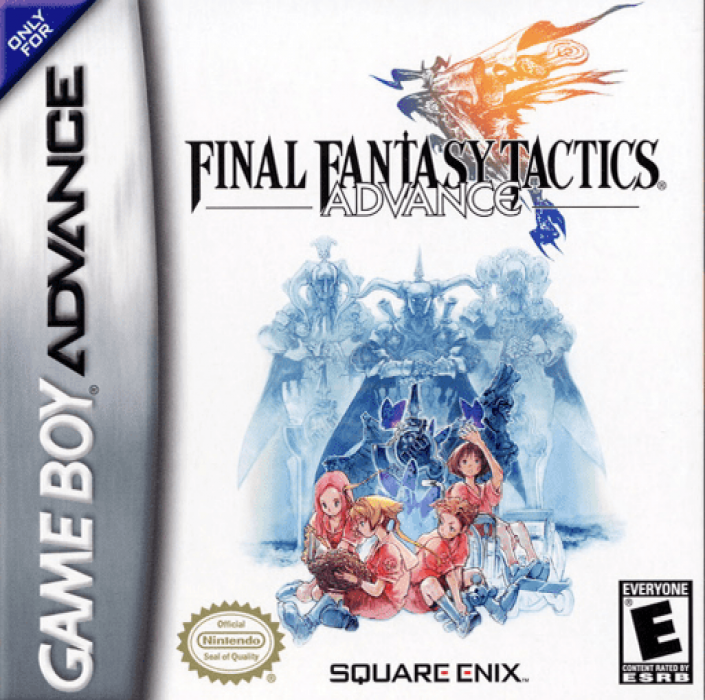
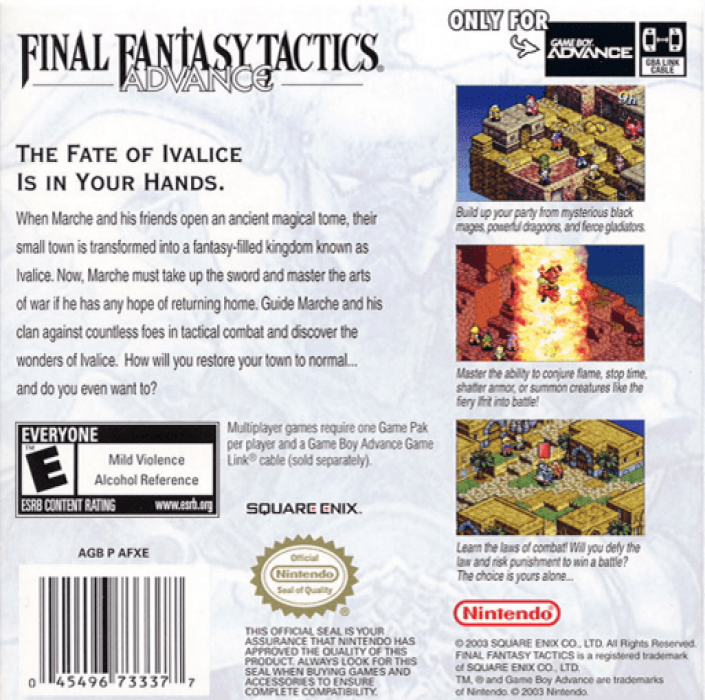
Final Fantasy Tactics Advance for Game Boy Advance is a tactical role-playing game released in Japan in February 2003 and in North America that September. Developed by Square and published by Square in Japan and Nintendo elsewhere, it carries the Final Fantasy Tactics name into a portable, mission-driven adventure. The story begins in the ordinary town of St. Ivalice, where Marche Radiuju and his school friends discover the ancient Gran Grimoire. After the book changes their town into a fantastical Ivalice, Marche joins a clan and begins looking for a way back to the real world.
Rather than sending one hero through fixed dungeon routes, the game asks the player to organize a party and choose missions from a growing selection. Story assignments move Marche’s search forward, while optional jobs provide battles, rewards, and other opportunities to develop the clan. Completing certain missions and using the items gained from them can add new locations to the world map. Shops, clan management, equipment, and mission choices make the journey between battles as important as the battles themselves.
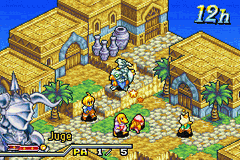
Combat takes place on compact, overhead grid maps and proceeds one unit at a time. Every character has a movement range and one opportunity to act, whether that means attacking, casting a spell, using an item, or taking another ability-based action. Terrain and position affect tactical decisions, while health and magic points limit what a unit can endure or perform. Experience earned in battle improves units, but party building is also shaped by the equipment each character carries and the abilities it can teach.
A broad job system lets the game’s human and fantasy races fill different roles. Players can outfit recruits for familiar Final Fantasy-style specialties such as fighters, mages, thieves, and archers, then learn abilities through the gear associated with those roles. Once an ability has been learned, it remains available even after a unit changes jobs, encouraging experimentation with combinations rather than a single permanent class choice. The world’s Moogle, Viera, Nu Mou, Bangaa, and human characters do not all have the same job options, giving recruitment and team composition an additional strategic dimension.
Its most distinctive rule is the Judge system. Before many fights, a Judge announces a Law that forbids a particular category of action, such as a weapon type, magic, or item use. Breaking the Law earns cards and can ultimately remove a unit from the field, so a dependable tactic in one mission may be unavailable in the next. Following the restrictions earns Judge Points, which can be spent on special support actions including summons. Some regions operate outside Judge control, but the system generally gives each encounter its own changing set of constraints.
Final Fantasy Tactics Advance also includes Game Boy Advance link-cable multiplayer for two players. Connected players can trade units and items, take on missions together, or battle one another, while the main campaign remains a single-player experience. The game is a successor to the 1997 Final Fantasy Tactics rather than a direct continuation of its plot, and its Ivalice, races, Judges, and clan-focused structure later informed Final Fantasy Tactics A2: Grimoire of the Rift on Nintendo DS. Its blend of portable mission play, turn-based positioning, and customizable jobs gives the GBA entry a distinct place within the wider Final Fantasy series.
Gallery
Details
- Developer
- Square Enix
- Publisher
- Square Enix
- Genre
- Tactical RPG
- Players
- 1
- Release Date
- September 8, 2003
- System
- GBA