About
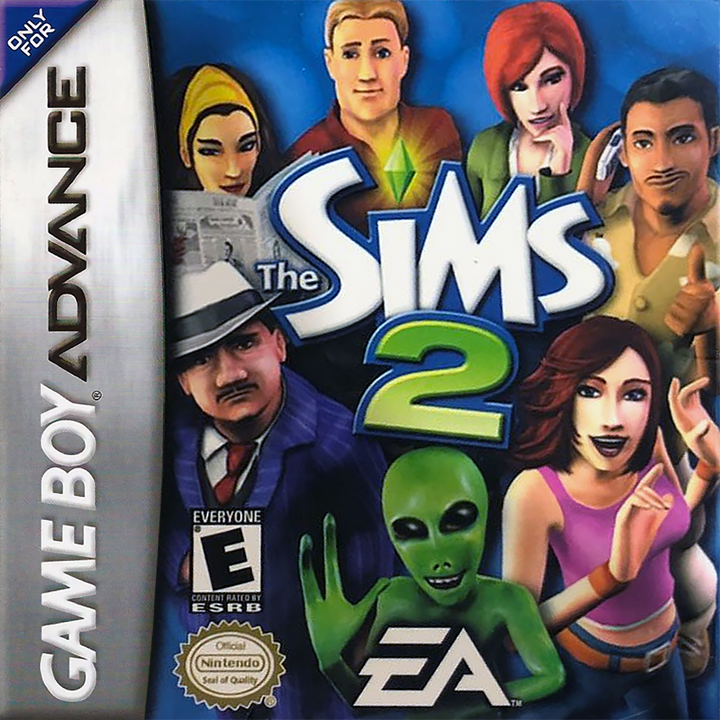
The Sims 2 for Game Boy Advance is not a portable recreation of the 2004 PC life simulator. Developed by Amaze Entertainment and published by Electronic Arts, it is a single-player, 2D isometric, story-led adventure set in Strangetown. North America received it on October 24, 2005; it followed in Europe on November 4. The game was Amaze's third and final Sims project after The Sims Bustin' Out and The Urbz: Sims in the City, and its separate design is important: the GBA edition does not use the PC game's generational, open-ended household simulation.
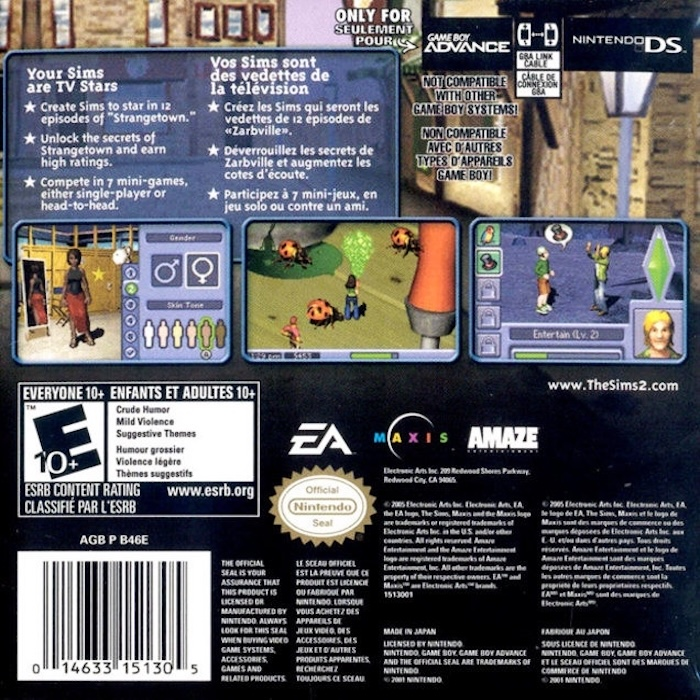
The player makes a Sim, selecting such details as name, gender, appearance, hairstyle, clothing, and an aspiration. That character arrives as a new resident and performer in Strangetown, where the townspeople do not know their lives are being recorded for a reality-TV programme. Daddy Bigbucks, the wealthy figure behind the production, employs the player as its star and communicates instructions through an earpiece. The central aim is to keep the programme's ratings healthy while gradually uncovering the town's odd circumstances.
Progress is arranged as a sequence of television-style episodes rather than a free-form neighborhood sandbox. Each scenario supplies objectives, characters to approach, problems to solve, and sometimes deliberately bizarre turns, while the player's performance contributes to ratings and opens further material. The published Nintendo description lists 24 episodes, framing them as a tour of Strangetown's eccentric locations and situations. This episodic format, with a defined story and a campaign-like progression, is the clearest distinction between the GBA game and the main PC release.
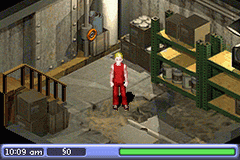
There are still recognizable Sims elements beneath that structure. The controlled character has needs including food, toilet, hygiene, and sleep to manage, and the chosen aspiration influences desires. Conversation choices shape encounters with local Sims; the player also earns money, acquires useful items, and can spend on home decoration or abilities that improve social approaches. The game therefore combines light life-management with quest-driven exploration instead of asking the player to construct and run an entire household.
Commercials within the show's fiction provide short minigames and an additional way to earn Simoleans. Nintendo also advertised Game Link Cable features: two GBA systems could trade items or compete in minigames. Those features fit the reality-show premise, turning the character's work on the production into both the framing device for its tasks and a source of rewards for further customization.
Contemporary coverage emphasized how deliberately different this version was from its relatives. GameSpot described it as a handheld-focused episodic game, rather than the familiar virtual dollhouse, and highlighted episodes built around strange Strangetown stories. Nintendo World Report likewise characterized it as a story-centered adventure that retained selected Sims mechanics, character creation, socializing, and minigames. The same review praised the presentation, animation, environments, Simlish, and score, but found the extended chains of conversations and fetch quests less compelling.
It should not be confused with the same-named Nintendo DS or PlayStation Portable games, which have their own distinct Strangetown stories and mechanics, or with the PlayStation 2, Xbox, and GameCube versions, which are closely related to one another. Nor is it the Windows and Mac The Sims 2 by Maxis, with its 3D neighborhoods, aging households, genetics, and expansion-driven simulation. The GBA title is its own Amaze Entertainment interpretation: a compact, surreal reality-show adventure that borrows Sims needs, relationships, customization, and humor for a linear handheld campaign.
Gallery
Details
- Developer
- Amaze Entertainment
- Publisher
- Electronic Arts
- Genre
- Life Simulation
- Players
- 1
- Release Date
- October 24, 2005
- System
- GBA