About
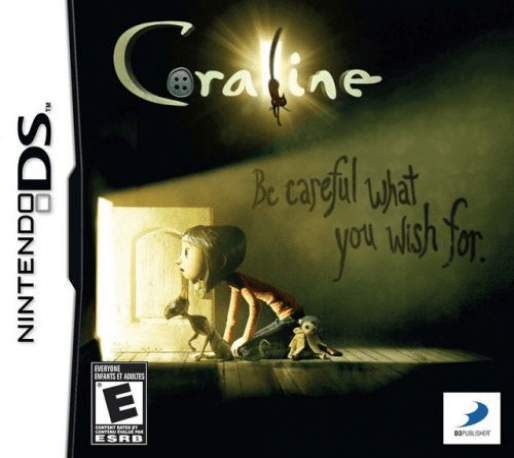
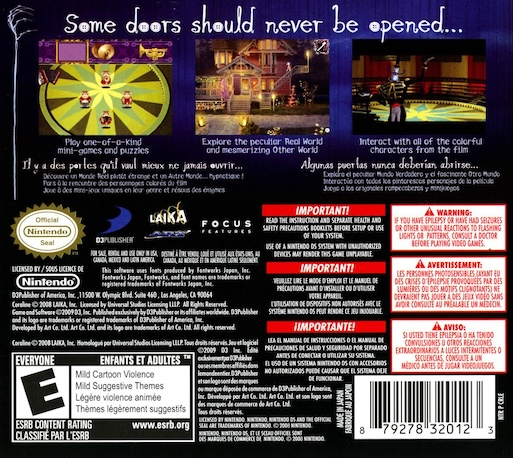
Coraline is a single-player Nintendo DS action-adventure game published by D3Publisher in North America on January 27, 2009. It is an adaptation of the 2009 stop-motion film directed by Henry Selick, itself based on Neil Gaiman’s novella. Although Coraline also arrived on PlayStation 2 and Wii, the DS edition is its own production: Art Co., Ltd. developed it for Nintendo’s dual-screen handheld rather than Papaya Studio, which handled the console versions.
The story follows Coraline Jones after her family moves into the Pink Palace, an old house divided into apartments. Restless while her parents focus on their gardening-catalog work, she explores the building and its grounds, meets Wybie Lovat and the eccentric residents, and learns that a small door in the living room can lead somewhere far stranger. The game uses the film’s setting, characters and central conflict as the framework for a compact licensed adventure.
Beyond the door lies the Other World, an apparently more inviting reflection of Coraline’s home. Its warmth and attention gradually reveal a threatening purpose, centered on the button-eyed Other Mother. Coraline must move between the ordinary Pink Palace and this sinister alternate place, working toward rescuing her family and confronting the force behind the illusion. The premise gives the handheld game an eerie fairy-tale atmosphere while keeping its plot accessible to players familiar with the film or book.
Exploration and task-based progression form the core of the DS game. Coraline speaks with characters, searches rooms and outdoor areas, gathers objects and completes chores, puzzles, and short challenges to unlock the next part of the story. Activities range from matching and timing tasks to target-focused and music-oriented mini-games. This structure makes the game less about combat than about moving through a film-inspired mystery by observing locations, following clues and helping the characters Coraline encounters.
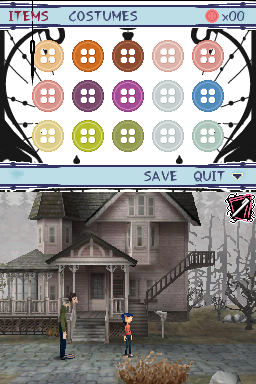
The Nintendo DS hardware shapes how these activities are presented. Players can use the directional controls or the stylus, with touch input supporting navigation, climbing and particular mini-games. Collectible buttons provide a reward for successful activities and can be used for extras such as clothing or passes that help bypass difficult challenges. Optional repeatable mini-games add another way to earn buttons after parts of the story have been completed.
Art Co., Ltd.’s DS credits list Tsuyoshi Yagi as director, Mitsunori Takemoto as lead programmer and Toshihiro Hirosawa as art director. The handheld version does not use the film cast’s voice performances, distinguishing it from the console editions, but it still aims to recreate the recognizable people and places from the movie within the DS format. Its use of stylus controls, simple interactions and many small activities gives it a different rhythm from the home-console releases.
Coraline is best suited to players who want a portable companion to the film’s world: the Pink Palace, its unusual neighbors and the deceptive Other World are the focus rather than an expansive original storyline. Its mix of exploration, fetch quests and mini-games reflects the era’s family-oriented movie tie-ins, while the darker source material gives its setting a more unsettling edge than many games aimed at younger audiences. For collectors of Nintendo DS adaptations and fans of Coraline, it preserves a distinctive handheld version of the story’s journey through a door that should have remained closed.
Gallery

Details
- Developer
- Art
- Publisher
- D3Publisher
- Genre
- Other Adventure
- Players
- 1
- Release Date
- January 27, 2009
- System
- NDS