About
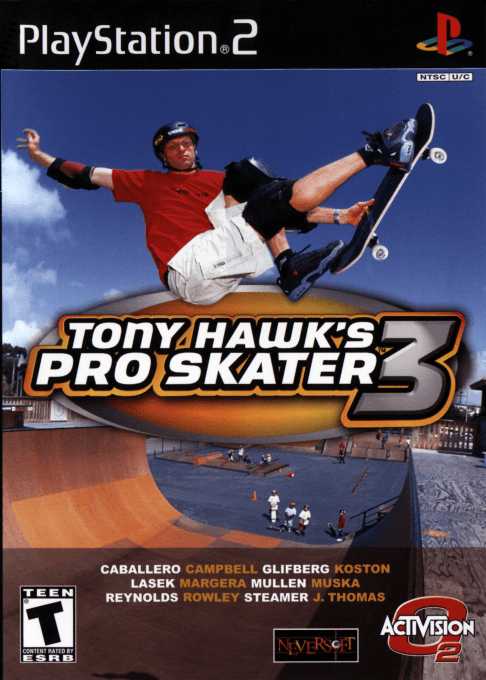
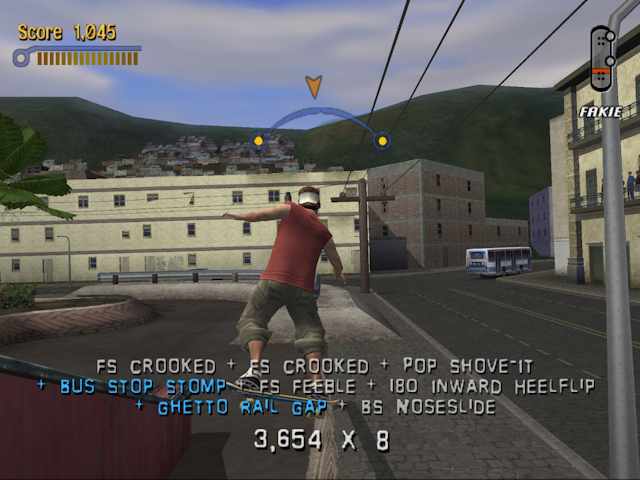
Tony Hawk's Pro Skater 3 is a fast-paced skateboarding game for PlayStation 2, developed by Neversoft and published by Activision in 2001. As the third main entry in the Tony Hawk's Pro Skater series, it keeps the arcade-focused foundation of its predecessors: pick a skater, enter a compact and densely built environment, and link flips, grabs, grinds, manuals, and aerials into huge scores. The PS2 version arrived during the series' rise from a successful sports-game franchise into a defining name in early-2000s action games.
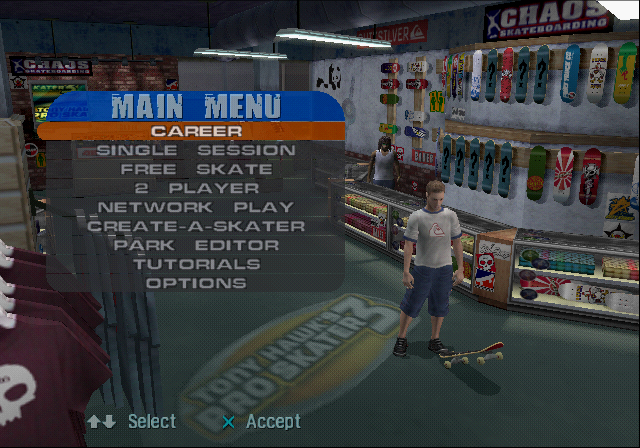
Career mode is structured around two-minute sessions in a broad set of skate locations. Each stage supplies a list of goals that mixes score targets with collectible letters, hidden tapes, and environmental objectives. Completing enough goals opens the next area and earns money for improving a skater's attributes. The approach encourages players to learn a level's rails, ramps, shortcuts, gaps, and objects rather than simply race through a linear course, so a familiar park can become a different challenge when pursuing a high score instead of a specific goal.
The central mechanical addition is the revert. On a vertical ramp, a player can perform this transition move on landing and then continue into a manual, keeping the combo alive after returning to the ground. Earlier games generally ended a combo when the skater landed back in a halfpipe or quarterpipe; the new link makes far longer sequences possible and changes how vert sections fit into a run. The game also includes hidden variations on standard tricks, expanding the reward for precise inputs and experimentation while retaining the immediately readable controls of the series.
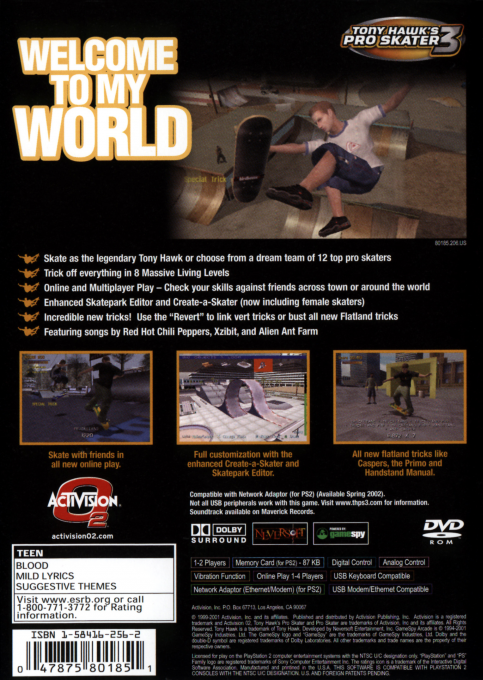
A roster of professional skateboarders gives the game its sports identity, with Tony Hawk joined by prominent riders from the era. Their signature tricks, video footage, and stat progression help distinguish them, while created skaters and unlockable characters add more ways to play. The PS2 release also includes a create-a-skater feature and a park editor, allowing players to build personal setups from ramps, rails, and other skateable pieces. These modes complement the authored levels by turning the game's movement system into a toolkit for custom lines and local competition.
The PlayStation 2 version is especially notable for its early online support. Players could connect for online multiplayer using compatible network hardware, making it an important early example of console online play on the system. Offline, the game supports familiar multiplayer events that turn its scoring mechanics into direct contests. Whether chasing a friend’s line, trying to control an area, or attempting to post the best combo before time expires, the competitive modes make the same balance-and-timing skills from Career mode matter in a social setting.
Neversoft designed the levels around recognizable themes and dense opportunities for improvisation, from streets and industrial spaces to larger attractions built around ramps and transitions. A licensed soundtrack provides the energetic rock, punk, hip-hop, and metal backdrop associated with the series, while the responsive animation makes the skater's board work and bails easy to read at speed. Players can approach a level methodically to clear objectives or use its connected surfaces to create a single ambitious combo, which is why practice and route discovery remain such a large part of the experience.
Tony Hawk's Pro Skater 3 was widely acclaimed on PlayStation 2, with critics praising its controls, level design, trick system, and the way the revert deepened scoring without discarding the series' accessible formula. It was also a major commercial success on the platform. For PS2 owners, this version represents a landmark entry in the skateboarding genre: a game that preserves the pick-up-and-play appeal of arcade sports while offering enough routes, goals, customization, and score-chasing depth to reward repeated sessions.
Gallery
Details
- Developer
- Activision
- Publisher
- Neversoft
- Genre
- Skateboarding
- Players
- 1-2
- Release Date
- October 30, 2001
- System
- PS2