About
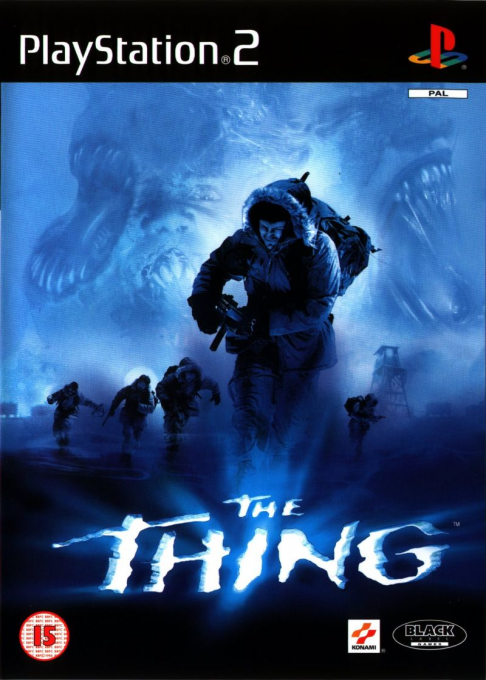
The Thing for PlayStation 2 is a 2002 third-person survival-horror action game from Computer Artworks, published in North America by Black Label Games and co-published for the console by Konami. Rather than retell John Carpenter's 1982 film, it continues the story three months after its ambiguous finale. Players take the role of U.S. Army Special Forces Captain J. F. Blake, sent with Bravo Team to Antarctica's ravaged Outpost 31 to learn what happened there. The mission quickly becomes a fight against the shape-shifting alien menace that can imitate its victims.
The PlayStation 2 game blends over-the-shoulder exploration and shooting with squad management. Blake searches snowbound research stations, laboratories, warehouses, and underground facilities for routes forward, documents, keys, equipment, and supplies. He can move, crouch, interact with objects, use tools such as flares and fire extinguishers, and switch to a stationary first-person aiming view for more deliberate shots. Pistols, shotguns, submachine guns, assault rifles, sniper rifles, grenades, launchers, and mounted guns give the campaign a wide combat toolkit, while limited health, ammunition, and environmental hazards keep progression tense.
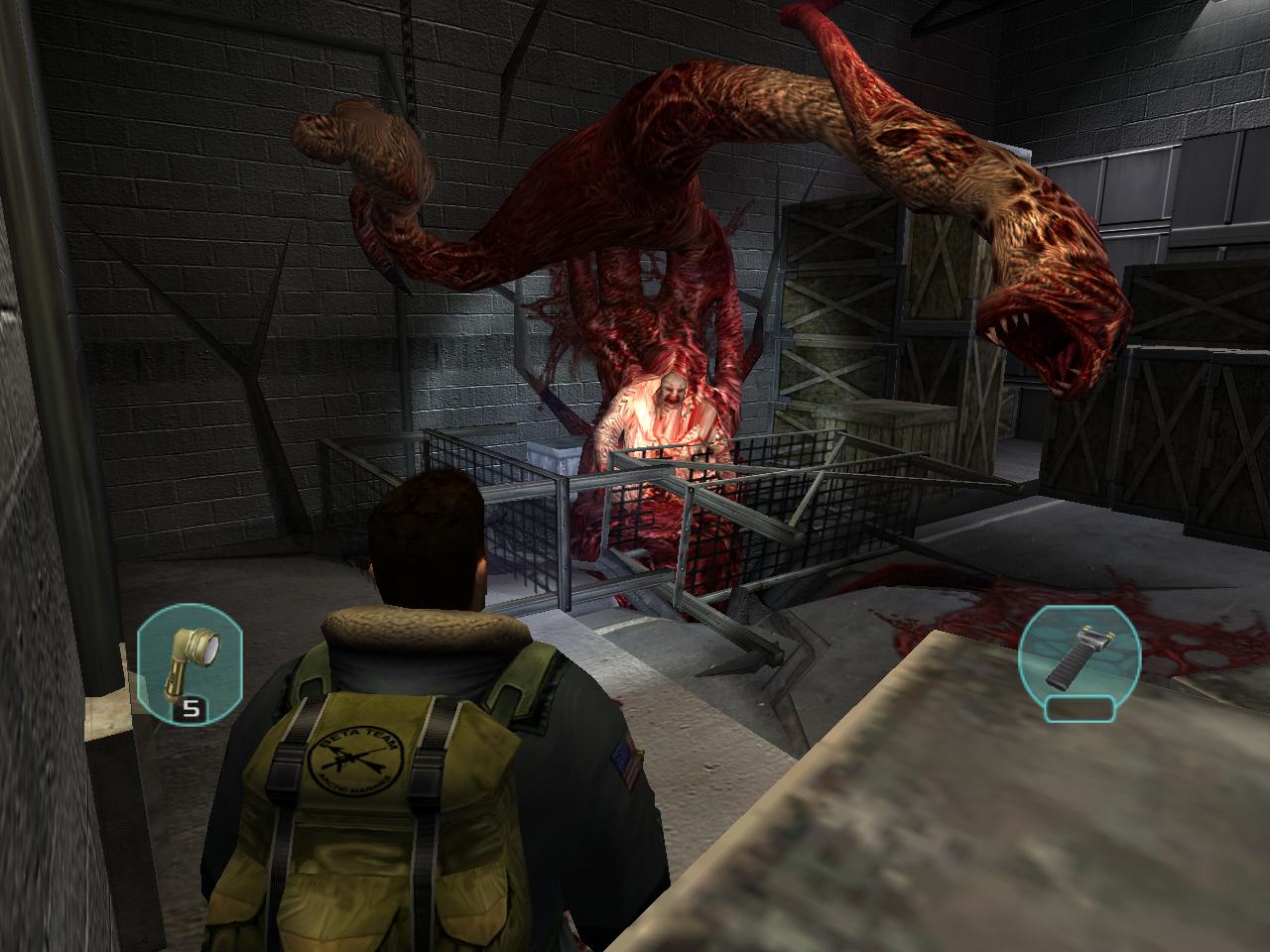
Fire is especially important in The Thing PS2. Small scuttling creatures can be dispatched with conventional gunfire, but stronger forms must first be weakened and then incinerated to stop them for good. The flamethrower therefore serves as a crucial finishing weapon as Blake encounters increasingly dangerous transformations and large bosses. The Antarctic setting is more than a backdrop: dark rooms, disturbing remains, blizzards, and isolated buildings create the pressure under which every new survivor and every unfamiliar sound can become a problem.
Blake is not always alone. Up to three non-player squad members can accompany him, and the game divides recruits into soldiers, engineers, and medics. Soldiers bring durability and firepower, engineers repair junction boxes that restore access to equipment and doors, and medics can treat injured teammates. Simple orders let Blake tell allies to follow, wait, hand over a weapon, or perform work suited to their specialty. Deciding whom to bring, equipping them, and keeping them alive are central parts of the PS2 campaign rather than incidental story scenes.
Its defining feature is the fear and trust system. Survivors watch Blake's actions and will not reliably obey someone they suspect of being infected. Supplying weapons or ammunition, healing allies, protecting them in combat, and using a blood-test kit on Blake can build confidence; reckless friendly fire or threatening behavior can destroy it. Fear rises in frightening locations and during attacks, degrading a teammate's performance and potentially sending them into a dangerous panic. Adrenaline, safer surroundings, supplies, and successful defense can steady the group, turning moment-to-moment survival into a question of leadership as well as aim.
The infection mechanic adds another layer to that uncertainty. Contact with the alien threat can put companions at risk, while story events can also reveal that a familiar face is no longer human. Blood testing offers evidence, but it does not remove the larger sense that a squad can become a danger as quickly as it becomes useful. This echoes the film's paranoia in a game structure built around escorting, commanding, and depending on people who may be terrified, distrustful, or transformed.
The story begins with the aftermath at Outpost 31 before moving Blake toward the nearby Norwegian installation and the research complex beneath it. He uncovers Gen-Inc. experiments involving the creature and a military conspiracy linked to Colonel Whitley, while searching for the missing Alpha Team. The adventure expands the film's setting with new personnel and facilities, yet it also returns to its unresolved legacy through the fate of R. J. MacReady. John Carpenter endorsed the project and appears in a voice role as Dr. Sean Faraday, helping connect this PlayStation 2 sequel to the source film without making it a direct adaptation.
Released for PlayStation 2 alongside Xbox and Windows versions in 2002, The Thing stands as a single-player survival-horror game shaped by early-2000s squad action and a licensed horror premise. Its combination of combat, specialist companions, fear management, proof of identity, and infection suspense gives the player a practical stake in the central question of its world: who can still be trusted when the enemy can look exactly like a human being?
Gallery

Details
- Developer
- Universal
- Publisher
- Konami
- Genre
- Survival Horror
- Players
- 1
- Release Date
- August 20, 2002
- System
- PS2