About
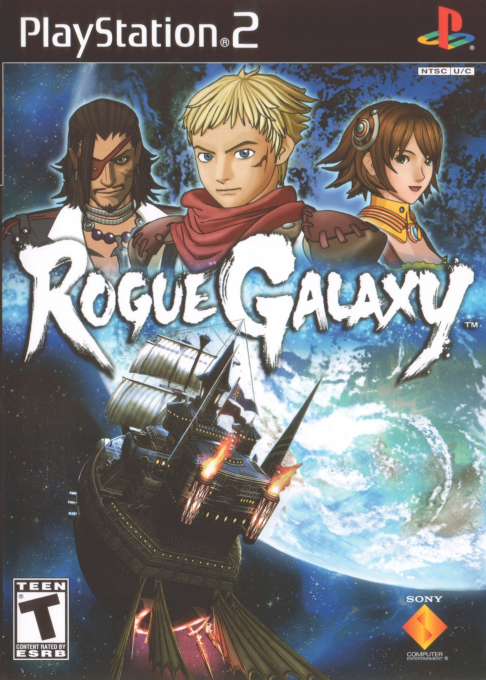
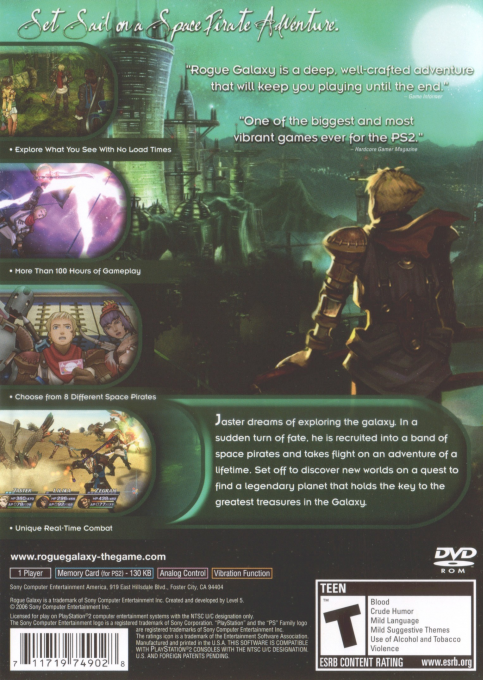
Rogue Galaxy PS2 is a science-fiction action role-playing game developed by Level-5 and published by Sony Computer Entertainment. It debuted in Japan in December 2005, while the expanded North American edition arrived in January 2007, followed by PAL territories later that year. The adventure places Jaster Rogue, a young worker from the desert world of Rosa, aboard the pirate ship Dorgenark after a case of mistaken identity gives him a route off his isolated home planet. What begins as a chance to see the stars develops into a galaxy-spanning search connected to a legendary lost world and forces threatening several planets.
Jaster travels with a changing group of allies drawn from across the setting. The Dorgenark crew includes the energetic Kisala, former bounty hunter Zegram, masked crewmate Simon, android navigator Steve, warrior Lilika, ex-soldier Deego, and scientist Jupis. Their journey moves between varied planetary locations rather than a single fantasy kingdom: desert settlements and ruins, a jungle homeland, a futuristic city, mines, prisons, and other destinations tied to the central quest. The space-pirate premise gives the story a broad, colorful ensemble while Jaster’s own past and his connection to the larger conflict gradually become more important.
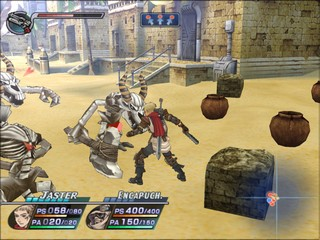
Exploration and combat are presented in third person. Encounters use real-time party battles instead of a turn-based command menu: the player directly controls one member of a three-character active team and can switch the controlled character during battle. The other two companions act according to selected tactics, with options to focus on particular enemies or take a more aggressive or restrained approach. Different party members bring their own weapons and special techniques, and particular lineups can unlock combination attacks. Defensive timing matters as well, since guarding can help restore the action gauge used for ordinary attacks.
Character growth is built around the Revelation Flow, a branching board that asks players to place suitable items into marked spaces to uncover abilities, statistic improvements, and other bonuses. Each playable character has a separate layout, so building the party involves more than simply gaining preset improvements at level-up. Equipment progression also centers on weapon synthesis. Weapons gain experience in use, and developed weapons of compatible types can be combined through Toady, a frog-like specialist, to create stronger gear. The system encourages players to weigh current equipment against possible upgrades and keep track of useful synthesis paths.
Rogue Galaxy also makes room for optional systems beyond the main voyage. Players can pursue hunter-related goals and special quarry battles, collect blueprints for the Factory feature, and use it to make items. The Insectron activity lets players capture, raise, and enter creatures in tactical contests, adding a separate collection and tournament pastime. These pursuits sit alongside the story rather than replacing it, offering reasons to revisit areas and experiment with the game’s items, combat party, and equipment systems.
The version represented by Rogue Galaxy PS2 outside Japan is not merely a translated copy of the first Japanese release. Level-5 and Sony added an optional water-world area called Alistia, additional content, refinements to battles and character abilities, more equipment, and changes to the Burning Strike system. In this edition, enemies can yield Burning Chips that let the player choose when to launch the dramatic multi-hit attack rather than waiting for its original random activation. With its connected mix of real-time action, party development, weapon crafting, planetary travel, and side activities, Rogue Galaxy stands as one of Level-5’s major original PS2-era RPGs.
Gallery
Details
- Developer
- Level 5
- Publisher
- Sony Computer Entertainment
- Genre
- Action RPG
- Players
- 1
- Release Date
- January 30, 2007
- System
- PS2