About
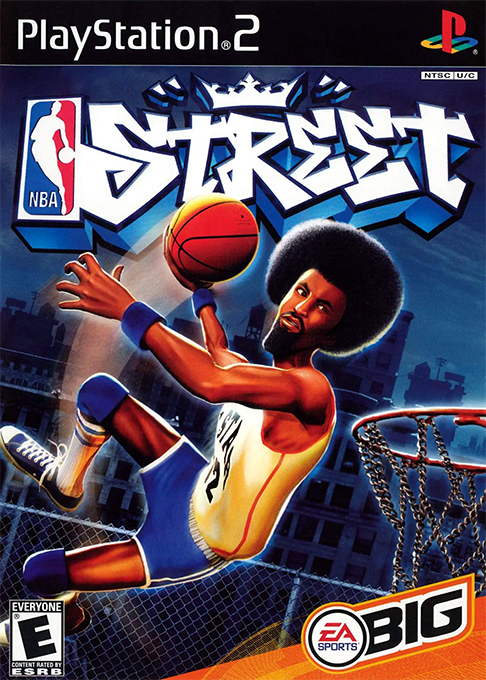
NBA Street brings professional basketball into an exaggerated three-on-three streetball setting on PlayStation 2. Released in June 2001, this original entry in EA Sports BIG’s NBA Street series was developed by NuFX with EA Canada and published by Electronic Arts. It uses licensed NBA teams and players while steering away from a simulation approach: games are compact, physical, and built around momentum, individual flair, and dramatic scoring swings.
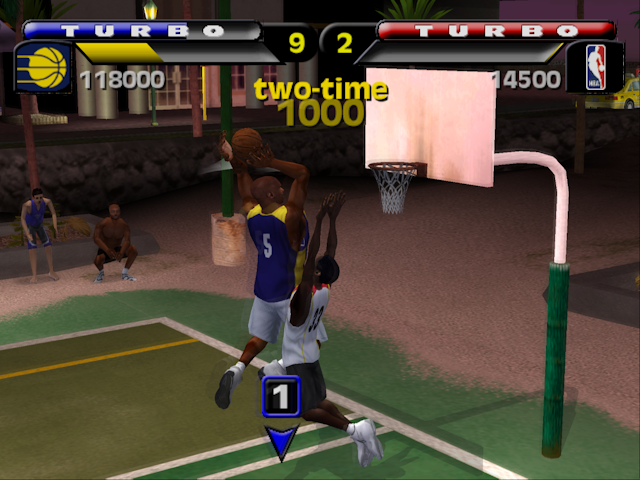
On the court, NBA Street plays as half-court basketball with three players per side. Standard basketball fundamentals still matter, including passing, shooting, steals, rebounds, blocks, and positioning, but every possession also presents a chance to build trick points. Stylish dribbles, feints, ankle-breaking moves, high-risk passes, loose-ball dives, emphatic blocks, and dunks all feed the game’s showmanship-focused scoring system. The result is an arcade basketball game where a clever sequence can be as valuable as a simple basket.
The defining mechanic is the Trick Meter. Successful flashy actions fill it over the course of a game, encouraging players to take chances and string moves together rather than merely protect a lead. Once the meter is full, a team can attempt a Gamebreaker, a special scoring play with a major swing attached: it adds points to the attacking team while taking points from the opponent. That reversal makes timing important, since a team that seems safely ahead can quickly be pulled back into a close contest.
Matches use streetball-style scoring rather than a clock-driven professional format. Ordinary field goals count for one point, while shots from beyond the three-point line are worth two. The first team to reach 21 wins, but it must lead by two points. This structure keeps each game focused and tense, with no final buzzer to protect a narrow advantage and plenty of room for a late Gamebreaker to change the outcome.
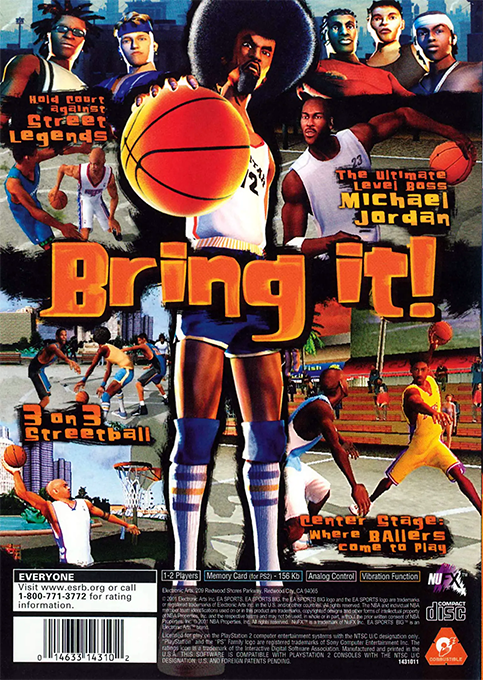
NBA Street includes 29 NBA teams drawn from the 2000–01 era, with a limited selection of players available for each club. The PlayStation 2 version also features Michael Jordan. Alongside the real NBA talent are the Street Legends, a group of fictional standout opponents associated with different regions of the United States. These personalities serve as memorable obstacles in the game’s progression and help give the licensed roster a more stylized streetball identity.
City Circuit is the principal single-player mode. Players create a custom baller, travel through American locations, challenge teams, and recruit players from NBA rosters while building a squad. Its ladder-like structure makes advancing through the circuit feel like a series of escalating pickup games, capped by difficult encounters with the Street Legends. The mode turns the individual matches into a longer campaign while retaining the immediate, pick-up-and-play structure of the on-court action.
Hold the Court offers another way to test a team, emphasizing streaks and sustained success. Together with quick exhibition-style play, it makes NBA Street suited to solo sessions as well as local competition. The game’s visual presentation, animation, and licensed atmosphere all support its big, playful tone, while the motion capture work included members of Vancouver streetball group The Notic, including Joel “The King Handles” Haywood.
NBA Street was received favorably by critics and became a successful PlayStation 2 release, selling 1.7 million copies in the United States by August 2006. More importantly, it established the formula for later NBA Street games: professional stars, city-court attitude, compact three-on-three contests, tricks that reward creativity, and Gamebreakers capable of transforming a match. For players looking for a fast, stylish PS2 basketball game rather than a traditional season simulation, it remains the starting point for one of EA Sports BIG’s best-known sports series.
Gallery
Details
- Developer
- Electronic Arts
- Publisher
- EA Sports BIG
- Genre
- Basketball
- Players
- 1-2
- Release Date
- June 18, 2001
- System
- PS2