About
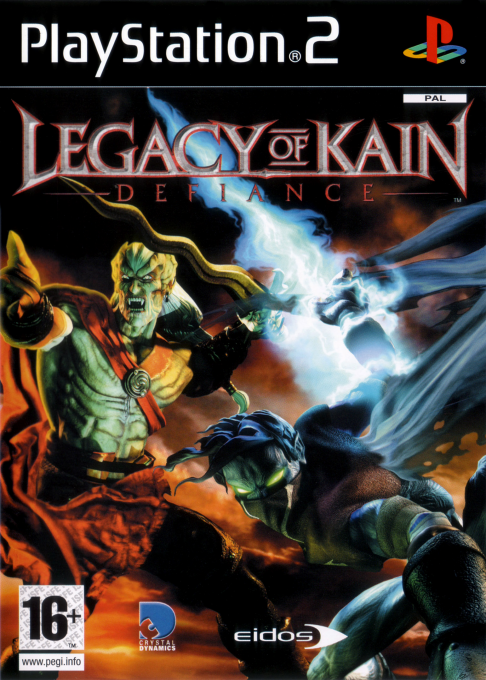
Legacy of Kain: Defiance is a dark fantasy action-adventure for PlayStation 2 developed by Crystal Dynamics and published by Eidos Interactive. Released in the early 2000s, it is the fifth main chapter in the Legacy of Kain saga and the chronological finale to the long-running conflict surrounding Nosgoth, its corrupted Pillars, and the powerful Soul Reaver. The game follows directly from Legacy of Kain: Soul Reaver 2, so its most dramatic revelations are designed to reward players who know the earlier Blood Omen and Soul Reaver stories. Its gothic ruins, ancient citadels, supernatural enemies, and theatrical dialogue give the journey a distinctive atmosphere on PS2.
Defiance tells its story through the alternating perspectives of Kain, a vampire ruler pursuing a chance to change Nosgoth's fate, and Raziel, his former lieutenant who has become a soul-devouring wraith. It is the only original Legacy of Kain game to make both characters playable. Their intertwined quests begin after a time paradox separates them and sends them on different paths through a world shaped by prophecy, manipulation, and an old war between the vampire Ancients and the Hylden. The narrative gradually connects events and characters from the previous games while focusing on whether either hero can act freely in a future seemingly controlled by the Elder God and the time-streaming sorcerer Moebius.
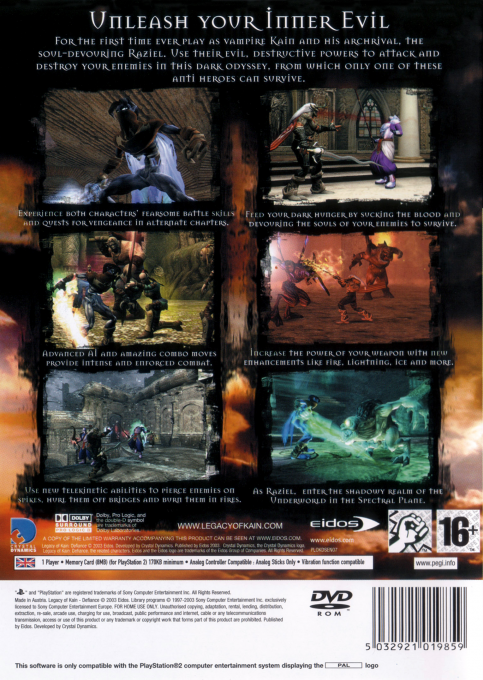
The PlayStation 2 adventure uses a third-person structure that combines exploration, climbing, environmental puzzles, platforming, and arena-style combat. Control switches at predetermined points between Kain and Raziel rather than allowing an on-demand swap, making each section part of the larger plot. Both protagonists can scale selected walls, glide across gaps, use telekinetic attacks, and draw strength from defeated enemies, but their routes emphasize different powers. Kain can make enormous jumps, turn into a swarm of bats, and use force to pull or throw foes, while Raziel can swim and shift between the Material and Spectral Realms to reach otherwise inaccessible paths.
Combat centers on the Soul Reaver in its material and spectral forms. Kain wields the physical blade while Raziel uses its wraith-like counterpart, and each character learns combos and special attacks by defeating enemies. Blood and souls restore their health, while Reaver energy can be built up for stronger area attacks. Kain discovers emblems that expand the weapon's abilities, and Raziel finds elemental Reaver powers that open new solutions in the environment. Health and energy upgrades are hidden as runes across the game, giving exploration a practical reward beyond advancing to the next story sequence.
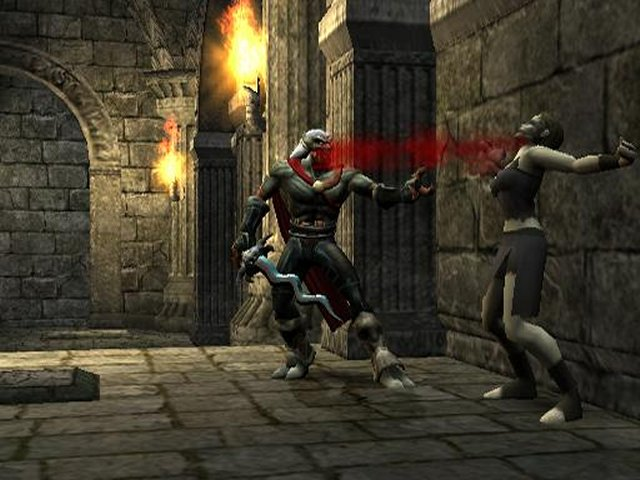
Nosgoth's enemies include Sarafan warrior-priests, vampire hunters, demons, Revenants, and other creatures connected to the series' mythological conflict. The two campaigns lead through locations such as ruined strongholds, a vampire citadel, and the ominous Avernus Cathedral. Fixed camera angles frame the large, vertical environments and the cinematic battles, although they can also make navigation and combat positioning more demanding. The game moves more decisively toward action than some earlier series entries, with frequent enemy encounters and increasingly elaborate Reaver techniques alongside its familiar block-moving and traversal puzzles.
A major appeal of Legacy of Kain: Defiance is its presentation. Crystal Dynamics continued the series' emphasis on brooding architecture, elaborate character animation, and a voice cast that treats its dense fantasy script with unusual seriousness. Kain and Raziel remain compelling opposing figures: one seeks to reclaim agency after centuries of manipulation, while the other struggles to understand whether his apparent destiny is a trap. The game uses long cutscenes and carefully staged confrontations to turn its lore into the driving force behind exploration and combat rather than merely background material.
For PlayStation 2 players, Legacy of Kain: Defiance is best approached as the culmination of a connected five-game saga rather than as a standalone action game. Newcomers can still enjoy its supernatural combat, imposing settings, and dual-protagonist design, but familiarity with Blood Omen, Soul Reaver, and Soul Reaver 2 makes its time-traveling conflicts and final choices far clearer. Its mix of swordplay, puzzles, traversal, and ambitious narrative gives it a memorable place among PS2 action-adventures, especially for players looking for a lore-heavy gothic fantasy experience built around one of the era's most recognizable antiheroes and his tragic rival.
Gallery
Details
- Developer
- Crystal Dynamics
- Publisher
- Eidos Interactive
- Genre
- Other Adventure
- Players
- 1
- Release Date
- February 6, 2004
- System
- PS2