About
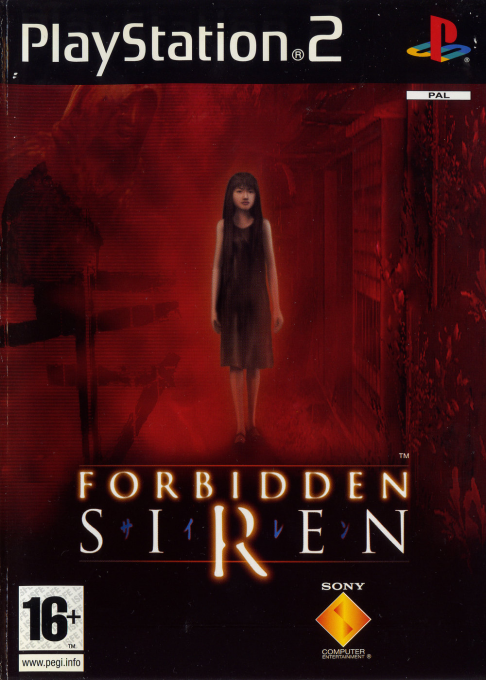
Forbidden Siren is the European and Australian title for Siren, the PlayStation 2 survival-horror game developed by Project Siren within Sony Computer Entertainment Japan and published by Sony Computer Entertainment. Directed and co-written by Keiichiro Toyama, it first arrived in Japan as Siren on November 6, 2003, before reaching Europe in March 2004 under its alternate title. This is the original game in the series, not the later sequel or the 2008 reimagining Siren: Blood Curse.
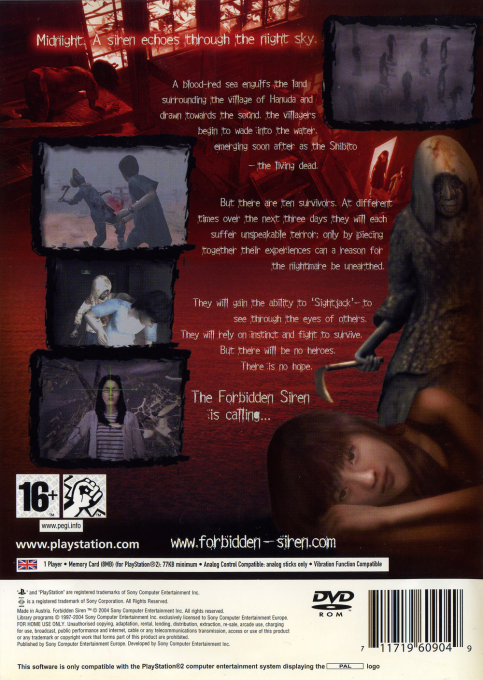
The nightmare begins in Hanuda, a fictional, isolated Japanese mountain village. At midnight, a siren sounds and the ordinary world gives way to a red sea and an outbreak that changes the village's inhabitants into Shibito - hostile, corpse-like beings. The game follows ten survivors over the three days after this disaster, shifting between their separate viewpoints as they try to endure the town's unnatural rules, find one another, and understand what has happened.
Its story is deliberately fragmented rather than presented as a single straight journey. Episodes jump among characters and times, with the Link Navigator arranging stages into a larger chronology. A decision or discovery in one person's scenario can create a new requirement or possibility in another's, so progress often comes from considering how the cast's paths intersect. Optional archive items expand the background of Hanuda and its unsettling history without turning the game into a conventional linear campaign.
Siren's defining mechanic is sightjacking. Survivors can tune in to the sight and hearing of nearby humans or Shibito, using an enemy's own perspective to judge patrol routes, locate objects, or discover whether a path is safe. It is a powerful source of information, but it comes with a risk: the character cannot move while using it. The result is a tense rhythm of listening, observing, and choosing a route before exposure turns knowledge into danger.
Stealth is usually more reliable than confrontation. Characters can crouch, move quietly, hide, close doors, use darkness to their advantage, and create distractions, while weapons range from improvised tools to firearms. Shibito may be knocked down, but they are not simply removed forever; many recover and resume the hunt. Different playable characters also have different circumstances and objectives, making survival feel dependent on timing, observation, and the particular limitations of the person currently on screen.
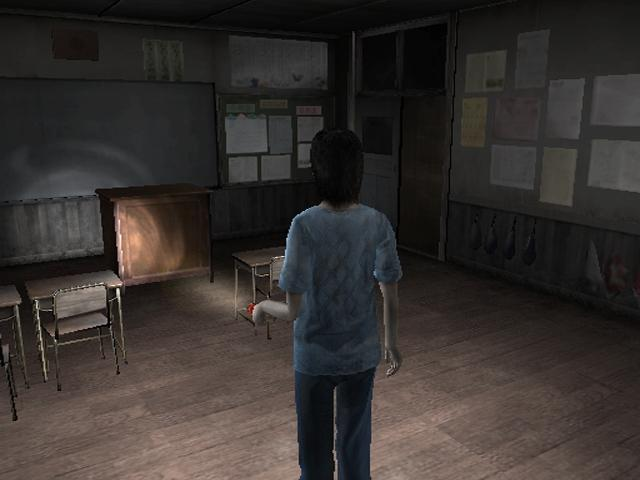
The game pairs this structure with a strongly Japanese rural-horror atmosphere. Its abandoned homes, shrines, flooded spaces, strange broadcasts, and photographed facial textures make Hanuda feel both lived-in and wrong. Rather than centering a heavily armed hero, Forbidden Siren makes vulnerability part of its design: limited control over events, uncertain routes, and the knowledge that danger can be watching from another pair of eyes sustain its dread.
Forbidden Siren was followed by Forbidden Siren 2 in 2006, a separate sequel with a new setting and ensemble. Siren: Blood Curse, released in 2008, revisits the first game's premise as a reimagining rather than a continuation of Hanuda's original storyline. The original later received modern PlayStation releases with technical features such as enhanced rendering, trophies, rewind, save states, and video filters, but its distinctive multi-character structure and sightjacking remain the heart of this 2003 PlayStation 2 horror game.
Gallery
Details
- Developer
- Sony Computer Entertainment
- Publisher
- Sony Computer Entertainment
- Genre
- Survival Horror
- Players
- 1
- Release Date
- March 12, 2004
- System
- PS2