About
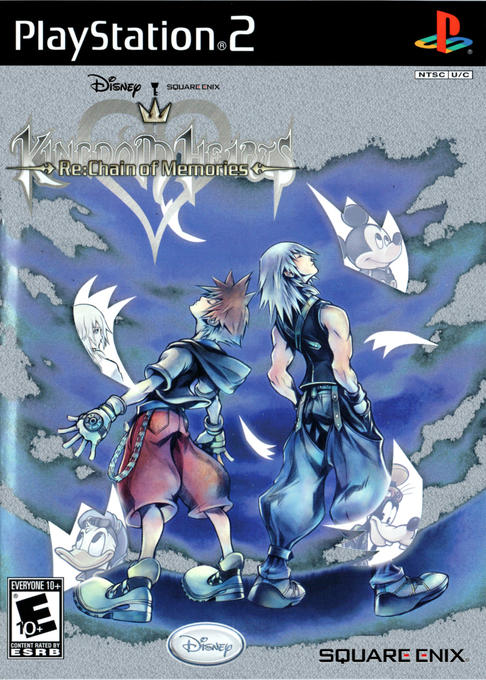
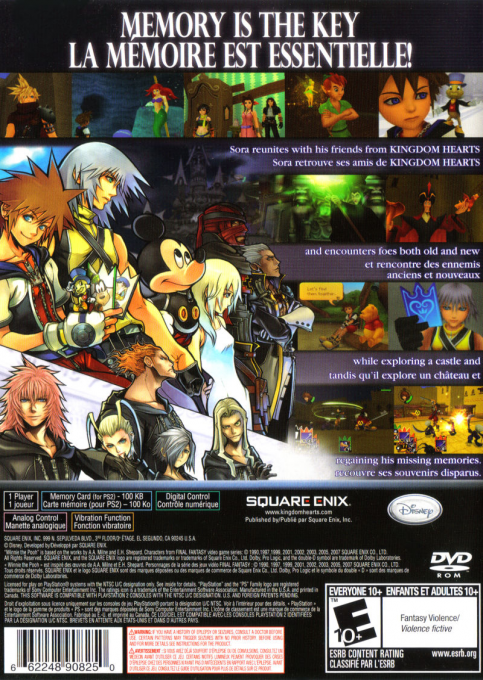
Kingdom Hearts: Re-Chain of Memories for PlayStation 2 remakes the Game Boy Advance title Kingdom Hearts: Chain of Memories as a fully three-dimensional action role-playing game. Set directly after the first Kingdom Hearts and before Kingdom Hearts II, it follows Sora, Donald, and Goofy as their search for Riku and King Mickey leads them to Castle Oblivion. The fortress promises answers, but its central rule gives the journey its unease: the farther its visitors travel within, the more memories they surrender.
A black-coated stranger sends the group toward the castle, where familiar places and faces return as reconstructions drawn from Sora’s memories. Those echoes let the adventure revisit Disney worlds from the first game while changing their context around the castle’s mystery. As Sora climbs, he encounters members of Organization XIII and becomes increasingly preoccupied with Naminé, a girl whose connection to his past is not what it seems. The story turns on the cost of recovering what has been forgotten and on whether altered memories can still carry genuine feelings.
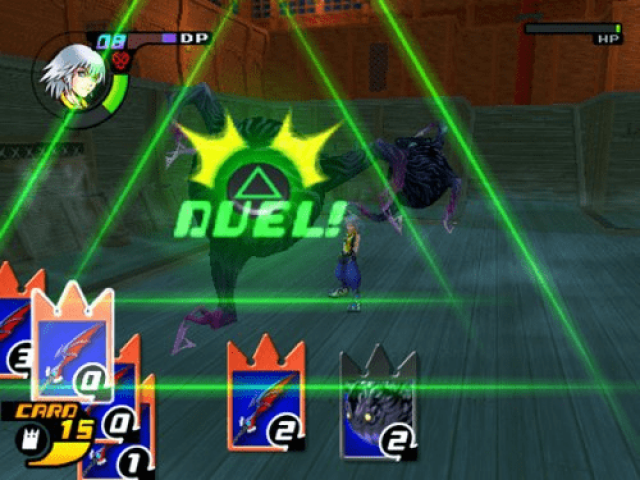
Rather than adopting the standard menu-driven battles of a card game, Re:Chain of Memories keeps combat moving in real time across enclosed arenas. Every attack, spell, item, summon, and defensive response comes from a card selected from the active deck. Card values run from zero to nine, so timing and value matter as much as the action on the card: a higher value can cancel an opposing play, while a zero is a potent interruption when used after an opponent has committed to an attack. Because opponents play cards too, a fight can shift from attacking to protecting a key move or forcing an opening with a card break.
Sora builds his own deck around Card Points, or CP. More powerful or higher-valued cards demand more of that limited capacity, which makes deck construction a tradeoff between strength, consistency, and flexibility. Cards can be played one at a time or combined in groups of three to form sleights: special techniques that turn particular combinations into stronger physical attacks, magic, or summons. A sleight can leave its first card unavailable until the deck is reloaded, so the system rewards planning the order of a hand as well as collecting useful cards. Progression increases options through health, CP, and learned abilities rather than simply replacing the card system with conventional equipment.
The castle itself is assembled with map cards earned in battle. At doorways between floors, the chosen card creates the next room and determines its conditions. Different cards influence such details as enemy strength and density, available treasure, save points, and other room properties. This room synthesis makes exploration part of the same card economy as combat: cards spent to open a route may also have been useful for creating a more favorable chamber. Story rooms punctuate the climb, while the player chooses how to connect many of the intervening spaces.
After Sora’s scenario, the Reverse/Rebirth campaign presents the other side of Castle Oblivion through Riku’s descent into its underground levels. It runs alongside Sora’s events and focuses on Riku’s struggle with the darkness left within him. His deck is largely fixed by the world he occupies instead of freely customized, and his fighting style leans on physical cards, enemy cards, and assistance from King Mickey. Successful card breaks build Dark Points, allowing Riku to enter Dark Mode and use his own sleights. The different structure makes the second campaign more than a retelling, providing another view of the Organization’s conflict and of Riku’s effort to choose a path between darkness and light.
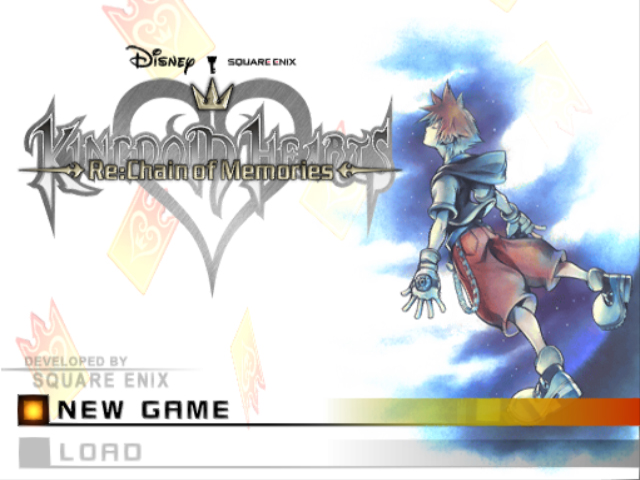
The PS2 version changes the original GBA presentation from 2D sprite-based worlds and battle screens to polygonal environments and characters in the visual style of the PlayStation 2 Kingdom Hearts games. It adds voiced scenes, an improved soundtrack, and new cutscenes and battles while retaining the card combat and room-synthesis framework at the heart of Chain of Memories. It also incorporates the Reaction Command concept associated with Kingdom Hearts II, giving certain encounters context-sensitive actions amid the deck-based battles. Its North American release was a standalone PS2 game; later editions included it in high-definition collections.
Re:Chain of Memories is a bridge chapter in the series, explaining the gap between Sora’s first adventure and Kingdom Hearts II without treating that interval as a simple detour. Castle Oblivion’s rules turn memory into both story subject and gameplay resource, while the two campaigns give Sora and Riku distinct routes through the same crisis. The result connects the characters’ lost abilities, the emergence of Organization XIII, Naminé’s role, and Riku’s continuing development to the larger Kingdom Hearts narrative.
Gallery
Details
- Developer
- Jupiter
- Publisher
- Square Enix
- Genre
- Card Battler, Other RPG
- Players
- 1
- Release Date
- December 2, 2008
- System
- PS2