About
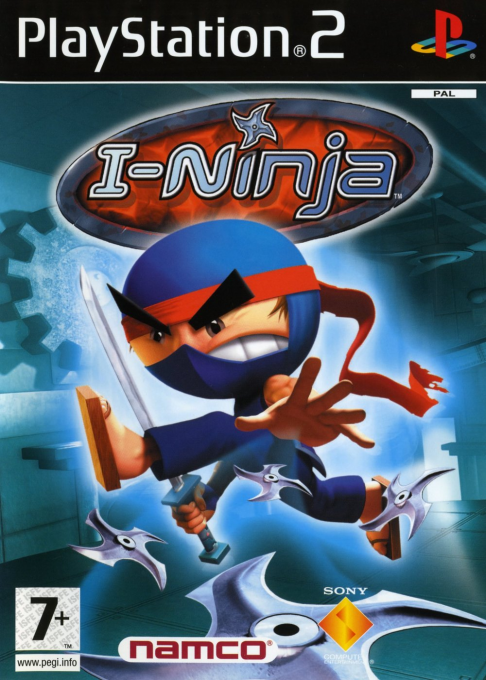
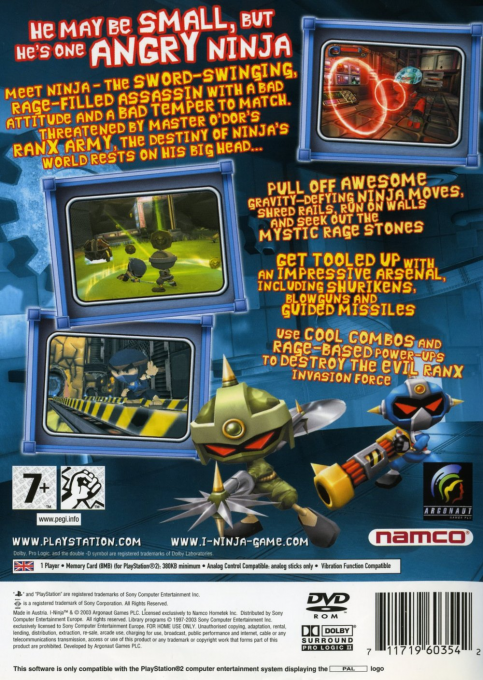
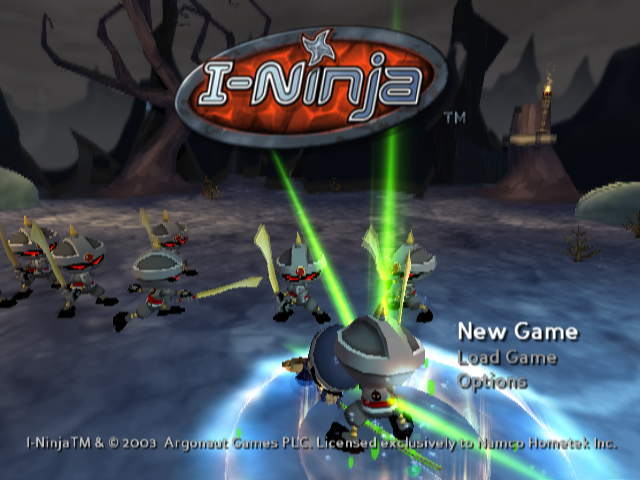
I-Ninja on PlayStation 2 is a fast-moving 3D action-platform game from British studio Argonaut Games. It reached North America in 2003 through Namco Hometek and arrived in Europe in early 2004, where Sony Computer Entertainment published the PS2 edition. The adventure stars Ninja, a small, blue-clad trainee whose reckless encounter with a Rage Stone has disastrous consequences for his clan and his Sensei. With his master returning as a ghostly guide, Ninja sets out to fight Emperor O-Dor and the robotic Ranx army behind the invasion.
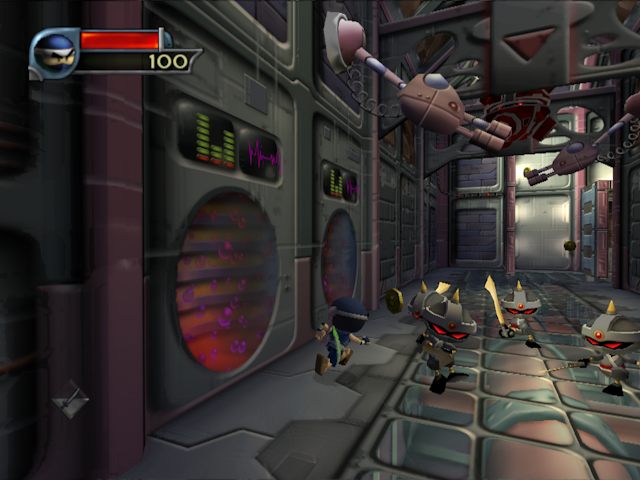
The PlayStation 2 game combines third-person platforming, sword combat and set-piece action. Ninja runs, jumps and double-jumps through stages built around hazards, enemies and collectibles, while his sword handles close-range attacks. A mid-air sword spin helps him stay aloft longer and soften a descent, making timing and positioning important during vertical platforming. Wall-running surfaces and grappling points extend his movement options, so routes can send him across gaps, around structures and through spaces that would otherwise be unreachable. The result is an action game where traversal is as central as fighting.
Combat grows beyond ordinary sword swings as the adventure progresses. Ninja can find and use tools such as shuriken and explosive darts; these can be aimed from a first-person view, while shuriken also support assisted targeting. Hits build an attack gauge that can be spent on temporary abilities, including recovery, increased strength and more dramatic attacks. One of the game's most recognizable states is its invincibility power: when activated, Ninja announces the title phrase and damages nearby opponents. Some encounters also shift into aerial duel arenas, where Ninja and an enemy battle while suspended in an open void using flight, dashes, sword attacks and projectiles.
The campaign is arranged as a succession of colorful, distinct locations rather than a single continuous world. Ninja travels from Robot Beach to Bomb Bay, Jungle Falls and Mountain Gorge in search of the stones tied to O-Dor's forces, eventually heading toward the villain's moon base. Each area mixes regular stages with challenges, boss confrontations and unusual action sequences. The objective is not merely to reach an exit: players are encouraged to earn grades and return to challenges while learning the abilities required for later obstacles. That level-based structure lets I-Ninja repeatedly change the pace between precision jumps, combat encounters and its larger spectacle-driven moments.
Ninja's blunt, impulsive personality gives the story a comic tone, while the plot steadily raises the stakes from rescuing Sensei to confronting O-Dor. The game’s presentation also had a notable production contribution: Don Bluth and Gary Goldman’s studio handled its 3D cinematics, and the credits include voice performers Billy West, Michael Bell, Dee Bradley Baker and Erin Fitzgerald. These animated scenes support the exaggerated character design and the game’s cartoon-styled world without changing the fact that the player experience is principally about direct control, movement and combat.
I-Ninja began as a Namco-published Argonaut project announced for PlayStation 2 and GameCube in 2002. Xbox and Windows versions followed in other markets, although the European console release was limited to the PlayStation 2 version. An announced Game Boy Advance adaptation did not reach release. The PS2 edition therefore represents an important version of a cross-platform early-2000s game: a single-player platform adventure that uses the era's 3D action vocabulary—collectible upgrades, acrobatic navigation, boss battles and staged missions—while giving it a deliberately mischievous ninja hero and robot-fantasy setting.
Gallery
Details
- Developer
- Argonaut Games
- Publisher
- Sony Computer Entertainment
- Genre
- Platformer
- Players
- 1
- Release Date
- February 13, 2004
- System
- PS2