About
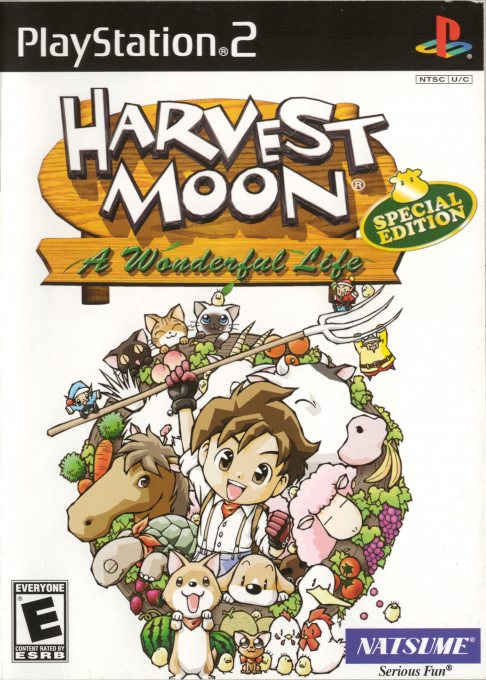
Harvest Moon: A Wonderful Life Special Edition is the PlayStation 2 version of the long-running rural-life simulation, developed by TOSE from Marvelous Interactive’s original design. Released in North America in 2005 and published in Europe by 505 Game Street, it brings the story of Forget-Me-Not Valley to Sony’s console as an expanded edition of the GameCube game. Rather than measuring success through combat or a final score, the game asks the player to build a home, tend a farm, form relationships, and watch a family change over the course of many in-game years.
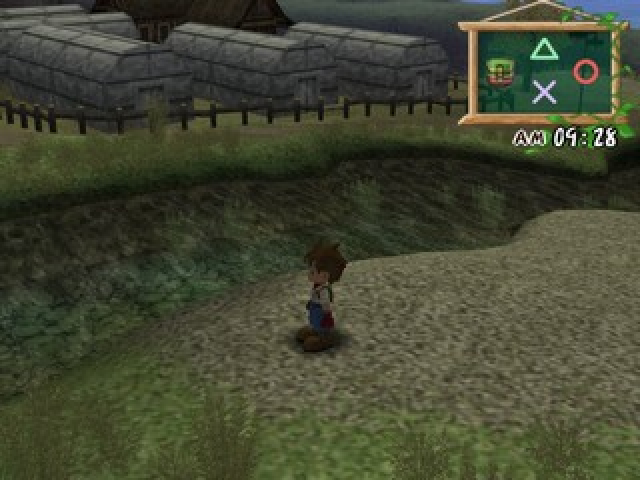
The story begins when a young man inherits a neglected farm from his father. Takakura, his father’s friend and the valley’s longtime resident, provides practical help, an initial cow, and a place to live. From there, each day is shaped by a routine of feeding and milking livestock, planting and watering crops, fishing, cooking, collecting wild items, and deciding how to spend the remaining hours. Seasons affect the work available and the farm steadily develops as the player earns money and invests in animals, tools, buildings, and equipment.
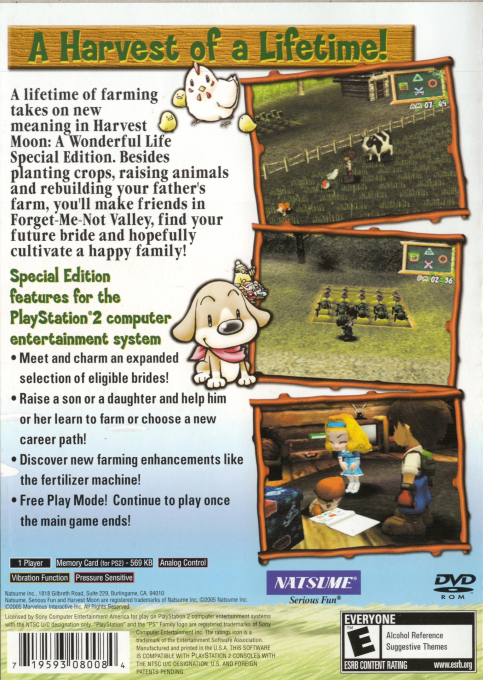
A Wonderful Life distinguishes itself by making time and family central to its structure. The first chapter requires the farmer to court and marry before the year is over, turning social choices into a key part of the game’s progression. The Special Edition adds Lumina as an eligible bride alongside the original candidates, while conversations, gifts, events, and everyday familiarity help determine relationships. Marriage is not simply an ending: it begins the next phase of a story that follows the household as the years pass.
Raising a child gives the game its unusual generational focus. The player’s son or daughter grows from infancy toward adulthood, and the people, places, skills, and interests encouraged during childhood can influence the path that child ultimately pursues. Friends in the valley have their own personalities and routines, so the farm’s daily work sits beside visits, cutscenes, and small discoveries. This emphasis on long-term consequences gives the gentle simulation a narrative arc without taking away the freedom to set a personal pace.
Farming remains the foundation of the experience. Cows, sheep, chickens, ducks, goats, and horses need regular attention, while crops offer another way to earn income and experiment with the land. Seed maker and hybrid-crop systems reward players who combine crops and plan ahead, and new machinery such as the fertilizer maker adds further ways to manage the farm. The game is deliberately hands-on: routine tasks can become demanding, but that repetition is also what makes gradual improvements to the property feel earned.
The PlayStation 2 Special Edition includes new events and music records, expands the marriage options, allows the possibility of a daughter, and introduces an endless mode after the original life-story conclusion. These additions make it the most feature-rich version of the original A Wonderful Life concept on its release hardware. It is still a single-player, deliberately paced game, built around observation and habit rather than fast action, and its 3D valley provides a more intimate setting than the broader towns common in earlier Harvest Moon entries.
Critics appreciated the core appeal of caring for a farm and family, while also noting that the PS2 conversion has longer loading and more noticeable performance issues than the GameCube original. Those technical compromises are important for players seeking a particular version, but they do not change the design’s central appeal. Harvest Moon: A Wonderful Life Special Edition is a patient, character-driven farm simulation about building a livelihood in a small community and seeing the results carry forward through an entire virtual lifetime.
Gallery
Details
- Developer
- TOSE
- Publisher
- 505 Games
- Genre
- JRPG
- Players
- 1
- Release Date
- October 28, 2005
- System
- PS2