About
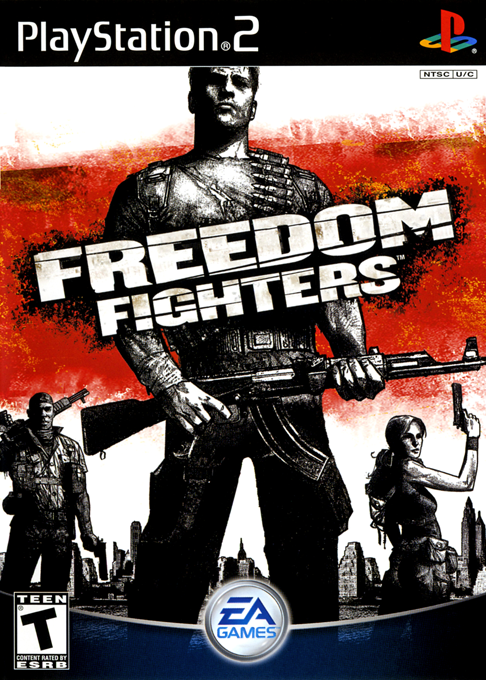
Freedom Fighters is a 2003 third-person action game for PlayStation 2 from IO Interactive and EA Games. It turns a Cold War alternate-history premise into a focused urban resistance campaign: the Soviet Union has become the dominant superpower and occupies New York City after a surprise invasion. Players control Christopher Stone, an ordinary plumber whose search for his abducted brother draws him into the fight against the occupying force. The PS2 release combines direct shooting with accessible squad command mechanics, placing its tactical decisions inside fast-moving street battles rather than separating them into a strategy layer.
Christopher begins with little more than the urgency to survive and find Troy, but soon works alongside resistance figures including Isabella Angelina, Phil Bagzton and Dihn Nguyen. The story moves through a recognizable but transformed New York, with Manhattan, Brooklyn and Governors Island serving as battlegrounds under Soviet control. Sewer hideouts provide the resistance with a refuge between operations, while propaganda broadcasts and military checkpoints help establish the pressure of life in an occupied city. The campaign follows Chris’s rise from civilian to a prominent resistance leader without losing sight of the personal stakes that brought him into the conflict.
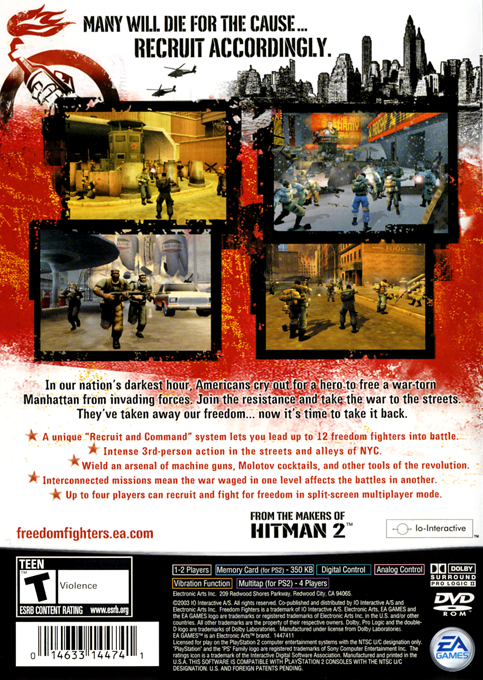
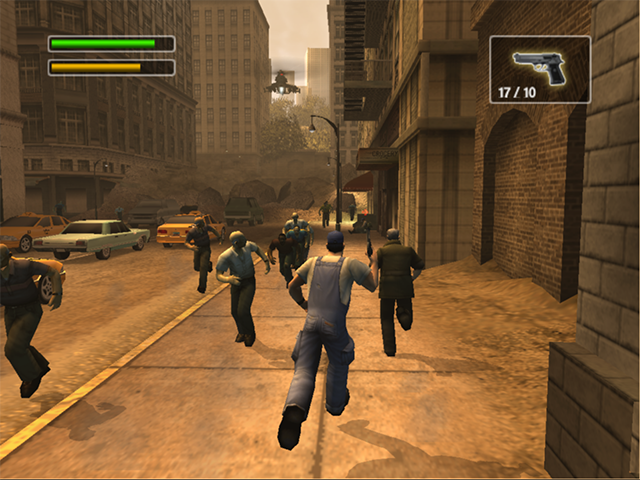
On PlayStation 2, the game is built around over-the-shoulder shooting, scavenged weapons and mission objectives that encourage players to look beyond simply eliminating every enemy. Chris can use firearms, explosives and improvised combat tools found in the environment, then carry those resources into confrontations shaped by streets, rooftops, interiors and fortified positions. Objectives commonly involve disrupting the occupation’s infrastructure, securing locations or helping the resistance gain a stronger foothold. This structure gives each operation a clear military purpose while leaving room for tense advances, defensive stands and attacks on enemy-controlled points.
Its defining system is charisma. Completing major goals and performing helpful acts such as liberating areas, rescuing prisoners or assisting civilians raises Chris’s standing with the resistance. Higher charisma allows him to recruit more fighters from people encountered in the field, eventually supporting a squad of up to twelve. The result is a sense of growth that is more than an equipment upgrade: successful actions visibly expand the group Chris can bring into later engagements. A difficult stronghold that feels overwhelming alone can become manageable after the player has earned the loyalty and manpower to approach it as a coordinated force.
The squad controls are deliberately simple, allowing Chris to order recruited fighters to follow, attack or defend. That economy matters in a console shooter, where commands must be issued quickly during firefights. Players can direct allies toward cover, send them at a hostile position or ask them to hold a useful point while Chris takes another route. The squad members are not just decorative companions; their presence changes the scale and rhythm of an encounter, letting the player create crossfire, reinforce an advance or protect a captured area. Some missions narrow the focus by placing Chris on his own, which makes the return to a larger group feel consequential.
Freedom Fighters also treats territory as part of its action-game pacing. Capturing or disabling important positions can alter the immediate tactical situation, opening a safer route or weakening a defensive network. The game’s missions connect the idea of a citywide uprising to smaller, readable tasks, so progress is measured both by story developments and by the places reclaimed from the occupiers. Rather than asking players to manage a complex strategic map, it makes leadership tangible through movement, gunfights and the growing number of citizens prepared to follow Chris into danger.
The PS2 version includes local split-screen multiplayer for up to four players. Its competitive modes place Soviet and resistance sides around flags and bunkers, with bunkers acting as important spawning points and objectives. Players can choose their side, switch among that faction’s available weapons and recruit soldiers according to the multiplayer charisma limit. This gives the versus mode a related but distinct use for the game’s squad concept, turning control of the battlefield into a contest between several commanders instead of a single-player campaign objective.
IO Interactive developed Freedom Fighters after Hitman 2: Silent Assassin, using its Glacier technology to create dense combat spaces and a presentation suited to its alternate New York. The game was released in North America on October 1, 2003, alongside versions for GameCube, Xbox and Windows. Its music was composed by Jesper Kyd, whose score combines electronic elements with choral material, including performances by the Hungarian Radio Choir. For PS2 players, Freedom Fighters remains a distinctive early-2000s action game: a campaign where an unlikely protagonist earns authority through decisive acts, and where straightforward commands turn a small band of allies into a visible resistance force.
Gallery
Details
- Developer
- IO Interactive
- Publisher
- EA Games
- Genre
- Third-Person Shooter
- Players
- 1-2
- Release Date
- October 1, 2003
- System
- PS2