About
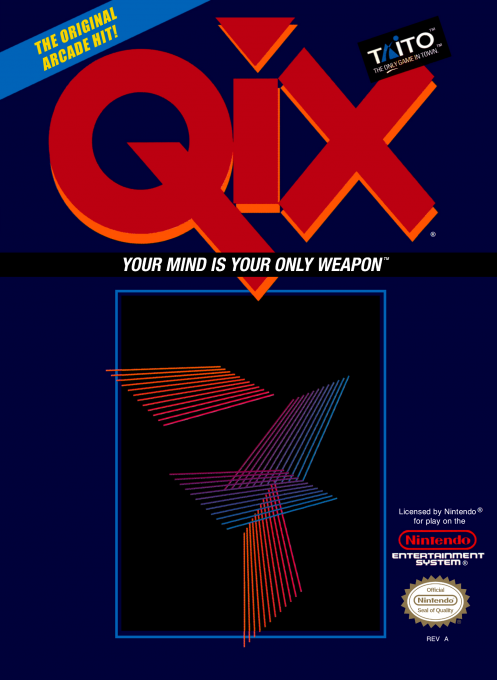
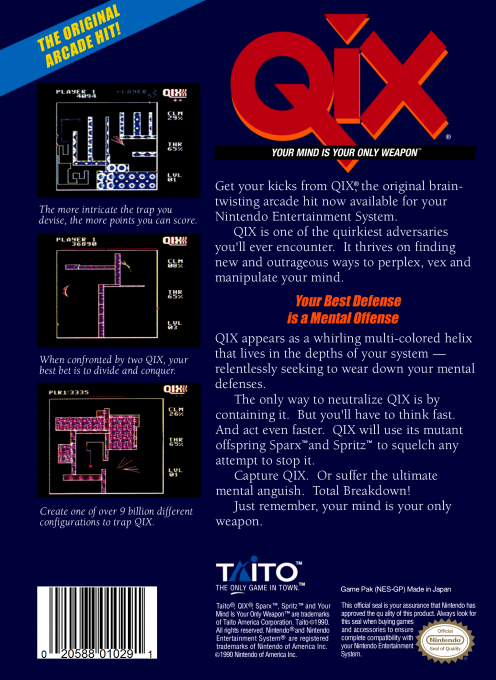
Qix for the Nintendo Entertainment System is Taito's 1991 home version of the abstract arcade action-puzzle game first released in 1981. Developed for NES by Novotrade and published by Taito, it turns a bare rectangular arena into a contest of nerve, positioning, and percentage-based scoring. The threat at the centre is the Qix, an unpredictable knot of shifting lines. Rather than fighting it directly, the player must carve up the field and confine it within ever-smaller territory.
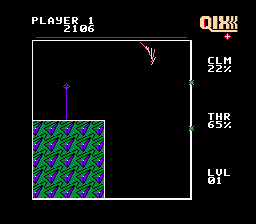
Play begins with a small marker travelling safely around the border of the screen. Pressing A while moving sends it into the open field on a Fast Draw, while B creates a Slow Draw. A completed route that reconnects with a solid edge claims the portion of the board that does not contain the Qix, filling it with colour and adding it to the running total. Fast lines let the player cover ground quickly; slow lines take longer to make but pay more, making each attempt a choice between speed, safety, and score.
That choice becomes dangerous as soon as the marker leaves the boundary. If the Qix touches an unfinished line, the player loses a life. Sparx patrol the completed borders and are equally hazardous on contact, while a stalled or trapped drawing attempt can bring a fuse racing down the exposed line. Later rounds add pressure with more enemies and tougher target percentages, so good play involves watching the centre, reading safe routes along the edges, and deciding when a large claim is worth the risk.
Qix on NES also adds Spritz, small hazards emitted by the Qix that can complicate a planned cut. Enclosing one earns a scoring benefit for Fast Draw territory. When more than one Qix is on the board, separating the creatures with a completed line ends the stage and increases the scoring multiplier for later play. These rules give the simple-looking playfield a changing rhythm: a player can make cautious small claims, prepare a narrow corridor, or gamble on a long line that captures a huge section at once.
The NES release offers a standard one-player game, an alternating two-player score competition, and a practice mode for learning the system without the normal progression. Its directional Control Pad and two draw buttons preserve the original game's direct, readable design while fitting it to a home cartridge. Qix has no conventional heroes, stages, or story campaign; its identity comes from the animated geometry, the constant pressure of moving hazards, and the satisfaction of turning empty space into claimed ground.
As a late NES adaptation of an early-1980s Taito arcade game, Qix stands apart from the platformers and character-driven action games common on the system. Its central idea proved durable enough to inspire sequels, follow-ups, and many games built around enclosing territory. This NES version keeps the focus on the original formula: guide the marker, close a shape, claim the safe side, and keep moving before the Qix or its roaming enemies erase the attempt.
Gallery
Details
- Developer
- Taito
- Publisher
- Taito
- Genre
- Logic Puzzle
- Players
- 1-2
- Release Date
- January 2, 1991
- System
- NES