About
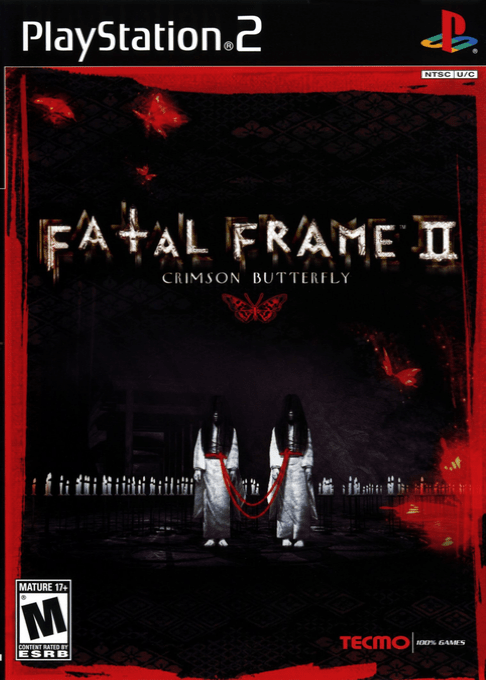
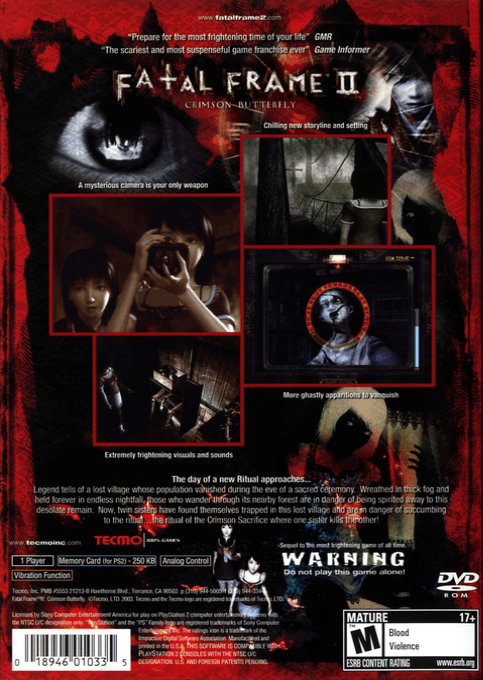
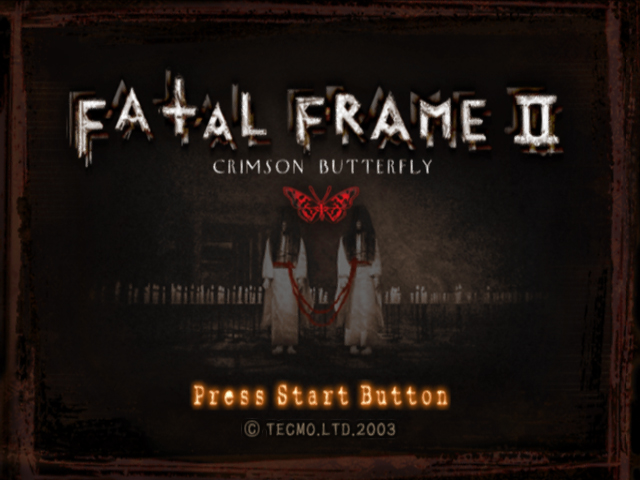
Fatal Frame II: Crimson Butterfly is a survival-horror game developed by Tecmo for PlayStation 2. It is the second main Fatal Frame game, released in Japan and North America in 2003; this PAL edition arrived in Europe on 30 April 2004 under Ubisoft, where it was known as Project Zero II: Crimson Butterfly. The game builds on the first Fatal Frame’s camera-based ghost hunting while telling a separate story rooted in Japanese folklore, abandoned places, and a tragedy involving twins.
The story follows teenage twin sisters Mio and Mayu Amakura. While revisiting a valley where they played as children, they follow a glowing crimson butterfly into Minakami, or All God’s Village: a settlement that vanished from the living world. The route home disappears behind them, leaving the sisters among deserted houses, shrines, and spectral villagers. As Mayu is increasingly drawn away from Mio, the search for an escape becomes inseparable from uncovering why the village is trapped in time.
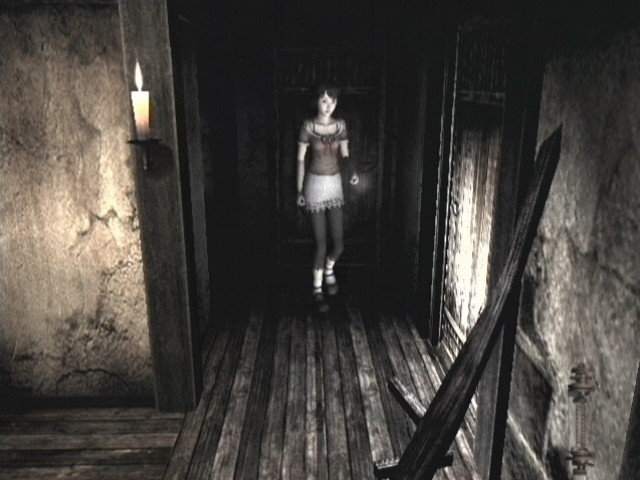
Players chiefly control Mio from fixed third-person perspectives, exploring the village’s alleys, residences, storehouses, and ritual sites. Documents, audio-like supernatural encounters, photographs, and short visions gradually reveal the history of Minakami and its failed ceremony. Mayu sometimes travels with Mio and can point toward leads, but separation is a persistent source of tension. Progress combines keys and mapped routes with environmental riddles, emblem mechanisms, and camera-based clues rather than relying on conventional weapons.
Mio’s essential tool is the Camera Obscura, an antique camera that can see and damage spirits. Raising it switches play to a first-person viewfinder, where a ghost must be kept in frame before a photograph is taken. Positioning and patience matter: stronger shots are available when an enemy is close or attacking, with Shutter Chance and Fatal Frame opportunities rewarding precise timing. Different films offer differing power and availability, so every confrontation asks the player to balance safety, ammunition, and the chance of a decisive photograph.
The camera also supports exploration. A filament guides Mio toward nearby supernatural activity, using different colours to signal hostile or non-hostile ghosts, and photographing certain apparitions preserves them as discoveries. Blue-glowing traces, spirit photographs, and the camera’s viewfinder make looking closely part of solving the village’s mysteries. This design turns the same device into weapon, detector, collection tool, and puzzle aid, giving Fatal Frame II its distinctive rhythm of cautious investigation interrupted by close-range ghost encounters.
Spirit Points earned through photographs can improve the Camera Obscura’s capabilities, while found Spirit Orbs are required for further upgrades. Players can enhance traits such as damage, charging behaviour, range, and special functions, tailoring the camera as the dangers intensify. Healing items, film supplies, save points, and optional ghost photographs encourage thorough searching. The result is survival horror built around resource management and observation: the player is often safest when backing away, but the best attack demands holding a ghost in sight.
Crimson Butterfly’s story can conclude in more than one way, with endings and unlockables tied to play conditions and difficulty. That replay structure gives extra weight to the relationship between Mio and Mayu and to the village’s ritual history, without changing the central premise of guiding Mio through Minakami. Completing the game can also open cosmetic rewards and supplementary material, inviting players to revisit chapters, find missed ghosts, and pursue different outcomes after the first escape attempt.
This PlayStation 2 original is not the same release as Fatal Frame II: Crimson Butterfly Director’s Cut for Xbox. The later Xbox version added enhanced presentation, an optional first-person mode for the wider adventure, Survival Mode in All God’s Village, extra costumes, a harder difficulty setting, and an additional ending. Later adaptations include Project Zero 2: Wii Edition, but the PS2 game remains the foundational version: a slow-burning haunted-village mystery in which Mio’s camera is the only reliable means of facing the dead and staying close to her sister.
Gallery
Details
- Developer
- Tecmo
- Publisher
- Ubisoft
- Genre
- Survival Horror
- Players
- 1
- Release Date
- April 30, 2004
- System
- PS2