About
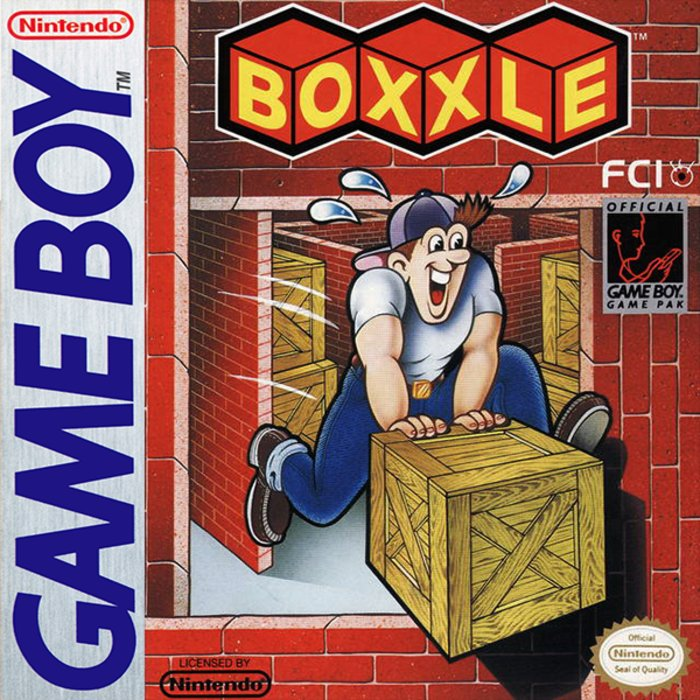
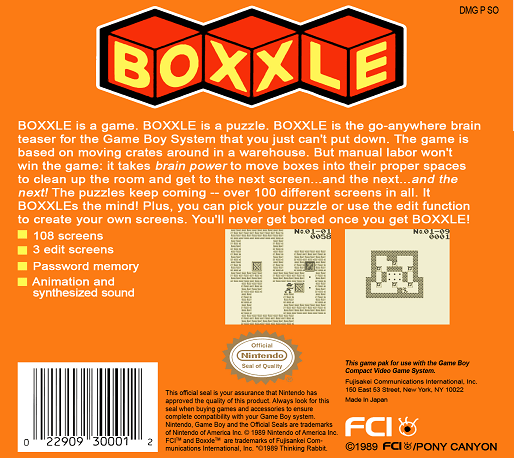
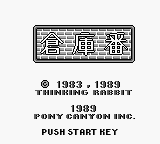
Soukoban for the Nintendo Game Boy is a compact grid-based puzzle game from 1989, developed by Atelier Double and published in Japan by Pony Canyon. It adapts the established Sokoban, or warehouse-keeper, puzzle idea for Nintendo’s monochrome handheld: a lone worker moves through small enclosed rooms, trying to place every crate on a marked storage square. The Japanese release is known as Soukoban (倉庫番), while FCI later brought the same Game Boy game to North America and Europe as Boxxle. Its simple overhead presentation makes each room immediately legible, but the rules turn a few walls, crates, and targets into a demanding exercise in planning.
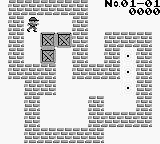
Each puzzle begins with the player walking one square at a time through a warehouse-like layout. A crate can be pushed only when there is an empty space beyond it; it cannot be pulled back toward the player. That one restriction defines the entire challenge. A box shoved into a corner without a target may be lost for good, and placing one crate carelessly can close the route needed to reach another. Success comes from studying the room’s shape, deciding which targets must be filled first, and preserving enough open floor to circle around the boxes. The game is single-player and contains more than one hundred individual puzzles, so it continually finds new arrangements within a very concise ruleset.
Soukoban’s Game Boy format is especially suited to short, self-contained problem solving. There is no action timer, enemy encounter, or need for quick reflexes; progress depends on reading the board and committing to a sequence of pushes. Early rooms introduce the relationship between crates and goal spaces in straightforward layouts, while later puzzles demand that the player consider bottlenecks, narrow corridors, and the order in which storage spaces are approached. Because a bad push can make a room impossible to finish, experimentation and restarts are part of the process. The focus stays on the satisfying moment when a planned route finally leaves every box on its destination.
Although it shares the fundamental box-pushing rules associated with the long-running Sokoban series, this is a specific Game Boy production rather than the original 1982 computer game. Atelier Double handled the Game Boy version, and the title arrived in Japan in September 1989, shortly after the system’s launch. Its later Western identity, Boxxle, is useful context for players searching catalogues outside Japan: the names refer to this regional release of the same handheld puzzle game. The release also established the basis for a follow-up, Soukoban 2 in Japan and Boxxle II abroad, which continued the Game Boy branch of the series.
Soukoban remains a clear example of why the Sokoban format travelled so readily between platforms. Its rooms require almost no elaborate presentation to communicate their goals, yet their layouts encourage careful observation and forward thinking. On Game Boy, the portable screen frames each puzzle as a small spatial challenge that can be considered at a player’s own pace. Whether encountered under its Japanese title or as Boxxle, this 1989 release offers a focused rendition of a classic push-box puzzle: easy to understand from the first move, but built around the consequences of every move that follows.
Gallery
Details
- Developer
- Atelier Double
- Publisher
- FCI
- Genre
- Other Strategy, Logic Puzzle
- Players
- 1
- Release Date
- September 1, 1989
- System
- GB