About
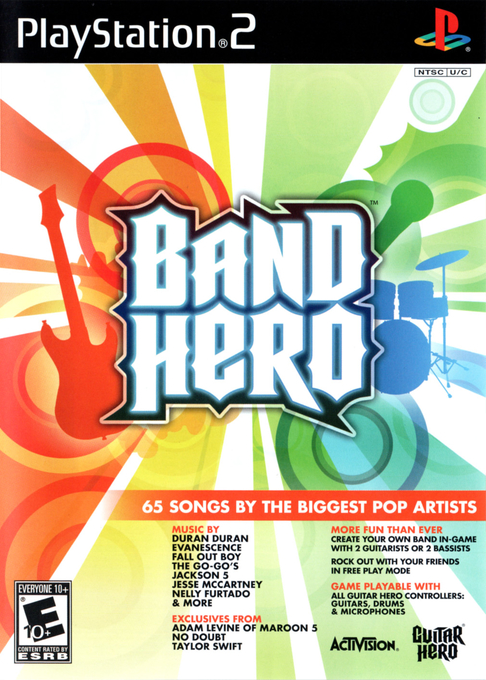
Band Hero is a 2009 rhythm game for PlayStation 2 and a pop-focused entry in Activision's Guitar Hero series. Developed for the system by Budcat Creations and published by Activision, it turns recognizable songs into cooperative performances for guitar, bass, drums, and vocals. Rather than centering its identity on hard rock, the game frames its setlist around radio pop, pop-rock, dance-oriented hits, and older crossover favorites, making it a natural fit for multiplayer sessions with players of varied musical tastes.
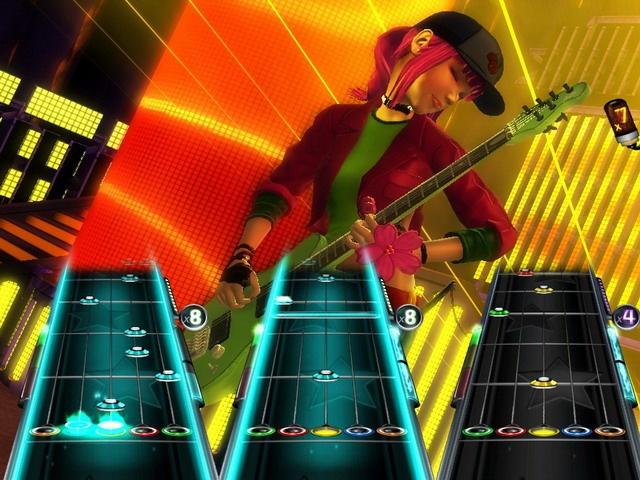
Like the other full-band Guitar Hero games, Band Hero asks each performer to match scrolling note patterns to the song. Guitar and bass players use fret buttons and strumming, drummers follow colored lanes with a drum controller, and singers perform through a compatible microphone. Successful passages build score and momentum, while missed notes reduce the group's performance. The central appeal is the way separate instrumental charts join together: a player can concentrate on one part while still hearing how it supports the rest of the arranged track.
The PlayStation 2 edition is specifically a Budcat port, not simply the same build as the PlayStation 3 and Xbox 360 releases. It uses the earlier Guitar Hero World Tour technology and a presentation style associated with the PlayStation 2 versions of the late-series games. That distinction matters for players collecting the PS2 library: it preserves the four-instrument premise and the game’s song-driven party format, but it belongs to the older console’s branch of the series rather than the higher-definition versions developed around Guitar Hero 5.
Band play accommodates lead guitar, bass guitar, drums, and vocals in any useful combination, so a group does not need to fill every role to begin playing. Players can also change difficulty or switch instruments during a performance, and the game includes drop-in and drop-out play intended to keep a social session moving when someone wants to join or step away. Those conveniences make the format less formal than a traditional career-only rhythm game and help it work as a living-room activity as well as a score-chasing challenge.
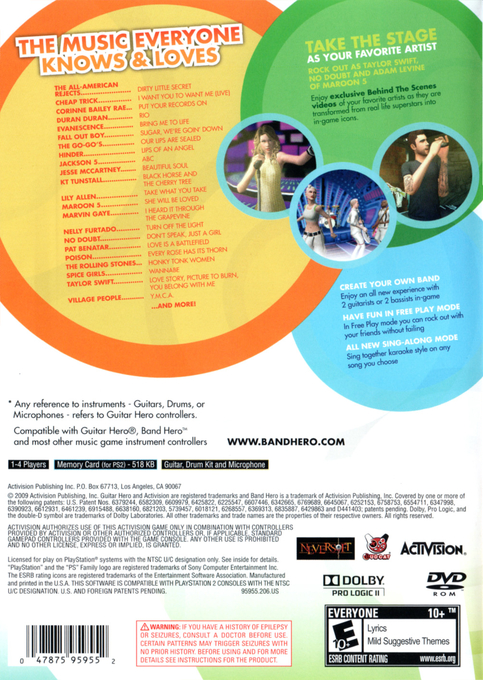
Its 65-song console soundtrack is deliberately broad. The selections include performers such as No Doubt, Taylor Swift, Maroon 5, the Jackson 5, Nelly Furtado, Lily Allen, and the All-American Rejects, alongside songs from several decades. The goal is not to present one narrow genre scene; it is to supply familiar hooks, vocal melodies, and playable band arrangements that can invite both experienced plastic-instrument players and people who recognize the songs from radio or family record collections.
Taylor Swift, Adam Levine of Maroon 5, and No Doubt appear as in-game playable artist avatars, with motion-capture work used for their virtual performances. Their presence gives the game a distinctive late-2000s pop-culture character, while the created-band options let players build their own stage identity around the songs. The mix of celebrity likenesses, costume-style customization, and accessible music selection reinforces the game’s emphasis on putting a group in front of a virtual audience rather than simulating the private practice of a single musician.
For returning Guitar Hero players, Band Hero shares much of the series’ established full-band language, including collaborative score play and recovery mechanics that can bring a struggling bandmate back into a song. It also carries forward the franchise’s interest in making songs and content work across related releases where licensing allowed, though the PlayStation 2 version should be viewed as its own platform-specific release with its own technical context. The essential experience remains immediate: choose a song, take an instrument role, and try to keep a group performance alive from the opening count-in to the final note.
Band Hero remains a useful PlayStation 2 pick for collections that want the later Guitar Hero band format on the system and prefer pop-oriented song choices over a more guitar-heavy playlist. It can be enjoyed as a solo rhythm game, but its design is clearest with friends sharing instruments, changing roles, and replaying songs to improve a band score. The result is a period piece of the music-game boom that turns a PS2 session into a brightly staged, cooperative performance built around songs meant to be immediately recognizable and easy to share.
Gallery
Details
- Developer
- Budcat
- Publisher
- Activision
- Genre
- Rhythm Game
- Release Date
- November 6, 2009
- System
- PS2