About
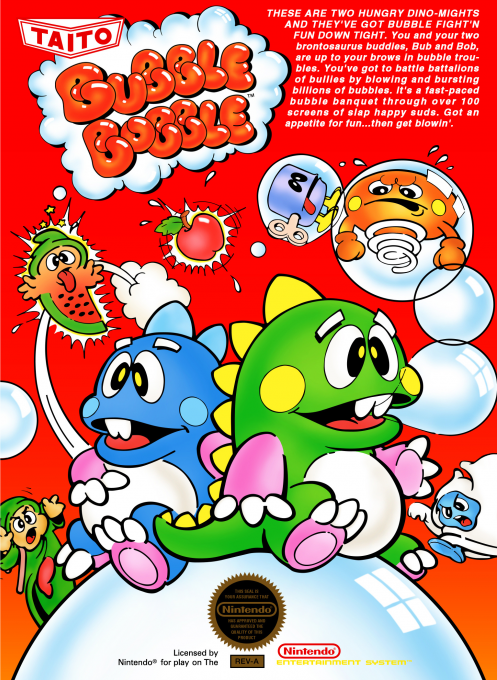
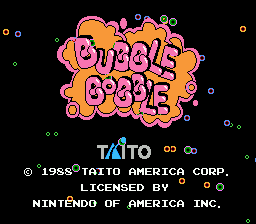
Bubble Bobble for NES brings Taito's arcade platform action to Nintendo Entertainment System in a 1988 home release. Based on Taito's 1986 coin-op, it stars the Bubble Dragons Bub and Bob, who explore the monster-filled Cave of Monsters after magic turns them into dragons. The task is simple to explain but demanding to master: clear each compact, single-screen round of every enemy and keep climbing toward the game's deeper secrets. Taito developed and published the NES edition, preserving the arcade game's colourful fantasy setting and its emphasis on quick decisions, positioning and score-building.
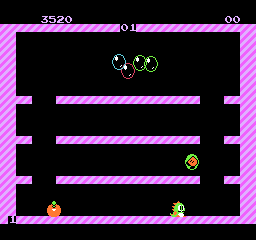
Bub and Bob can run, jump and blow bubbles. A bubble can trap an enemy, but trapping it is only the first step: the player has to burst the bubble, usually by jumping into it or charging against it, before its occupant gets free. Defeated enemies leave behind food that adds points, and taking out several foes together raises the reward. Bubbles are not merely projectiles. They float and can be used as temporary footholds, so an apparent obstacle course becomes a route-planning challenge as players create their own way to higher ledges.
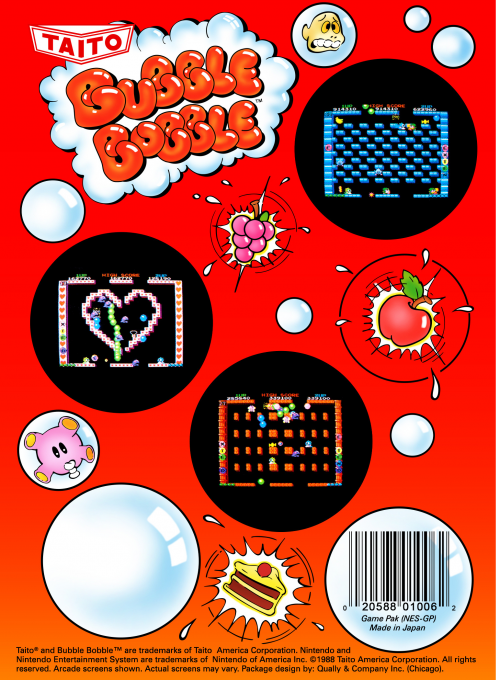
Every round is confined to one screen, with platforms, gaps, walls and enemy patterns providing its puzzle-like shape. Some stages let a character fall through an opening at the bottom and reappear at the top, adding another route to consider. Air currents influence how bubbles drift, while different enemies bring their own movement and attacks. Contact with an enemy or its projectile costs a life. Waiting too long also makes a round more dangerous: trapped enemies can escape in an enraged state, and the pursuing Baron von Blubba is there to force an overdue clear.
Items make Bubble Bobble NES more than a steady sequence of bubble traps. Candy improves the speed and distance of bubble blowing, shoes increase movement speed, and other pickups can produce screen-clearing attacks or short-lived protection. Water, fire and lightning effects can turn a well-timed bubble burst into a broad attack. Magic jars open bonus screens, parasols can skip ahead, and letter bubbles that spell EXTEND lead to a special screen. The changing item set encourages players to recognize opportunities rather than rely on one tactic throughout the adventure.
The NES controls fit the concept neatly: the Control Pad moves each dragon, A jumps, and B blows bubbles. It supports one or two players, with Bub on the first controller and Bob on the second; a second player can join an ongoing game. Co-operation helps cover a screen, rescue a partner from danger and arrange large multi-enemy bursts, but it also asks both players to work around the same moving bubbles and limited platforms. For a console game of its period, the edition also includes a password option and a continue choice for revisiting reached progress while the system remains powered on.
The route to the ending contains more than an ordinary run through its rounds. Nintendo's publisher information highlights hidden commands, secret material and a true ending that cannot be obtained in solo play, giving two-player completion a meaningful role beyond shared score chasing. The NES manual likewise points players toward a special item in round 99 and treats discovery as part of finishing each world. Those details reward repeated attempts and careful experimentation without changing the immediate goal of clearing the screen in front of you.
Bubble Bobble's home conversion remains closely tied to the design that made the arcade original distinctive: friendly-looking dragons, a direct control scheme and platform levels that double as action puzzles. Its enduring Bubble Bobble identity also continued through later Taito games and reissues, including appearances connected with the wider series. On NES, it is a focused two-player platform game whose depth comes from learning bubble movement, using the level geometry and uncovering the goals that lie beyond a straightforward clear of the final regular round.
Gallery
Details
- Developer
- Taito
- Publisher
- Taito
- Genre
- Platformer
- Players
- 1-2
- Release Date
- November 1, 1988
- System
- NES