About
Arkanoid for NES brings Taito’s 1986 arcade block breaker to Nintendo’s 8-bit system. Released in Japan in 1987 as a Taito-developed and Taito-published Famicom game, it recasts the simple paddle-and-ball challenge as a science-fiction escape. After the colony ship Arkanoid is attacked, the survivors’ small Vaus craft is left inside a dangerous space labyrinth. The task is to break through its walls, survive the hazards ahead, and overcome the hostile force known as DOH. The result is a compact arcade game whose clear objective conceals a demanding test of timing, positioning, and control.
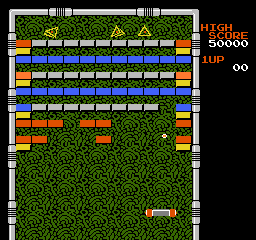
Each round places a formation of blocks above the Vaus. Players move the craft left and right to return an energy ball, aiming its rebounds into gaps and toward the remaining blocks while preventing it from falling below the screen. Clearing the destructible wall advances the journey to another layout. The ball’s angle is especially important: a return from the edge of the Vaus can send it across the board at a very different trajectory than a centered hit, so a rescue at the last moment can also be an opportunity to change the attack. Silver blocks take repeated impacts, while gold blocks cannot be destroyed, making each pattern a small problem in route planning as well as reflexes.
Falling capsules add the game’s changing tactical layer. Catching one can lengthen the Vaus, slow the energy ball, multiply the balls in play, or arm the craft with lasers; other effects can make the situation more difficult. Deciding whether to leave the safety of the ball’s expected path to chase a capsule is part of Arkanoid’s tension. Floating obstacles also drift into the field, disrupting shots but offering bonus points when hit. The NES manual identifies these hazards as debris from the destroyed planet, fitting the game’s sparse but distinctive space setting without slowing the fast, score-driven action.
The NES release supports one or two players, with players taking turns rather than sharing the same field. It can be played with the standard Nintendo controller, using the Control Pad to guide Vaus and the A Button to launch the ball or fire lasers. Taito also made a dedicated Arkanoid controller for the game: its rotary knob provides direct left-right movement and its fire button handles launching and laser shots. The controller connects to the NES’s second controller port and even includes an adjustment point for calibrating the knob, a notable attempt to bring the arcade dial-style feel into the home version.
This conversion is more than a straight copy of the arcade original. The Famicom/NES game adds three rounds before the final confrontation in the North American version, so DOH appears after a longer run of stages than in the Japanese release. Its underlying formula still reflects the arcade game that revived and popularized the brick-breaker style established by Breakout: a single screen, a bouncing ball, and increasingly awkward arrangements that reward careful recovery. Arkanoid’s power capsules, science-fiction presentation, and specialized controller help give this NES version its own identity among early home arcade conversions.
Progress becomes steadily less forgiving as layouts introduce tougher targets, unbreakable barriers, and awkward lanes for the ball to travel through. Extra balls and useful capsules can provide breathing room, but neither replaces the need to read the rebound and keep Vaus under control. Reaching the end means facing DOH, turning a long series of block-clearing rounds into a final test of the same fundamentals. For players exploring the NES library, Arkanoid remains a focused example of how a familiar arcade premise could be adapted around the console’s controls while retaining its quick restarts, escalating patterns, and distinctive hardware option.
Gallery
Details
- Developer
- Taito
- Publisher
- Taito
- Genre
- Breakout
- Players
- 1-2
- Release Date
- August 1, 1987
- System
- NES