About
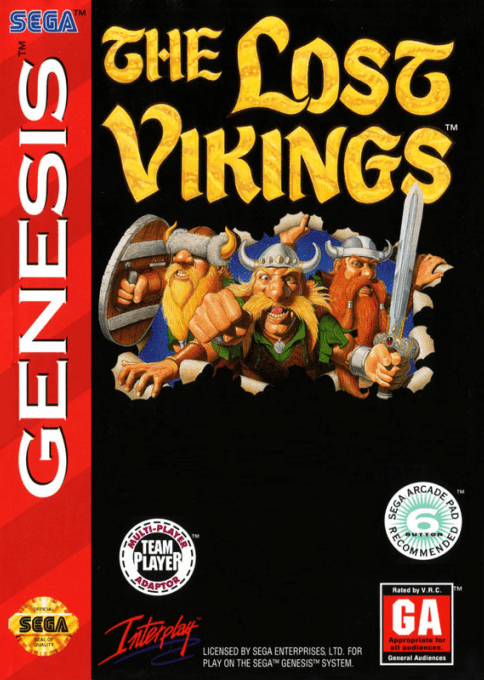
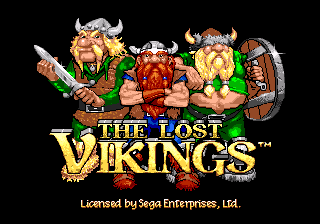
The Lost Vikings for Sega Genesis/Mega Drive is a puzzle-platform adventure developed by Silicon & Synapse and published by Interplay. Released in North America in January 1994, it brings the studio's 1993 console game to Sega hardware with a lighthearted science-fiction premise and levels built around cooperation. Erik the Swift, Baleog the Fierce, and Olaf the Stout are seized by Tomator, ruler of the Croutonian empire, for an alien collection. After escaping his ship, the three travelers must survive strange places across time and space and find a route back to their own era.
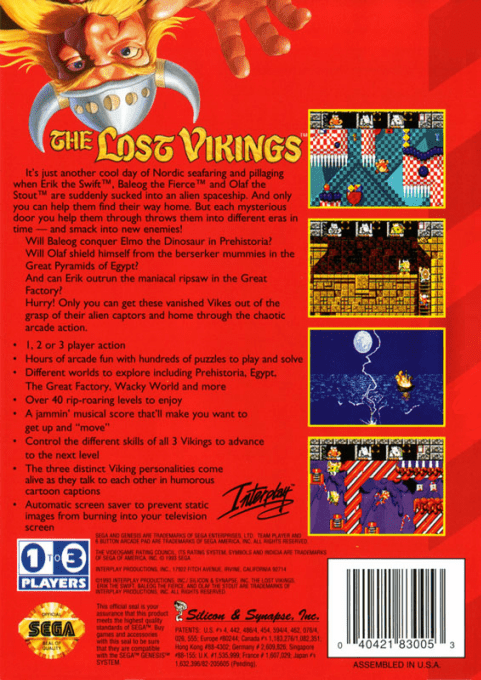
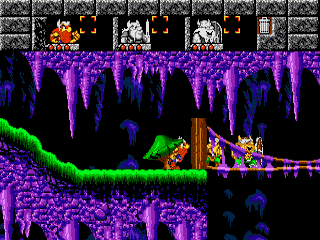
The essential idea is that all three Vikings have to reach each level's exit, but none can solve the route alone. The game is viewed from the side and asks the player to swap between the heroes, plan ahead, and make one character's talent create an opportunity for another. Keys, food, bombs, and other usable objects can be picked up, carried, and handed between nearby Vikings. Enemies, traps, switches, locked doors, lifts, and gaps turn every screen into a small problem whose solution depends on managing the whole group rather than simply reaching the right side of the stage.
Erik is the quickest of the trio. He can run, jump, and use his helmet to break certain walls or charge through obstacles. Baleog supplies the party's offense: his sword deals with threats at close range, while his bow can strike enemies and activate distant switches. Olaf carries a shield that stops attacks, doubles as a step for the others, and lets him glide. These abilities overlap just enough to encourage experimentation, yet their limits are what give the puzzles their shape. An arrow may open a path Erik cannot reach; Olaf may hold a position or make the platform that lets the others continue.
Progression demands care because a downed Viking can leave a level impossible to finish even if the remaining two are still alive. Health-restoring food and a stock of practical items therefore matter alongside timing and movement. The controls are deliberately direct, but the challenge comes from deciding who should act first, where to park a companion safely, and when to regroup. The game combines platform hazards with deliberate puzzle solving instead of treating combat as the only obstacle, so advancing often means reading the layout, testing an interaction, and then coordinating a sequence of actions.
Tomator's abduction gives the journey its playful framework, while the levels supply the variety: the Vikings pass through prehistoric scenery, Egyptian-themed areas, industrial spaces, and other far-flung environments. Short character exchanges and the exaggerated contrast between the heroes help distinguish them without interrupting the action for long. Erik is the eager mover, Baleog is the fighter, and Olaf is the defensive, food-loving problem solver. Their differing silhouettes and abilities also make it easier to see at a glance which member of the team is suited to the next task.
The Genesis/Mega Drive version is more than a change of hardware. It contains five stages beyond the 37 found in the original release, for a total of 42 levels, and supports one to three players locally. In a multiplayer session, the party still relies on all three Vikings, so cooperation becomes part of the challenge as players divide responsibility for the heroes. That makes this edition a distinctive choice for groups as well as for a solo player who prefers switching among the characters. It remains a side-scrolling game, but its pacing is set by coordinated decisions rather than constant forward motion.
The Lost Vikings also captures an early period in the history of Silicon & Synapse, the company later known as Blizzard Entertainment. Its combination of colorful fantasy, comic alien menace, and character-specific puzzle design gave the game a clear identity among 16-bit platform adventures. A follow-up, The Lost Vikings 2, arrived in 1997, while the original's three heroes later appeared in other Blizzard-related games. Those connections do not change the Genesis game's self-contained story, but they help explain why Erik, Baleog, and Olaf remained recognizable figures long after their first escape.
For players looking for a Sega Genesis/Mega Drive puzzle game with action-platform controls, The Lost Vikings is centered on a simple but demanding rule: every Viking matters. It rewards observation, orderly use of each character's tools, and patience with rooms that only open once the team is arranged correctly. The Sega release preserves the original quest to defeat Tomator and get home while expanding the stage count and allowing the three-person concept to be shared locally. Its mix of character switching, inventory use, environmental puzzles, and cooperative play makes each completed exit feel like a joint escape rather than a single hero's victory.
Gallery
Details
- Developer
- Silicon & Synapse
- Publisher
- Interplay
- Genre
- Platformer
- Players
- 1-2
- Release Date
- January 1, 1994
- System
- Genesis/Megadrive