About
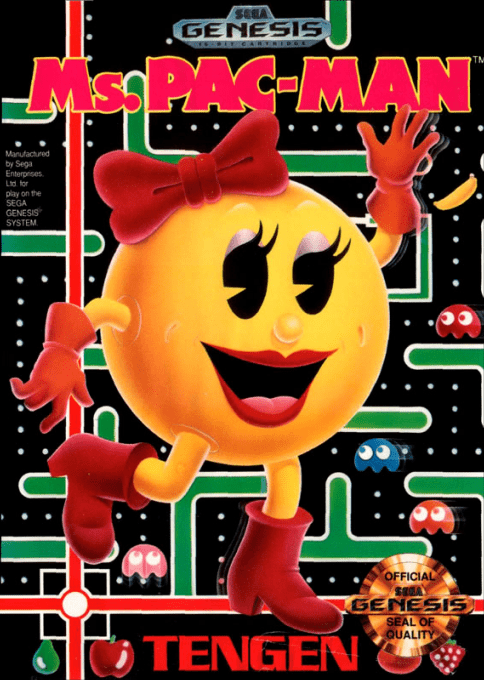
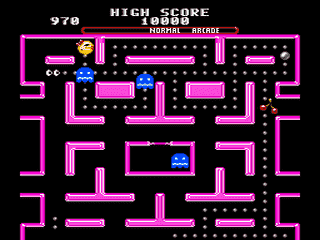
Ms. Pac-Man is a maze game in which the player guides Ms. Pac-Man through enclosed corridors, clearing every pellet while avoiding four pursuing ghosts. A touch from a ghost costs a life, so success depends on reading the maze, choosing safe turns, and keeping an escape route open. Each round ends only when every pellet has been eaten, after which the game moves to another maze and a faster, more demanding chase.
The familiar risk-and-reward system remains central. Four energizers let Ms. Pac-Man temporarily turn the ghosts blue and eat them for escalating point values, while eaten ghosts return to the central pen as eyes before joining the chase again. Fruit bonuses appear during a round for additional points. As play advances, the pace rises and the ghosts' vulnerable period grows shorter, making efficient routes and well-timed energizers increasingly important.
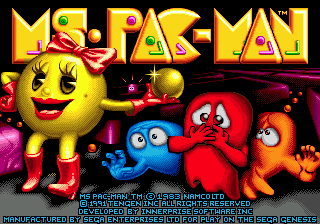
This 1991 Genesis/Mega Drive release is a 16-bit conversion of the arcade game, preserving its core pellet-clearing play, ghost threats, bonus fruit, and between-round scenes. The maze view scrolls vertically when the action moves beyond the visible portion of the television screen, rather than presenting the entire full-size board at once. Its arcade maze selection is faithful to the arcade layout, including the original game's four-maze rotation.
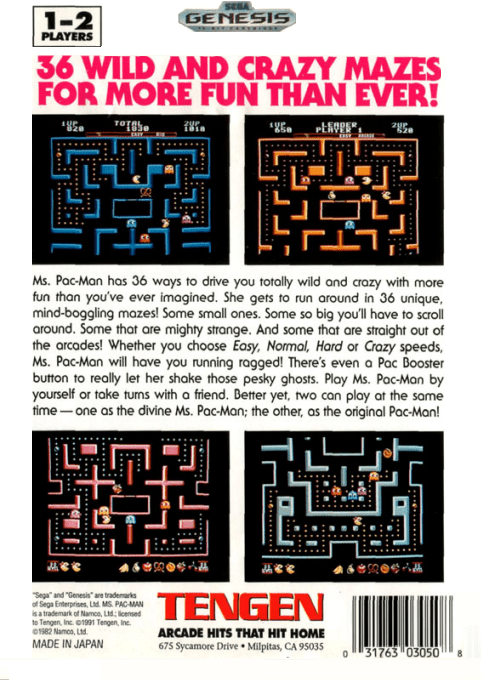
Where the arcade game offers its established maze sequence, this version adds a choice of four maze sets: Arcade, Mini, Big, and Strange. Arcade uses the original layouts; Mini offers smaller boards; Big supplies larger boards that scroll vertically; and Strange introduces alternate maze designs. The selection changes the shape and scale of the routes to be cleared while retaining the same fundamental chase and scoring rules.
The conversion also exposes play settings beyond the coin-op format. Players can select a difficulty, choose a limited number of continues, and use the Pac-Booster speed option. The booster lets the player character move much faster, creating a tradeoff between speed and control. These adjustments can be combined with the maze choices, giving the cartridge several distinct ways to approach the same basic game.
For one player, Ms. Pac-Man can be played alone; a two-player alternating option follows the traditional take-turns structure. The Genesis version additionally supports simultaneous two-player cooperative and competitive play, with the second player controlling Pac-Man. In cooperative play the pair work through a maze together, while competitive play turns pellet collection and scoring into a contest even as both players must contend with the ghosts.
Simultaneous play also changes how energizers affect the match. When either player takes an energizer, the ghosts enter their vulnerable blue state, but in competitive play the other player cannot collect dots while that state lasts. The other player can still take an energizer and reverse the effect. The two characters can collide as well, sending the struck character careening until a wall stops them, so close quarters can create both hazards and tactical opportunities.
The arcade source continues indefinitely as its difficulty cycles, but the Tengen-derived Genesis version gives every maze variation a defined conclusion. Play ends after round 32 and adds a fourth intermission, The End, in which Pac-Man and Ms. Pac-Man wave goodbye. That ending, the selectable maze sets, flexible options, and simultaneous Pac-Man-and-Ms.-Pac-Man play make this release an expanded home version rather than simply an arcade reproduction.
Gallery
Details
- Developer
- Innerprise Software
- Publisher
- Time Warner Interactive
- Genre
- Maze
- Players
- 1-2
- Release Date
- July 1, 1991
- System
- Genesis/Megadrive