About
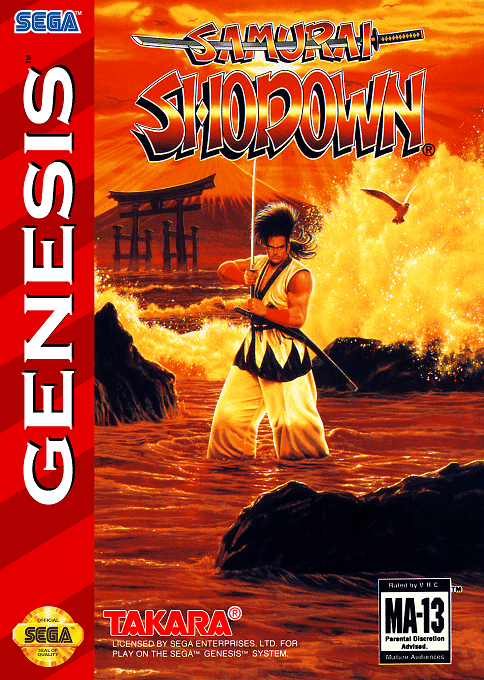
Samurai Shodown for Sega Genesis and Mega Drive brings SNK’s landmark weapon-based fighting game to Sega’s 16-bit console. This 1994 conversion, developed by Saurus from SNK’s 1993 Neo Geo original, is known as Samurai Spirits in Japan. Its late-18th-century setting, sword-and-spear duels, and cast of fighters set it apart from the contemporary wave of modern, bare-knuckle fighting games. The Mega Drive edition keeps the original’s emphasis on decisive individual strikes and tense spacing while adapting the experience to cartridge hardware.
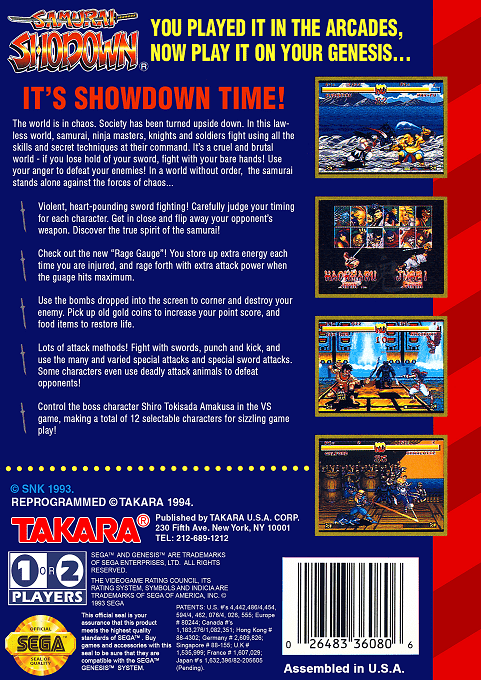
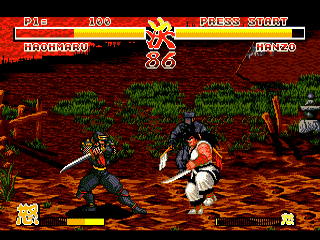
Players select a warrior and battle through one-on-one rounds against computer-controlled rivals, or face another player in versus play. Movement, jumps, crouches, guards, weapon attacks, kicks, and character-specific techniques make every matchup a contest of range and timing. Heavy blows can take a large portion of an opponent’s vitality, so success depends less on long automatic strings than on reading an opponent, defending at the right moment, and committing to an attack when an opening appears. Weapons are central to the action: being disarmed changes a fighter’s options until the weapon is recovered.
The adventure centers on a gathering threat in Japan. Shiro Tokisada Amakusa, returned through the influence of the dark god Ambrosia, seeks to spread chaos, and warriors from several countries converge for their own reasons. The roster includes wandering swordsman Haohmaru, nature-protecting Nakoruru and her eagle Mamahaha, kabuki performer Kyoshiro Senryo, American ninja Galford and his dog Poppy, and historical-inspired figures such as Hanzo Hattori and Jubei Yagyu. Each combatant has a distinct weapon, reach, special techniques, stage, and ending, giving the single-player path different character perspectives.
Samurai Shodown’s fights use dramatic details inherited from the arcade design, including a referee who signals successful hits with colored flags and occasional items that can enter a round. The game’s brisk exchanges reward a well-placed slash, while the varied international roster adds contrasting fighting styles to its stylized historical fantasy. Traditional Japanese instrumental colors in the music support the setting, even as the game moves from samurai duels to encounters with ninjas, nobles, thieves, and supernatural adversaries.
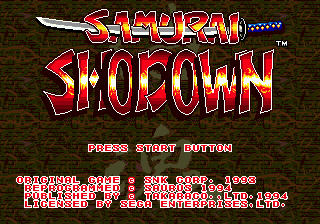
This Genesis/Mega Drive version is a specific, scaled-down interpretation of the Neo Geo game rather than a direct duplicate. It removes Earthquake and his stage, fixes the view at a close distance instead of using the arcade camera zoom, and changes or omits some attacks. Its opening is presented as text rather than the arcade’s full introductory sequence; it also leaves out post-match character art, some ending material, and much of the announcer’s character-name callouts. The changes provide larger on-screen fighters but a more confined arena.
The port nevertheless preserves the core duel-driven identity that made Samurai Shodown the opening entry in a long-running SNK series. Amakusa is available for two-player battles without a code, and the game offers a home-console route into its cast of weapon specialists. For Genesis and Mega Drive players, Samurai Shodown remains a distinctive 1994 fighting game: a conversion shaped by technical compromises, but still built around careful distance, individual character tools, and the danger of one clean sword strike.
Gallery
Details
- Developer
- SNK
- Publisher
- Saurus
- Genre
- Fighting
- Players
- 1-2
- Release Date
- January 1, 1994
- System
- Genesis/Megadrive