About
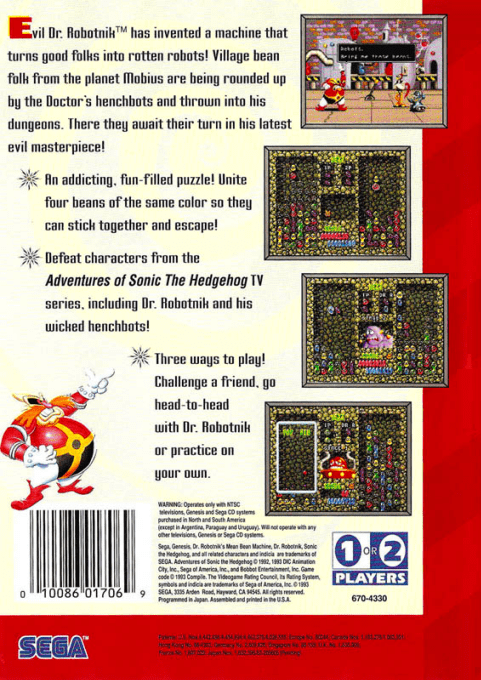
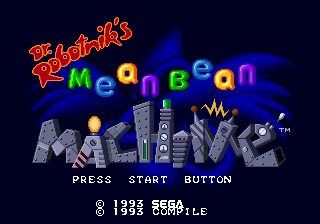
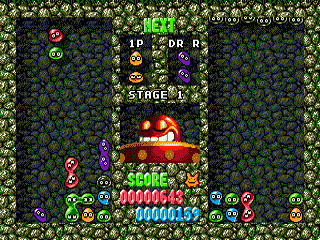
Dr. Robotnik's Mean Bean Machine is a competitive falling-block puzzle game for the Sega Genesis/Mega Drive, developed by Compile and published by Sega in 1993. Its bright Sonic presentation disguises a demanding match-and-chain game: pairs of colored beans descend into a tall playfield, and the player slides or rotates them before they land. Form a connected group of four or more beans of the same color and it disappears, potentially dropping the beans above into another match.
That simple rule produces the game’s central thrill. A modest clear can set off a chain reaction, and a well-built board can turn one final placement into several waves of disappearing beans. Chains attack the opposing field by dropping gray nuisance beans there. Those obstacles do not vanish in ordinary color groups; a player must clear matching beans next to them. The round ends when a player’s stack reaches the top of the board, so fast decisions, clean layouts, and the ability to recover from a messy field matter as much as planning elaborate combos.
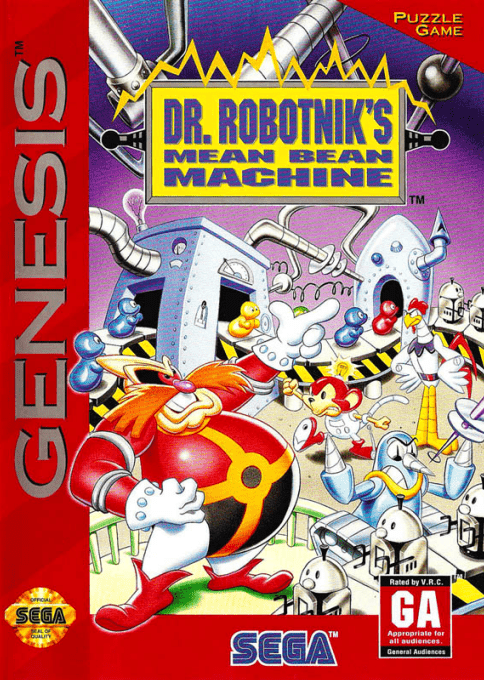
The Genesis version frames that puzzle contest with Doctor Robotnik’s Beanville scheme. Robotnik has captured the bean-like residents and intends to run them through his Mean Bean-Steaming Machine, turning them into obedient robotic servants. The player is Has Bean, the renamed version of Puyo Puyo’s Carbuncle, battling through Robotnik’s strange henchbots to prevent the plan. The cast, portraits, dialogue, and cartoon tone draw especially from the Adventures of Sonic the Hedgehog animated series, giving the game an identity quite unlike its Japanese source.
Scenario Mode is the main single-player challenge. It sends Has Bean through thirteen computer-controlled opponents whose speed, pressure, and willingness to use chains steadily increase. Each confrontation is a direct head-to-head puzzle duel rather than a conventional Sonic-style stage, and that structure makes every victory feel like a lesson in reading the board under pressure. Early opponents introduce the pace, while later rivals punish careless stacking and force players to understand how nuisance beans can be redirected through a strong chain.
The cartridge also includes Exercise Mode for practicing without the same campaign progression and a one-player-versus-two-player mode for local competition. Two players share the basic objective but generate constant interference for one another, making a round swing quickly when one side converts a small setup into a long sequence. The accessible controls and instant visual feedback make it easy to begin, yet the tactics around leaving useful colors in place, opening space for future drops, and choosing when to trigger a chain give repeat sessions considerable depth.
Mean Bean Machine is a Western adaptation of Compile’s 1991 Puyo Puyo, one of the games that established the formula later known for colored-blob puzzle battles. Sega replaced most of that game’s fantasy setting and characters with Robotnik’s bean-themed cast for overseas audiences, while preserving the core paired-piece, four-match, and nuisance-attack design. That history makes the Genesis release both a Sonic spin-off and a significant early English-language showcase for Puyo Puyo’s competitive system.
The game has remained visible through later Sega and Sonic collections, including Sonic Classics, Sonic Mega Collection, Sonic’s Ultimate Genesis Collection, and Sega Genesis Classics, as well as the Genesis Mini lineup. Its presentation is rooted in the early 1990s, but the rules stay immediately readable: arrange colors, clear groups, make chains, and survive the other player’s attack. For puzzle fans exploring the Genesis library, Dr. Robotnik’s Mean Bean Machine offers a polished, lively duel game whose friendly cartoon surface conceals a sharply escalating challenge.
Gallery
Details
- Developer
- Compile
- Publisher
- SEGA
- Genre
- Logic Puzzle
- Players
- 1-2
- Release Date
- December 1, 1993
- System
- Genesis/Megadrive