About
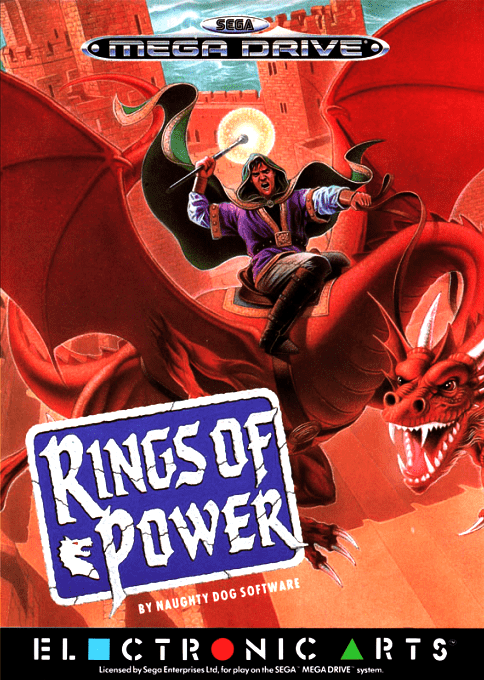
Rings of Power for the Sega Genesis, known as the Mega Drive in many regions, is a single-player fantasy role-playing game developed by Naughty Dog and published by Electronic Arts in 1992. It casts the player as Buc, an apprentice sorcerer sent across the world of Ushka Bau to prevent the destructive god Void from recovering the pieces of the Rod of Creation. Those pieces are the eleven titular rings, and finding them requires much more than marching through a fixed sequence of dungeons: the game presents a broad isometric world with towns, wilderness, secrets, and routes to explore.
Buc begins the adventure as a student of the Art of the Mind, one of six magical disciplines in the setting. His larger mission is to build a party that represents the other arts as well, recruiting companions such as the knight Slash, necromancer Mortimer, archer Feather, conjuror Alexi, and enchanter Obliky. The party’s composition matters because its members bring different spell capabilities to encounters. Rather than relying on conventional swords, armour, and equipment progression, Rings of Power centers its combat and character growth on magic, party management, experience, and the careful use of each adventurer’s available strength and magical reserves.
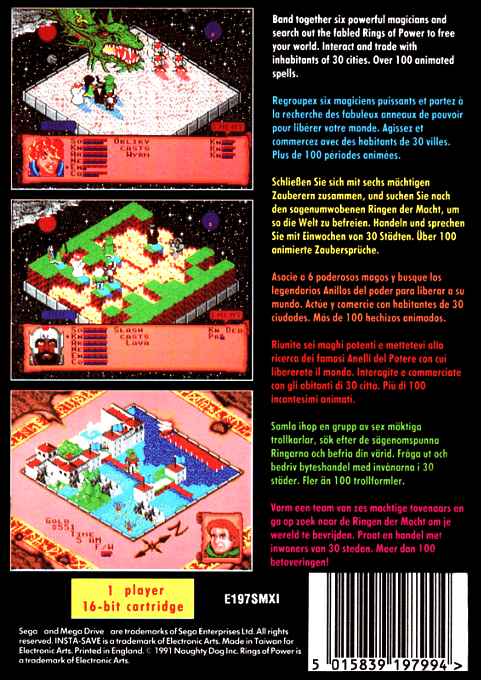
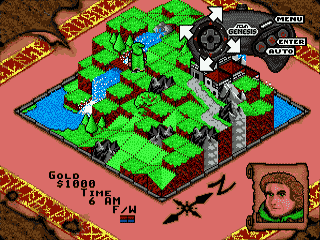
Exploration is viewed from an angled overhead perspective and uses diagonal movement, giving the Genesis game a markedly different feel from side-scrolling action titles on the system. Buc can speak with the inhabitants of Ushka Bau for clues, quest information, and leads on the rings. Money can be used in conversations, including to obtain information or gain access to certain places, while camping restores the party and advances time. A day-and-night cycle changes the world’s routines, so some objectives or encounters must be approached at the appropriate time rather than immediately after they are discovered.
Travel is a major part of the design. The party can make its way over land and use several kinds of transport, including boats, ships, dinosaurs, and dragons, to reach more distant areas. Magical gateways also link parts of the world. This freedom gives Rings of Power a more open-ended structure than many console RPGs of its era: players can investigate settlements, gather knowledge, and decide which leads to follow as they work toward the central hunt for the eleven rings. The scale of its map and the amount of written dialogue make observation and note-taking useful parts of the journey.
When combat begins, Buc’s group faces enemies in turn-based battles. Players can choose spells directly or let the game select them automatically, and can adjust how aggressively party members behave. Damage lowers a character’s strength, while spellcasting draws on magic; depleted resources make a party less effective until it has a chance to recover. Victories provide currency and experience, and experience supports access to stronger magic. The result is an RPG built around preparing a six-person team and deciding when to fight, rest, travel, bargain, or pursue another thread of the adventure.
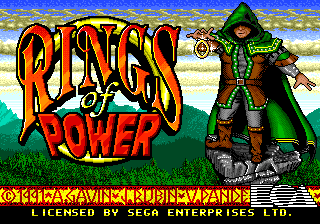
Rings of Power also occupies an interesting place in Naughty Dog’s early history. Conceived under the working title Buccaneer and initially planned for computers, the project became the studio’s first console release when development shifted to Sega’s 16-bit hardware. Andy Gavin and Jason Rubin created it while finishing college, with Vijay S. Pande also contributing to its design and programming. Its ambitious isometric setting, magic-focused party system, battery-backed saving, and unusually large quest-driven world make Rings of Power a distinctive early Genesis/Mega Drive role-playing game and an important early chapter for the developer behind later console series.
Gallery
Details
- Developer
- Naughty Dog
- Publisher
- Electronic Arts
- Genre
- JRPG
- Players
- 1
- Release Date
- February 1, 1992
- System
- Genesis/Megadrive