About
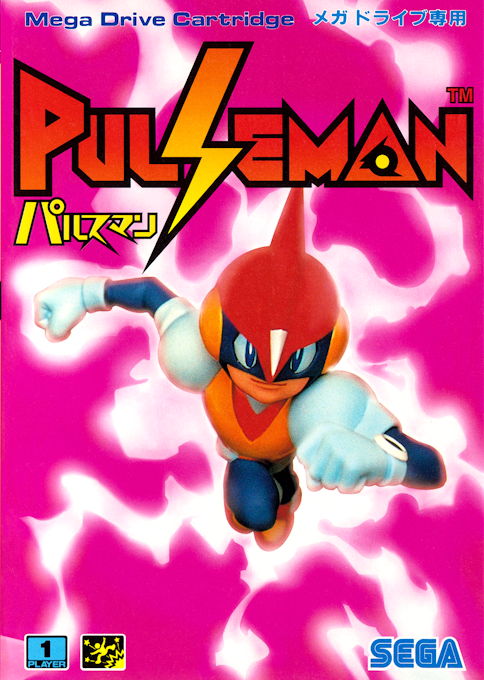
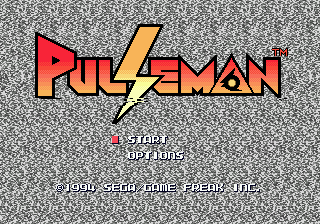
Pulseman Genesis/Mega Drive is a single-player action-platform game developed by Game Freak and published by Sega. It first arrived on cartridge in Japan on July 22, 1994, when Sega’s 16-bit machine was known there as the Mega Drive. North American players later encountered it through the Sega Channel service in 1995 rather than a retail Genesis cartridge release. The game places a brightly colored electronic superhero in a near-future struggle against cybercrime, combining fast traversal, stage hazards, and combat built around electrical energy.
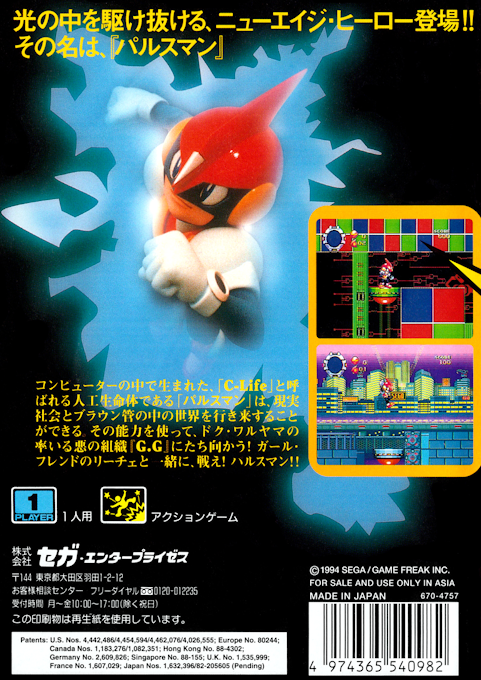
The story begins with computer engineer Doc Yoshiyama and his advanced artificial life project, C-Life. Their connection produces Pulseman, a boy who is part human and part digital life form and can exist beyond the computer world. Yoshiyama is subsequently corrupted and re-emerges as Dr. Waruyama, leader of the Galaxy Gang. Pulseman sets out to stop the organization’s technological attacks, giving the adventure a science-fiction premise that moves between physical locations and computer-themed spaces.
Pulseman’s defining ability is the charge he builds while moving. Running fills his electrical power, and that charge can be spent on attacks or on the Volteccer, a high-speed transformation that sends him racing as a ball of electricity. The move can break through enemies and ricochet from surfaces, turning precise timing and the shape of a room into part of the challenge. Power lines and other electrical routes also give the hero distinctive ways to cross sections of a level, so momentum is useful for more than simply reaching the next platform.
The game is structured as an escalating series of stages with regular foes, traps, alternate paths, and major encounters. A basic projectile gives Pulseman an option at range, while close combat and charged movement keep the player shifting between offense and mobility. Platform layouts reward learning when to preserve a charge, when to release it, and how a Volteccer bounce will change direction. These ideas make the controls central to the game’s progression rather than treating the electric theme as decoration alone.
Game Freak brought a deliberately animated, comic-book-like cast and a vivid electronic world to Sega’s hardware. Ken Sugimori directed the project, while Satoshi Tajiri, Atsuko Nishida, and Junichi Masuda were among the staff associated with its development before the team became widely known for the Pokémon series. Masuda later recalled handling programming, sound effects, and music work on Pulseman, including technical effects suited to the Mega Drive’s FM sound hardware. That connection places the game in an important early period for the studio, while its design remains its own self-contained Sega release.
The original Japanese edition is the key version for Pulseman’s 1994 release history: it was sold for Mega Drive in Japan, whereas the 1995 North American appearance was distributed through Sega Channel. Sega later brought the game back through Wii Virtual Console releases, allowing a wider audience to access the same 16-bit adventure. For players exploring Game Freak’s work outside its later monster-collecting series, Pulseman stands as a focused platform game whose hero, story, and mechanics are all tied to the idea of electricity in motion.
Gallery

Details
- Developer
- Game Freak
- Publisher
- SEGA
- Genre
- Platformer
- Players
- 1
- Release Date
- July 22, 1994
- System
- Genesis/Megadrive