About
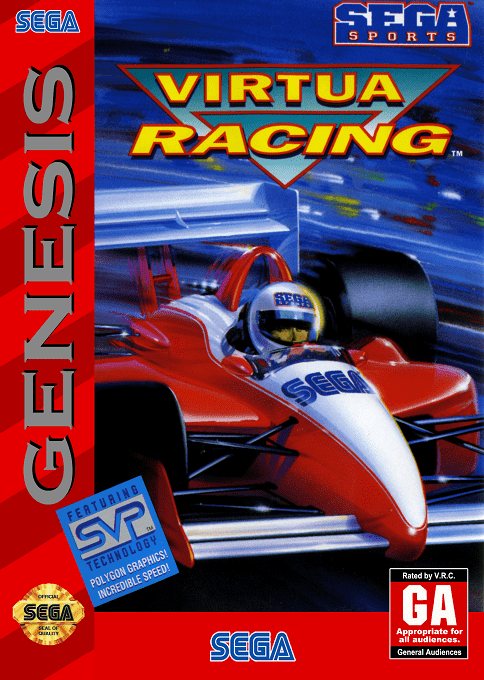
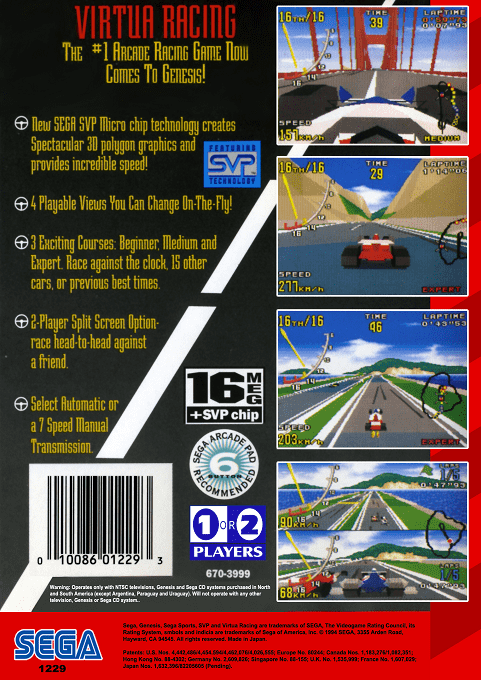
Virtua Racing for Sega Genesis and Mega Drive is Sega's 1994 home conversion of the 1992 Model 1 arcade racer. Developed and published by Sega, it puts the player in a single-seat, open-wheel racing car and condenses the arcade game's polygonal circuits for Sega's 16-bit console. Its most unusual feature is the cartridge itself: it contains the Sega Virtua Processor, or SVP, an additional processor that helps the Genesis/Mega Drive draw the game's real-time 3D racing world.
The basic goal is direct and demanding: finish each race ahead of the computer-controlled field before the clock expires. Steering guides the car through sweeping bends, sharp turns, elevation changes and roadside hazards, while acceleration and braking determine whether a fast entry becomes a clean corner or an expensive trip onto the grass. Checkpoints extend the remaining time, so a steady racing line matters as much as outright speed. The home version keeps the arcade game's approachable, immediate handling rather than presenting a detailed Formula One simulation.
Three circuits provide the progression, arranged from the introductory Big Forest to Bay Bridge and the more exacting Acropolis course. Each route has its own visual identity and cornering demands: Big Forest runs through an amusement-park setting, Bay Bridge is built around its broad span, and Acropolis tests drivers with tighter sections and a notable hairpin. A practice-minded player can learn braking points and work toward faster laps, while the competitive format also supports two players. The split-screen race turns the same short circuits into a contest for position as well as survival against the timer.
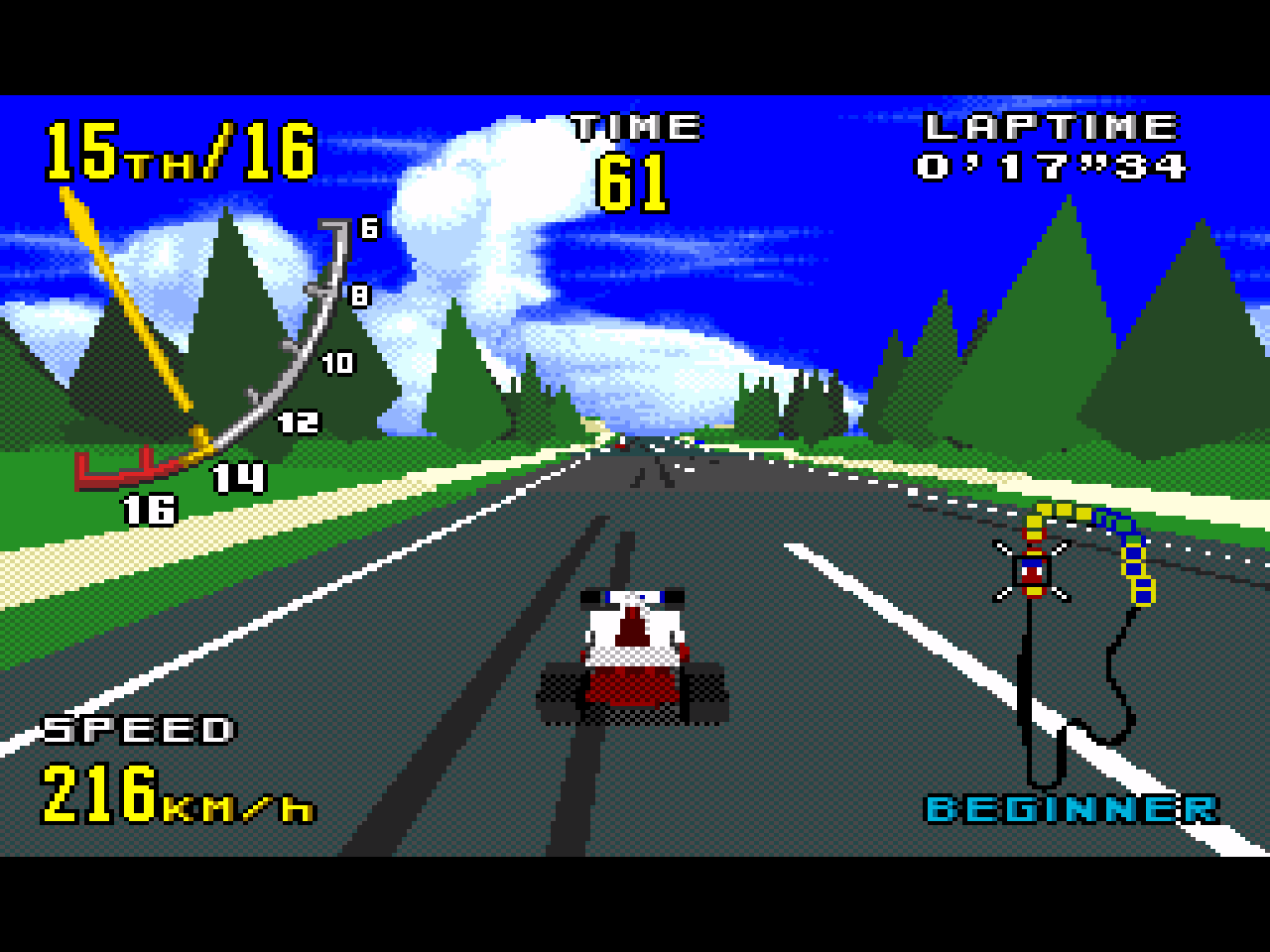
Virtua Racing also brought one of the arcade original's defining presentation ideas to the Genesis/Mega Drive: selectable viewpoints that can be changed during a race. Players can move between external chase-style angles, a higher overview and a driver-oriented perspective, altering how they judge turns and nearby rivals. The angular cars, scenery and trackside objects are part of the game's deliberate polygon look, and the SVP makes that moving 3D presentation possible on hardware that normally relied on sprite and tile-based visuals. This makes the cartridge a technical showcase as well as a racing game.
This Genesis/Mega Drive release should not be confused with Virtua Racing Deluxe for the Sega 32X. That later 32X version adds vehicles and circuits and differs substantially in its presentation, while the Saturn edition was another separate release with its own extra content. The 1994 Genesis/Mega Drive game is instead the SVP-equipped conversion with the original three-course structure. Its cartridge was unusually costly to produce, and Virtua Racing ultimately remained the only Genesis/Mega Drive game to use the SVP.
The game arrived during Sega's early push to bring its 3D arcade technology into the home. Virtua Racing's arcade debut helped establish the visual language later associated with Sega driving games: polygonal roads, rival cars in a shared 3D space, changing camera angles and the sensation of speed created by a receding track. On Genesis and Mega Drive, the conversion necessarily simplifies the Model 1 original, but it preserves the central race-against-the-clock design and demonstrates an ambitious attempt to bridge arcade and console hardware in 1994.
Gallery

Details
- Developer
- SEGA
- Publisher
- SEGA
- Genre
- Racing & Driving
- Players
- 1-2
- Release Date
- March 14, 1994
- System
- Genesis/Megadrive