About
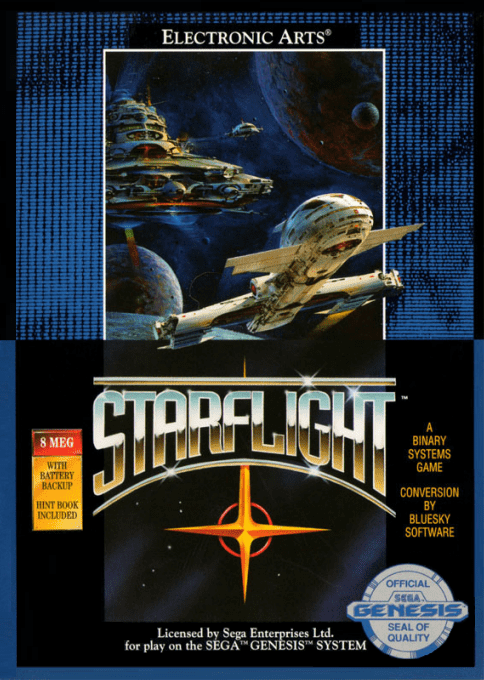
Starflight for Sega Genesis and Mega Drive is a 1991 single-player space-exploration role-playing game published by Electronic Arts and converted for the console by BlueSky Software. It adapts the earlier Binary Systems computer game into a cartridge adventure while retaining its wide-open interstellar premise. As captain of an Interstel ship from the colony world of Arth, the player leaves Starport to investigate a region full of unexplored systems, unfamiliar civilizations, valuable resources, and clues to a much older catastrophe.
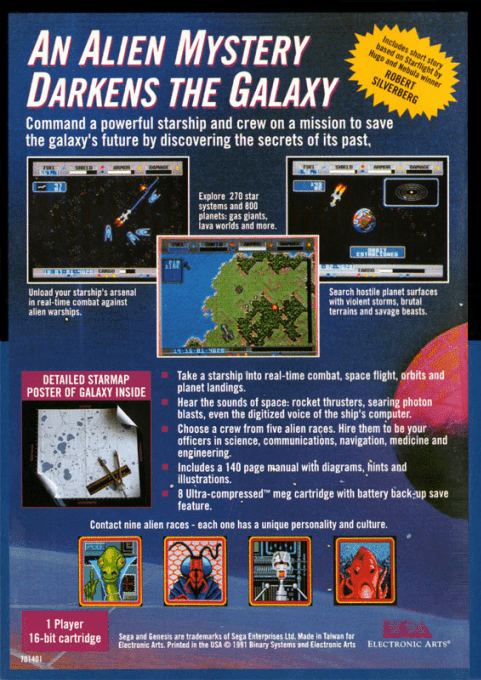
The voyage begins with practical preparation rather than a fixed mission route. At Starport, players recruit a crew, assign people to shipboard roles, train their skills, buy fuel, and spend earnings on upgrades such as equipment, defenses, and weapons. Crew composition matters because different species have different aptitudes and skill limits. The ship can be improved over time, so early expeditions for minerals, biological samples, artifacts, and colonization data become the means to fund longer and more dangerous journeys.
Exploration in Starflight Genesis moves between a star map, space flight, orbit, and planetary landings. The science officer evaluates worlds for conditions including gravity and composition before the captain commits to a descent. On a planet, the crew uses a Terrain Vehicle to travel across the surface, scan its surroundings, recover minerals and lifeforms, and search for ruins or other discoveries. Selling useful finds and recording promising colony worlds gives exploration an economic purpose, while fuel use and the hazards of travel make route planning important.
Not every encounter is a resource run. The galaxy is inhabited by several distinct spacefaring peoples, and contact can lead to conversation, trade, intimidation, or combat. Players choose how to hail other vessels and must react to the behavior of groups such as the merchant-minded Thrynn, plantlike Elowan, and the persistent Veloxi. Ship battles use maneuvering alongside short-range lasers and more distant missiles, but diplomacy and careful questioning can reveal information that weapons cannot. Continuum fluxes offer rapid travel between paired points in space, creating another useful tool for reaching distant areas while demanding capable navigation.
The wider story unfolds through those discoveries instead of being delivered all at once. Arth’s inhabitants are rediscovering the technology and history of the fallen Old Empire, and reports of stars flaring across the region gradually turn exploration into an urgent investigation. Alien testimony, abandoned vessels, artifacts, and remote worlds can all provide parts of the larger picture. This structure lets a player spend time mining, mapping, improving a ship, or following narrative leads, while the central threat gives the open-ended journey a clear long-term objective.
BlueSky Software’s Genesis/Mega Drive version is more than a simple change of hardware. It was rebuilt for the 16-bit console with revised presentation and alterations to the ship and terrain vehicle systems; the vehicle receives additional equipment that supports amphibious mining. Electronic Arts released the conversion in 1991, five years after the original PC debut, bringing Starflight’s blend of crew management, planetary expeditions, alien contact, trading, and space combat to Sega’s library. It remains the first game in the Starflight series; Starflight 2: Trade Routes of the Cloud Nebula followed on computers but was not a Genesis sequel.
Gallery
Details
- Developer
- BlueSky Software
- Publisher
- Electronic Arts
- Genre
- JRPG
- Players
- 1
- Release Date
- January 1, 1991
- System
- Genesis/Megadrive