About
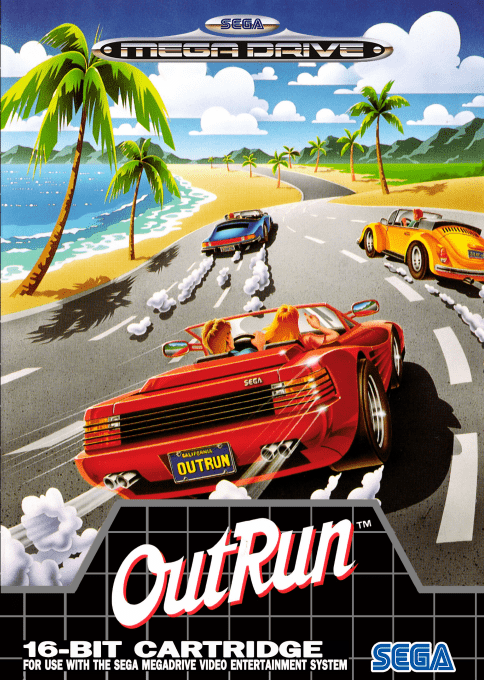
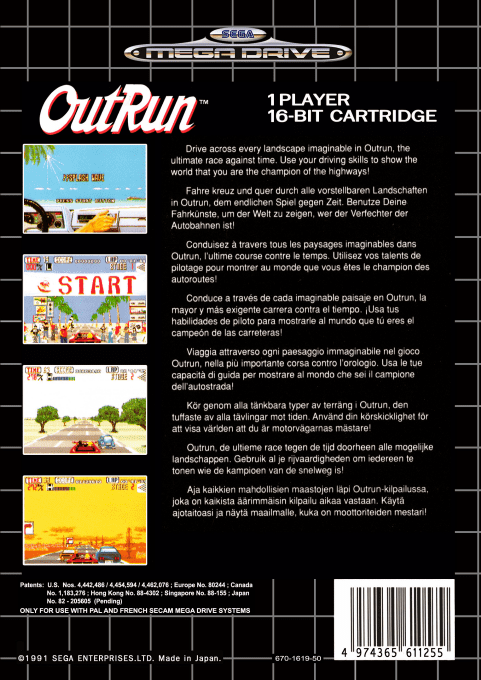
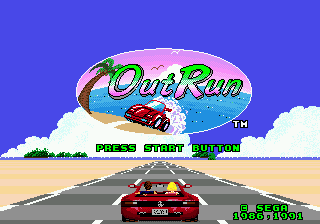
OutRun for Genesis/Mega Drive is Sega's 1991 16-bit home conversion of the company’s landmark arcade driving game. Published by Sega, the cartridge brings the series’ sunny, European-inspired road trip to a single player armed with a red convertible, a passenger in the seat beside them, and a strict countdown clock. Rather than presenting a conventional race against a field of named rivals, OutRun frames the action as a rapid journey toward a chosen destination. Every run begins with a music selection and asks the driver to keep moving through traffic, hills, bends, and changing scenery before time runs out.
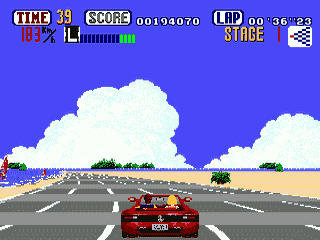
The view sits just behind the car, making the road’s rises, dips, and sweeping curves as important as the vehicles ahead. Steering requires a balance between speed and control: leaving the road, colliding with traffic, or striking roadside hazards costs valuable momentum. Acceleration, braking, and a two-speed manual transmission give the player direct responsibility for keeping the car composed, with lower gear useful for difficult sections and high gear built for open stretches. Checkpoints extend the timer, so a strong run is about reaching each marker cleanly enough to earn the seconds needed for the next leg.
OutRun’s defining structure is its branching route map. At the end of a stage, a fork presents a left-or-right decision, and that choice determines the next environment and the eventual finish. The Mega Drive version contains the familiar network of 15 course segments, leading to five destinations through a variety of landscapes. Routes can carry the drive past coastal roads, desert scenery, ancient-looking arches, windmills, and urban streets, while the sequence of choices creates different journeys from the same starting point. Reaching a destination produces one of several closing scenes, giving players reason to explore routes beyond simply surviving their first trip.
This Genesis/Mega Drive edition is a conversion of Yu Suzuki’s 1986 arcade original, not the separate Master System, Game Gear, or later 3D releases. The arcade cabinet’s specialized scaling hardware and motion setup are naturally absent on the home console, but the port preserves the behind-the-car perspective, time-limit format, route choices, traffic avoidance, and two-gear driving model that define the game. Its focus remains the sensation of a fast drive through stylized locations rather than vehicle customization, championship standings, or head-to-head multiplayer.
Music is central to the experience. The driver chooses from the arcade favorites “Magical Sound Shower,” “Splash Wave,” and “Passing Breeze” before setting out, with “Last Wave” associated with the results sequence. The Mega Drive conversion also adds “Step on Beat,” an extra composition for this version, expanding the in-car radio selection to four songs. That feature suits OutRun’s deliberately relaxed fantasy of a scenic escape: the soundtrack continues while the player watches the road, chooses a direction at each fork, and tries to turn a short arcade-style run into a complete cross-country cruise.
Released in Japan in August 1991 and internationally that year, OutRun arrived on the Mega Drive, known as the Genesis in North America, several years after the original arcade hit and after earlier 8-bit Sega versions. It stands as the 16-bit cartridge interpretation of a game that helped establish Sega’s driving-game identity, while remaining distinct from follow-ups such as Turbo OutRun, OutRunners, and OutRun 2. For Genesis/Mega Drive players, its appeal lies in immediate controls, memorable routes, selectable music, and the simple challenge of learning which roads lead to each of the five goals.
Gallery
Details
- Developer
- SEGA
- Publisher
- SEGA
- Genre
- Racing & Driving
- Players
- 1
- Release Date
- October 1, 1991
- System
- Genesis/Megadrive