About
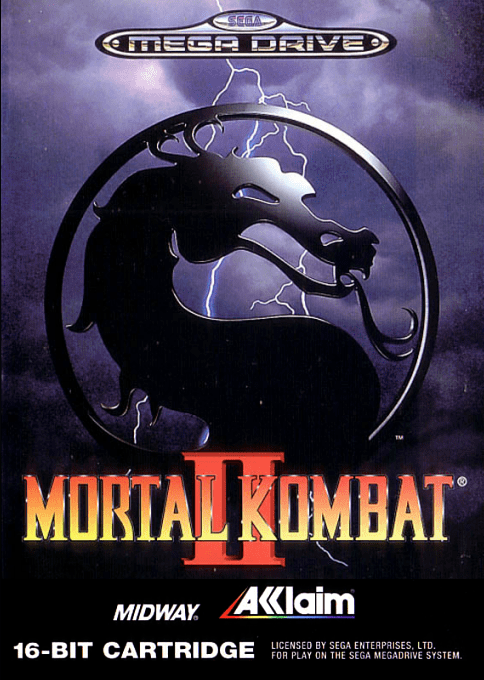
Mortal Kombat II on Genesis/Mega Drive is Probe Software's 16-bit conversion of Midway's 1993 arcade fighter, published by Acclaim and released for the console on September 9, 1994 as part of the simultaneous "Mortal Friday" home launch. It continues the first tournament's story: after Liu Kang defeats Shang Tsung, the sorcerer persuades his master Shao Kahn to lure Earth's surviving warriors into a new contest in Outworld. The single-player ladder culminates against Shang Tsung, the four-armed Kintaro, and Emperor Shao Kahn, while the Versus mode lets two players fight, including mirror matches between identical characters.
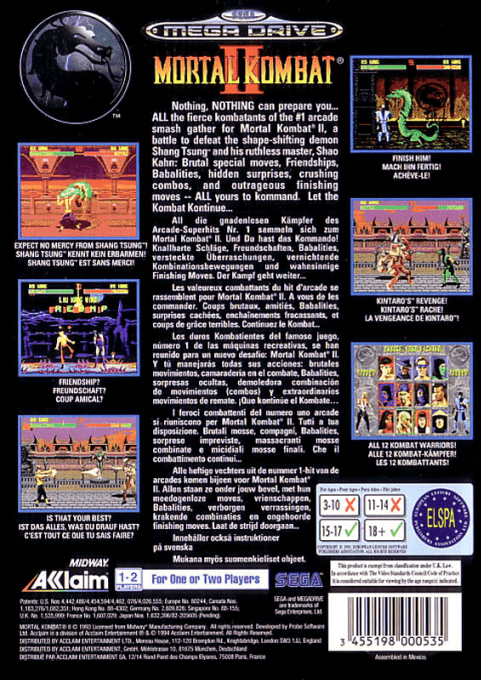
The 12-character selectable roster retains Liu Kang, Johnny Cage, Raiden (spelled Rayden in this port), Sub-Zero, Scorpion, Reptile and the rejuvenated Shang Tsung. It adds the blade-armed Baraka, Special Forces officer Jax, Shaolin descendant Kung Lao, and the rival female assassins Kitana and Mileena. Kano and Sonya are not selectable; they appear chained in the background of Kahn's Arena. Jade, Smoke and Noob Saibot remain hidden challengers rather than normal selection-screen fighters, giving the port secret encounters beyond the regular ladder.
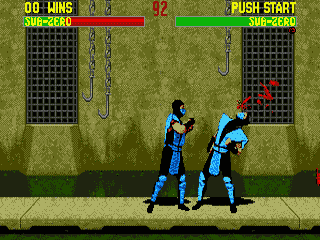
Combat is fast, round-based one-on-one fighting: take two rounds by draining the opponent's life bar, then use the brief "Finish Him/Her" window for a finisher. The sequel expands the original's move set with a crouching punch, more distinct high and low kicks, stronger roundhouses, reduced recovery after attacks, and new specials for returning fighters. Players combine directional inputs with high and low punches, high and low kicks, and block; throws, projectiles, teleports, flying attacks and character-specific special moves create the familiar spacing and counterplay.
Its finishers are central to the game’s identity. Alongside multiple Fatalities for most characters, Mortal Kombat II introduced Babalities and Friendships as comic alternatives, and its arenas support stage Fatalities such as sending an opponent into the Dead Pool, ceiling spikes or the Kombat Tomb. The Genesis version keeps the blood and Fatalities enabled by default, unlike the original Genesis Mortal Kombat, which required a blood code. It also includes some port-specific animation differences, exclusive Easter eggs, and Sega Activator support.
A hidden Test Mode can be added from the Options screen by highlighting Done and entering Back, Down, Back, Forward, Down, Forward, Back, Back, Forward, Forward. Its switches include options such as one-hit kills and the "Oooh Nasty" setting. With that setting enabled, Rayden can perform the Genesis-only Fergality in the Armory, turning the defeated opponent into Probe programmer Fergus McGovern. The port also retains secret-fight conditions for Jade and Smoke and requires 25 consecutive two-player victories to face Noob Saibot, rather than the 50 associated with the arcade version.
The cartridge is a comparatively full-featured 16-bit conversion, but it is not identical to the arcade machine: its graphics, audio and animations are adapted to Genesis hardware, while its play options and secrets give it a character of its own. It arrived in North America as Mortal Kombat II and in Europe under the Mega Drive branding. Regional censorship is most notable in the Japanese Super Famicom release of the game, where blood was recolored green and character-specific lethal Fatalities were obscured in black and white; that treatment should not be mistaken for the standard Genesis/Mega Drive version’s default red blood and uncensored finishers.
The game’s Outworld setting, digitized actors, savage finishing moves and dense secrets made it a defining early-1990s fighting game. For a Genesis player, its appeal is the complete core roster, brisk competitive matches, a substantial ladder of bosses and hidden opponents, and enough secret-mode material to reward continued local play after the first credits roll.
Gallery
Details
- Developer
- Probe Software
- Publisher
- Acclaim
- Genre
- Fighting
- Players
- 1-2
- Release Date
- September 9, 1994
- System
- Genesis/Megadrive