About
Beneath a Steel Sky is a 1994 cyberpunk point-and-click adventure from British studio Revolution Software, published by Virgin Interactive. The game originally reached Amiga and MS-DOS computers, placing its story in a damaged future Australia where vast city-states have displaced the world beyond their walls. It follows Robert Foster, a man raised in the outback region known as the Gap, after armed agents destroy his community and take him to Union City. A crash gives Robert the chance to escape, beginning a single-player journey through a meticulously controlled metropolis.
Robert is not entirely alone. His closest companion is Joey, an outspoken artificial intelligence whose personality is carried on a circuit board rather than tied to one machine. That small design detail becomes central to the adventure: Joey can be installed in suitable robotic bodies encountered during the story, creating both practical puzzle opportunities and characterful exchanges. Together, Robert and Joey work their way from the city’s upper levels toward its less polished districts, looking for a route out while discovering why Union City wanted Robert in the first place.
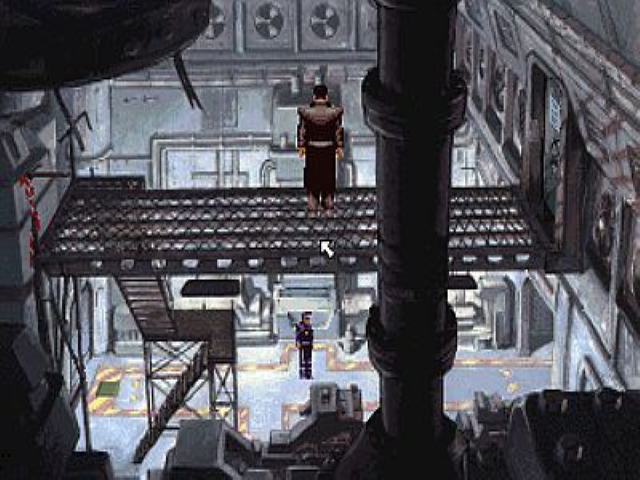
Gameplay uses a third-person, point-and-click interface built around examining locations, collecting objects, talking to residents, and finding logical uses for inventory items. Players direct Robert with the mouse, choose objects in the environment, and combine or present items when a problem calls for them. Conversations supply leads as well as atmosphere, while the city’s workers, officials, and other inhabitants reveal how thoroughly daily life is shaped by the system above them. Progress comes from observation and experimentation rather than combat, although some situations can put Robert in danger and send the player back to a saved game.
Union City gives the adventure its distinctive setting. The glittering, corporate façade is balanced against polluted surroundings, social division, surveillance, recycling facilities, transit tunnels, and people trying to survive under rules they did not choose. At the center is LINC, the computer network that governs the city’s routines and security. As Robert moves through its connected spaces, a kidnapping mystery grows into a larger story about identity, control, artificial intelligence, and the human cost of an orderly society. The dialogue allows a serious premise to coexist with dry humor, much of it supplied by Joey’s blunt reactions to his changing mechanical circumstances.
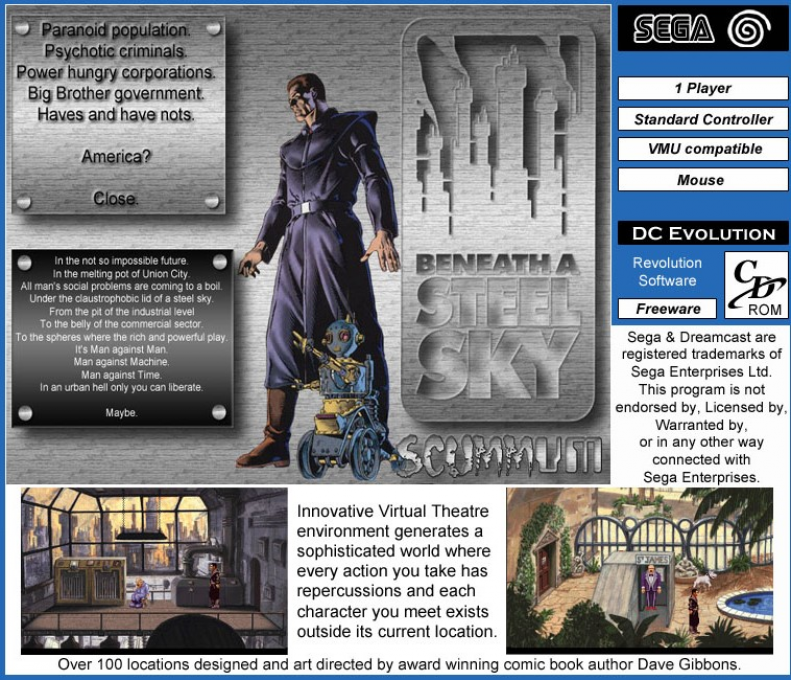
Beneath a Steel Sky was created with Revolution’s Virtual Theatre technology, an engine also used for the studio’s earlier Lure of the Temptress. Its visual identity came from a collaboration with comic artist Dave Gibbons, whose work shaped the game’s characters, backgrounds, and opening comic-book sequence. The original release appeared on floppy disks and CD-ROM, with the CD version adding spoken dialogue. An Amiga CD32 edition also used the format’s audio and voice capabilities. These versions preserve the same puzzle-driven structure while reflecting the storage and presentation differences of their respective hardware.
The game remains an important early work from Revolution Software, later known for the Broken Sword series. In 2003, Revolution made the original game available as freeware and released source material that helped support it through ScummVM. A remastered iOS edition followed in 2009 with touch-oriented controls, hints, improved audio, and new animated material based on Gibbons’s artwork. Its world was eventually revisited by the sequel Beyond a Steel Sky, but the 1994 adventure stands on its own as Robert Foster’s escape from Union City and an enduring example of story-led computer adventure design.
Gallery
Details
- Developer
- Revolution Software
- Publisher
- Virgin Interactive Entertainment
- Genre
- Graphic Adventure
- Players
- 1
- Release Date
- April 11, 1994
- System
- Dreamcast