About
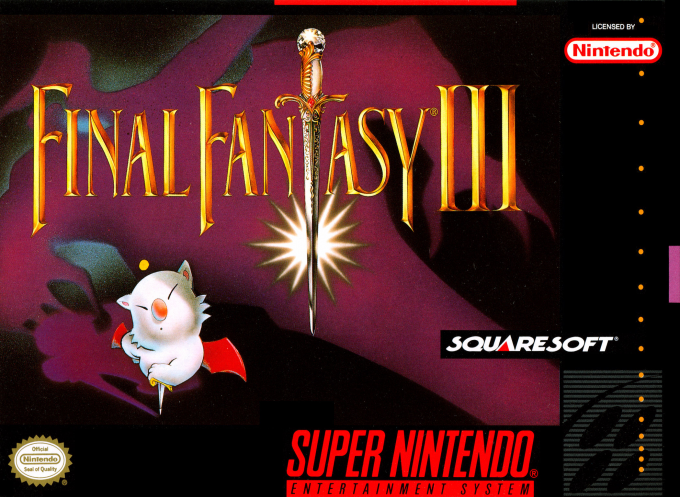
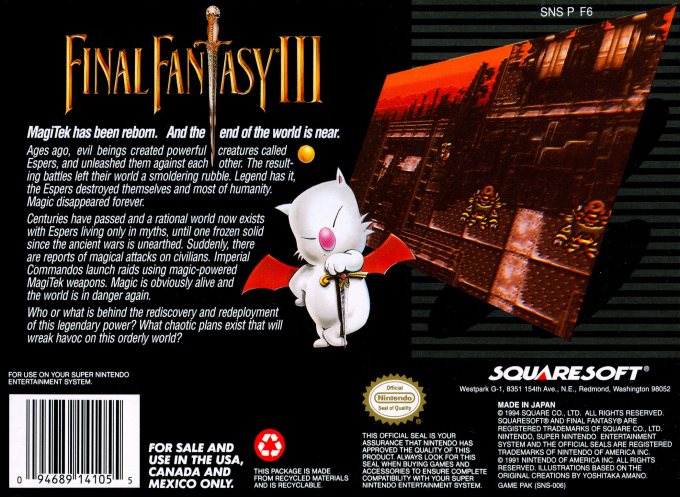
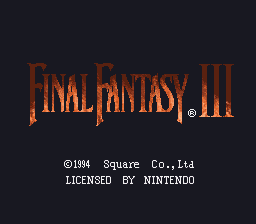
Final Fantasy III is the name Square gave its 1994 North American Super NES release of what the series now calls Final Fantasy VI. It is not the Famicom title later localized under the same name. On this original SNES cartridge, a thousand years have passed since the War of the Magi left the world scarred and magic all but forgotten. Steam power, iron, and industry have filled the void, but the Empire is hunting the legendary Espers and turning their power into MagiTek weaponry. A mission to the snowy mining town of Narshe brings a mysterious young woman face to face with a frozen Esper, setting a vast adventure in motion.
The journey moves from imperial cities and desert castles to airship routes, haunted trains, floating continents, and the shattered remnants of a changing world. Terra’s uncertain past sits at the center of the opening, but this is deliberately an ensemble tale. Thief-turned-treasure-hunter Locke, brothers Edgar and Sabin, former general Celes, samurai Cyan, gambler Setzer, and many other allies each bring their own perspective, history, and reason to resist the Empire. The cast’s shifting focus gives the adventure room for humor, mystery, grief, and moments of genuine grandeur without reducing the party to a single chosen hero.
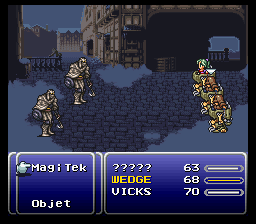
Exploration follows the classic 16-bit role-playing format: travel the world, investigate towns and dungeons, speak with residents, uncover equipment, and prepare for dangerous encounters. Battles use Square’s Active Time Battle system, so commands become available as each character’s gauge fills. Choosing an attack is only the beginning. Every party member has a distinctive command set, from Edgar’s Tools and Sabin’s Blitz techniques to Cyan’s SwordTech, Setzer’s Slots, and Shadow’s Throw ability. That variety makes party construction matter, and it gives routine encounters a brisk, tactical rhythm.
Magic is both a story-defining force and a major part of character growth. By equipping magicite associated with Espers, characters can learn spells through earned battle points and can receive stat bonuses at level-up. This lets the player keep a character close to an obvious role or gradually build unexpected combinations, while summons provide powerful effects in combat. Relics, weapons, armor, and status protection add another layer of decision-making, whether the goal is survival against a difficult boss or a stronger strategy for the road ahead.
Final Fantasy III balances that flexible progression with a memorable sense of place. The Super NES presentation pairs expressive sprites with detailed backdrops, dramatic Mode 7 effects, and Nobuo Uematsu’s score to make every new location feel distinct. The opera sequence, a ghostly ride through the Phantom Train, and the rise of the Blackjack airship all show how much atmosphere Square built into the cartridge. The game also uses its visual language to tell the story: characters turn, pause, and act in small scenes that carry personality far beyond the size of their sprites.
The stakes sharpen as the Empire’s pursuit of magic threatens to repeat the catastrophe of the distant past. Villain Kefka brings a volatile presence to that conflict, while the heroes must decide what they are willing to protect when the world no longer feels secure. The adventure’s structure eventually opens into a broad search across a transformed world, inviting players to reunite the scattered party, follow optional leads, seek powerful Espers, and decide how much of its hidden material to discover before the final confrontation.
This SNES version is especially important for its original North American identity. It was released as Final Fantasy III because earlier numbered installments had not reached that market, while later releases use the worldwide series numbering, Final Fantasy VI. The name changed, but this is the same sixth mainline adventure: the original 2D Super NES edition with its own English-era presentation, mechanics, and text. For players exploring the game’s history, that label is a useful reminder of how differently the series first arrived in North America.
More than a showcase of its era, Final Fantasy III remains a richly varied role-playing game built around discovery and choice. Its large cast encourages experimentation, its Esper system rewards long-term planning, and its world keeps finding new ways to surprise the player. Whether revisiting the North American SNES classic or encountering it for the first time, this is a sweeping fantasy of lost magic, imperial ambition, and a group of unlikely allies trying to keep their world from breaking again.
Gallery
Details
- Developer
- Square
- Publisher
- Square
- Genre
- JRPG
- Players
- 1-2
- Release Date
- October 11, 1994
- System
- SNES