About
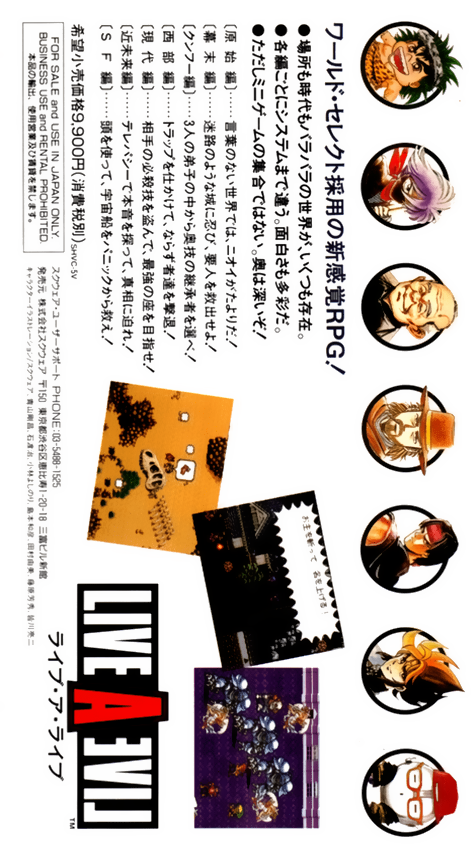
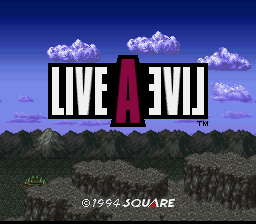
Live A Live is Square’s 1994 Super Famicom role-playing game, released in Japan as a bold anthology rather than a single continuous quest. Its opening premise is immediately inviting: choose from seven standalone stories, each led by a different hero in a different age. Prehistory, imperial China, Edo-period Japan, the American frontier, the present day, a near-future city, and a distant-future spacecraft give the cartridge an unusually broad dramatic range. The order is yours to set, so a first session can begin with martial arts, a western, science fiction, or something stranger without asking the player to work through a conventional RPG prologue first.
That structure is more than a change of scenery. Each scenario has its own mood, objective, and way of moving the action forward. One may lean toward exploration, another toward conversation or problem-solving, and another toward direct confrontations; the same basic RPG framework is repeatedly reshaped by the setting. Live A Live therefore feels like a collection of compact experiments that share a common language instead of seven chapters of the same adventure. The chapters are short enough to invite a change of pace, but distinctive enough that changing eras also changes the game’s texture.
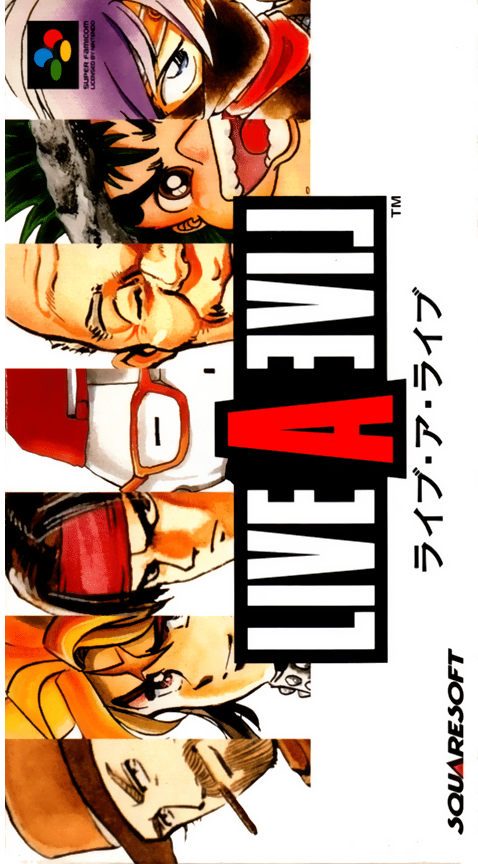
The presentation reinforces that variety with a remarkable guest-art concept for a 16-bit Square release. The protagonists of the seven principal stories were designed by seven manga artists: Gosho Aoyama, Osamu Ishiwata, Yoshinori Kobayashi, Kazuhiko Shimamoto, Yumi Tamura, Ryouji Minagawa, and Yoshihide Fujiwara. Their different sensibilities give each period its own visual personality while the sprite work keeps everything legible on Super Famicom hardware. Yoko Shimomura’s score, her first major RPG work after joining Square, provides another strong link between wildly different worlds, shifting its color to suit each scenario while giving the game a memorable musical identity.
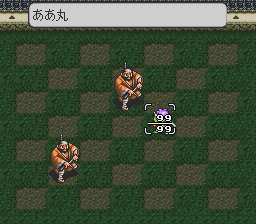
When a battle begins, Live A Live leaves behind the usual line of heroes facing a line of enemies. Its signature Checker Battle system is turn-based combat on a grid, where position and timing matter as much as selecting an attack. Characters move square by square, and techniques cover particular ranges and patterns, turning the battlefield into a small tactical puzzle. A powerful move can be ideal from one tile and ineffective from another; an enemy’s reach likewise encourages careful spacing. The system gives the game a strategy-game edge without abandoning the immediacy of an RPG command menu.
The original’s rules also support brisk scenario-by-scenario play. Battles conclude with recovery rather than forcing a long drain on the party’s basic health, and the individual chapters vary their encounter structure and progression. Some reward a measured search of the environment, some put the emphasis on reading an opponent or learning the rhythm of a fight, and some make their setting-specific hook central to the experience. This willingness to alter the rules from chapter to chapter is the heart of Live A Live: it asks what a role-playing game can become when theme, protagonist, and mechanics are allowed to change together.
There is a special pleasure in playing it as a Super Famicom original. The concise scenarios, expressive pixel art, and confident shifts in genre make it a vivid snapshot of Squaresoft experimenting at a moment when 16-bit RPGs could still take sharp formal risks. It is approachable in pieces yet rewards attention to how its separate stories echo one another, without needing a spoiler-heavy explanation of where they lead. For retro RPG players, it offers the rare chance to sample several distinct adventures in one carefully constructed game.
This description refers specifically to the Japanese 1994 Super Famicom release. Square Enix later remade Live A Live for Nintendo Switch in 2022 with HD-2D visuals, rearranged music, and modern convenience improvements, followed by other platforms; that is a separate version of the same work. The original remains defined by its 16-bit presentation, its seven freely chosen opening scenarios, and the inventive grid battles that made its compact anthology format stand out.
Gallery
Details
- Developer
- Squaresoft
- Publisher
- Squaresoft
- Genre
- JRPG
- Players
- 1
- Release Date
- September 2, 1994
- System
- SNES