About
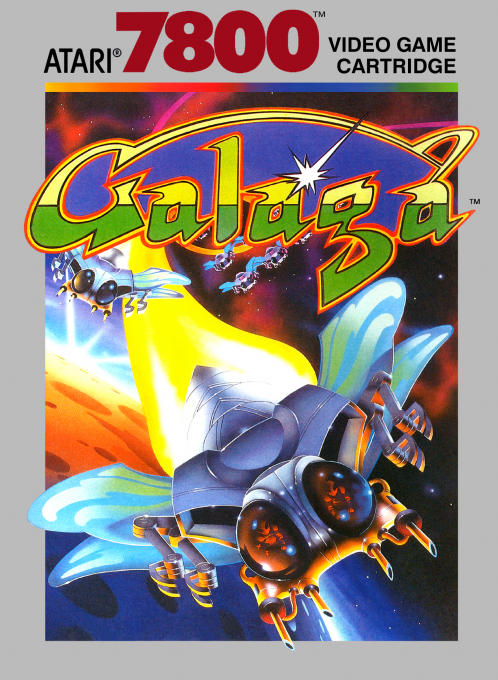
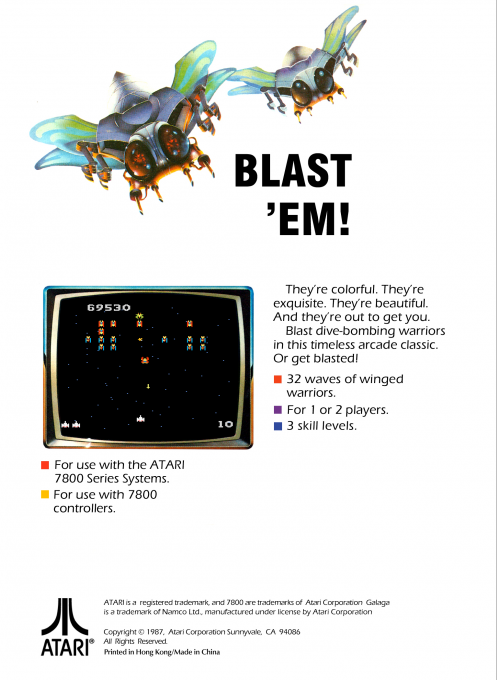
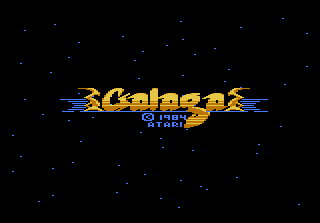
Galaga for the Atari 7800 is Atari’s home conversion of Namco’s 1981 fixed shooter. Released in 1986 as one of the 7800’s launch titles, it adapts the arcade game’s single-screen battles into one- or two-player score competition. The objective is to clear successive waves of Galagan invaders while keeping the player’s Command Ship alive. The action takes place along the bottom of a wide playfield as enemy formations sweep in from above and the sides, take up positions, and then break away to attack.
Before a game, the player selects one or two players and one of three difficulty settings: Novice, Advanced, or Expert. The joystick moves the Command Ship left and right, and either controller button fires its intergalactic missiles; holding a button enables rapid fire. The console’s Pause control stops and resumes play. A new game begins with four Command Ships in total, with one in the battle line and the rest held in reserve. A ship is lost by contact with an enemy or an enemy missile.
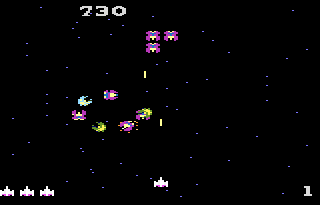
Each wave begins with the aliens flying into formation. The smaller Drone and Hornet enemies can be destroyed with one hit, while the tougher Flagships take two. Once the formation is established, individual enemies dive toward the player in curving attack patterns and fire as they descend. The escalating waves preserve Galaga’s central rhythm: shoot enemies during their arrival or formation, then dodge their missiles and diving runs while finding openings to clear the screen.
The Flagship’s tractor beam supplies the game’s defining risk-and-reward mechanic. A Flagship can capture the current Command Ship and carry it to the formation. If the player still has a reserve ship, the replacement can destroy the Flagship while it is moving to free the captured craft. The rescued ship joins the active one as a dual fighter, doubling the player’s firepower but also creating a larger target. Hitting the captured ship during the rescue attempt destroys it instead, so recovering it is a deliberate tactical gamble rather than a simple bonus.
Challenging Stages interrupt the regular combat waves with preset enemy flight patterns. The aliens do not fire during these rounds, leaving the player to shoot as many as possible for points. Destroying the complete group of 40 earns the largest bonus, while the changing formations reward quick reactions and familiarity with their paths. Regular play continues afterward with fiercer attacks, more aggressive dives, and the same pursuit of score and survival.
The 7800 conversion keeps the arcade game’s wave structure, dual-fighter system, enemy variety, and Challenging Stages, but its presentation is not identical. The 7800 display gives the play area a wider feel, the player ship is smaller, and the Boss Galaga sprites are the same size as the other enemies rather than larger as in the arcade game. Its stage identifiers use plain numbers in place of the arcade’s emblem-style badges. The home version also uses the 7800’s color palette and sound hardware, resulting in a visibly and audibly different presentation from the coin-operated original.
The conversion is close in rules and controls, but the later waves expose a technical difference from the arcade version. As the game reaches roughly wave 10 and beyond, the heavier on-screen activity can produce slowdown and jitter in the enemy formation. The three selectable difficulty levels offer a way to set the pace at the start; Expert begins at wave 10 with faster enemies. Despite those distinctions, the 7800 release remains a direct home interpretation of Galaga’s formation shooting, capture-and-rescue strategy, and score-focused bonus rounds.
Gallery
Details
- Developer
- Namco
- Publisher
- Atari
- Genre
- Shoot 'em Up
- Players
- 1-2
- Release Date
- August 1, 1986
- System
- Atari 7800