About
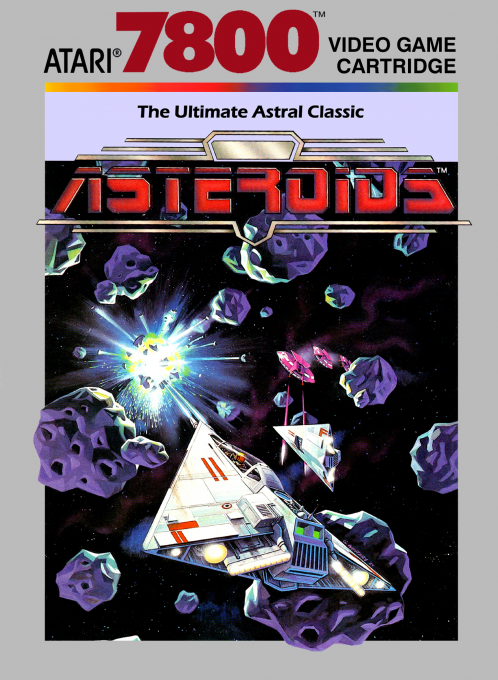
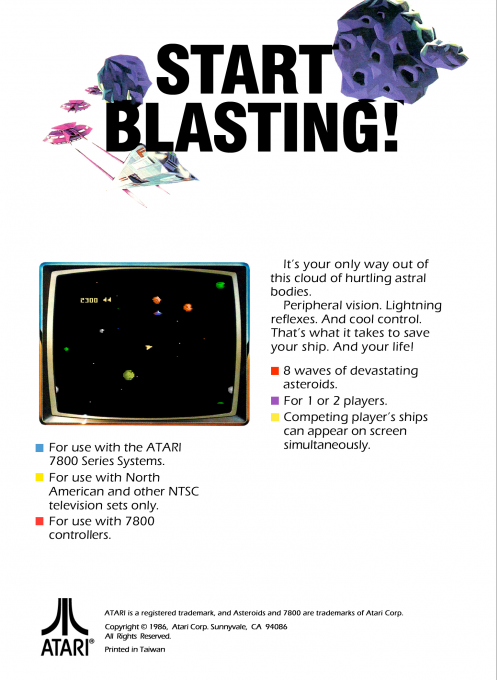
Atari Corporation published Asteroids for the Atari 7800 in 1986, bringing its celebrated 1979 arcade shooter to the ProSystem during the console’s launch period. The 7800 cartridge is a raster, color home conversion of the original monochrome vector game, retaining the spare wraparound space arena while adapting its controls to the system’s joystick. General Computer Corporation is commonly credited with the 7800 conversion, while Atari Corporation issued the cartridge and its 1986 manual.
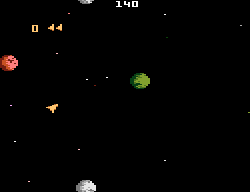
The player pilots a small ship trapped among drifting rocks. Left and right rotate its nose, forward applies thrust, and momentum carries the ship onward after thrust is released; success depends on steering that inertia rather than simply moving in four directions. A button fires photon shots straight ahead, with only four shots permitted on screen at once. Objects cross one edge of the playfield and re-enter from the opposite edge, so both danger and a well-aimed shot can return from behind.
Each wave begins with large asteroids, and a hit breaks each one into two medium pieces; medium rocks divide into two small ones, while small rocks disappear. The next wave arrives after the field is cleared and becomes harder to destroy. On Novice, the manual specifies a gentler rule in which large and medium asteroids simply shrink when hit. Colliding with any asteroid destroys the ship, so clearing rocks also creates faster, more numerous hazards before it makes the screen safe.
Alien Robot Saucers periodically cross the battlefield and fire photon lasers. They are absent on Novice, while the higher difficulty settings increase asteroid speed and saucer accuracy. The scoring table rewards the changing risk: large, medium, and small asteroids are worth 20, 50, and 100 points; large and small saucers score 200 and 1,000. A bonus ship is awarded every 10,000 points, and the session’s high score remains displayed until the console is switched off.
Hyperspace is the emergency control, activated by pulling the joystick backward. It moves the ship to a random place on the screen, which can avert an imminent collision but may put it directly into danger or destroy it during the warp. Players start with a reserve fleet of three ships; a replacement enters only after the center of the field is clear of passing asteroids. That delay makes a lost ship consequential even before the reserve count is exhausted.
Alongside standard one-player play and alternating two-player play, the 7800 version adds simultaneous two-player variations. Competition Asteroids puts both ships on screen, allows one player’s shots to destroy the other, and awards 500 points for doing so; the game ends when one player has no ships left. Team Asteroids instead makes partners share reserve ships and lets their photon fire pass harmlessly through each other, turning the same crowded field into cooperative score chasing. The two ships are visually distinguished as gold for player one and blue for player two.
Four selectable settings—Novice, Intermediate, Advanced, and Expert—change the pressure without changing the basic objective: survive while demolishing every rock and saucer in the field. In contrast with the arcade cabinet’s five dedicated buttons and vector display, the 7800 release consolidates turning, thrust, hyperspace, and firing onto a home controller and presents colored player ships in its multiplayer modes. It preserves Asteroids’ central tension between careful rotation, drifting momentum, controlled shooting, and the tempting but unpredictable escape of hyperspace.
Gallery
Details
- Developer
- Atari
- Publisher
- Atari
- Genre
- Shoot 'em Up
- Players
- 1-2
- Release Date
- November 1, 1987
- System
- Atari 7800