About
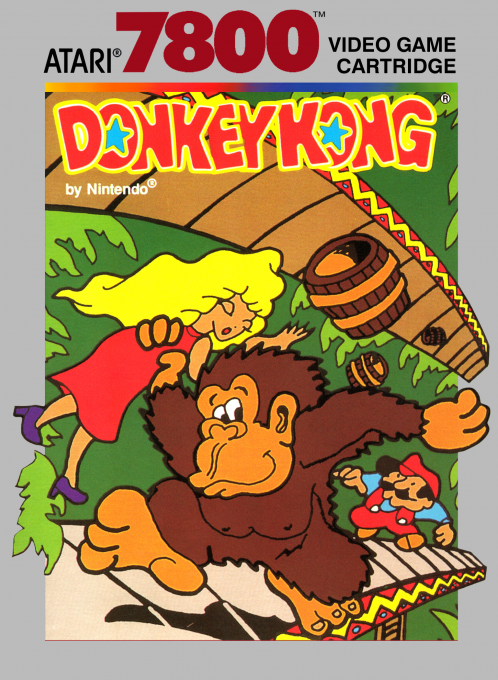
Donkey Kong for the Atari 7800 brings Nintendo’s landmark arcade rescue game to Atari’s 8-bit console in a 1988 cartridge published by Atari and developed for the system by International Technology Development Corporation. Mario’s girlfriend has been carried to the top of a steel fortress by the huge ape Donkey Kong, and every round turns that simple premise into a brisk climb through moving hazards, narrowing routes, and a steadily draining bonus clock.
Mario runs along the fortress ramps, climbs ladders, and jumps the barrels and fireballs sent into his path. A well-timed leap is the essential survival skill: it clears danger, scores points, and keeps the rescue moving upward. The controller also lets Mario take hold of a hammer, his brief but valuable answer to incoming barrels and fireballs. With the hammer in hand he can smash threats for points, but it disappears quickly and prevents him from climbing ladders, forcing players to decide when a little safety is worth giving up mobility.
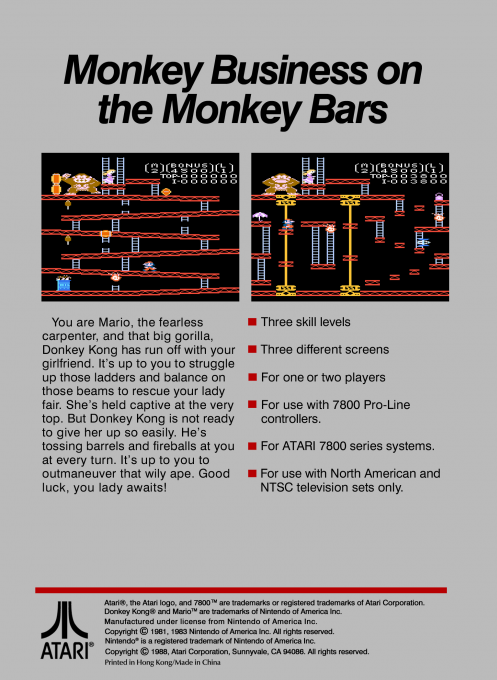
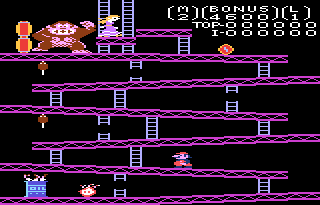
This Atari 7800 conversion is built around three repeating screens. The opening ramp screen is the familiar tilted-girder ascent, where Donkey Kong rolls barrels downhill and Mario must run, jump, or hammer a path upward. The elevator screen trades barrels for platforms and moving lifts, with bouncing springs making the upper routes especially dangerous. On the rivet screen, Mario has to cross every rivet to remove it while dodging pursuing fireballs; clearing the last one ends the cycle and sends him back to the ramps at a tougher difficulty.
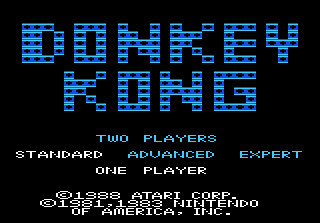
The game supports one or two players and lets players choose a starting game level before play begins. Each player starts with three Marios, receives an extra life at 20,000 points, and races against a bonus counter that begins at 5,000. Letting that counter empty costs a life just as surely as an enemy collision or a bad fall. Scores come from decisive play—jumping barrels, collecting the purse and umbrella, removing rivets, and using the hammer effectively—so the same climb rewards both survival and efficient route planning.
Rather than attempting every arcade screen, the 7800 release presents the ramp, elevator, and rivet stages and omits the cement-factory stage. That makes it a distinct home version with its own compact rhythm: a three-screen rescue loop that becomes faster and more demanding after each successful pass. The cartridge retains the central push-and-pull of the arcade design, from the angled ramps and partial ladders to the choice between a safe detour and a risky dash for a bonus item.
Donkey Kong’s broader importance comes from the 1981 arcade original, a game that introduced Mario—then known as Jumpman—and established an enduring template for platform action. Its combination of running, jumping, ladders, hazards, score chasing, and a visible rescue objective helped make the act of moving through platforms feel like a complete game genre rather than a single gimmick. The Atari 7800 edition arrived years later, but it preserves the direct, immediately readable challenge that made the original such a lasting fixture of the arcade era.
For Atari 7800 players, Donkey Kong is a focused test of timing and nerve. Barrels punish hesitation, springs turn elevator routes into traps, and the rivet stage demands that Mario cover the whole screen without being cornered by fireballs. Its rules are easy to grasp within seconds, yet the changing speed, score incentives, and limited lives give every repeat trip up the fortress a reason to be played a little more cleanly than the last.
Gallery
Details
- Developer
- International Technology Development
- Publisher
- Atari
- Genre
- Platformer
- Players
- 1-2
- Release Date
- November 1, 1988
- System
- Atari 7800