About
X-Men: Children of the Atom (USA 950105) is Capcom's one-on-one arcade fighting game for the CP System II hardware. Developed and published by Capcom, this U.S. program revision is dated January 5, 1995, following the game's Japanese arcade debut in late 1994. It adapts Marvel's X-Men world into a fast, six-button fighter, drawing its central conflict from the "Fatal Attractions" comic storyline. Magneto stands at the center of the crisis, and the game frames every battle as part of the struggle around his plan for mutant dominance.
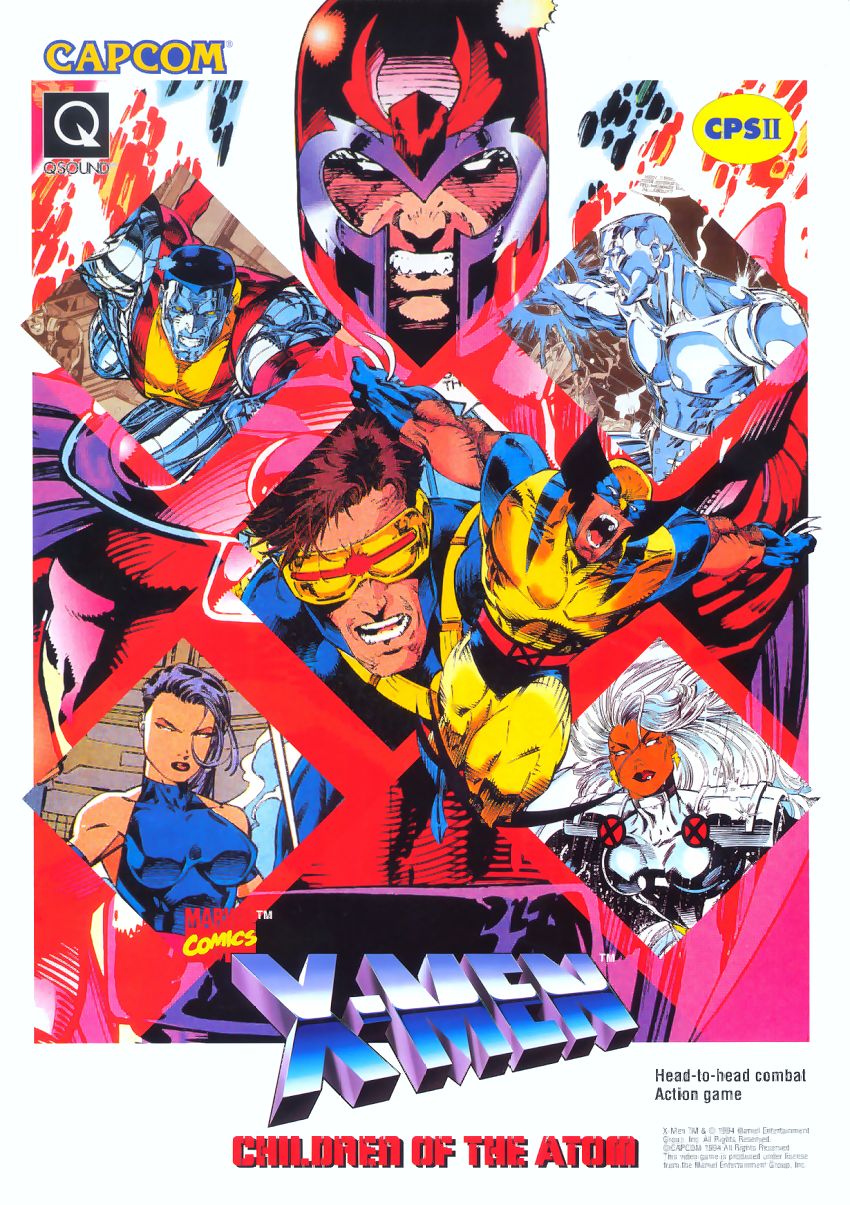
The arcade game offers ten standard selectable combatants: Cyclops, Colossus, Iceman, Psylocke, Storm, and Wolverine represent the X-Men, while Omega Red, Sentinel, Silver Samurai, and Spiral bring rival powers to the roster. Each fighter has a distinct set of normal attacks, special moves, throws, and screen-filling techniques based on their comic-book abilities. Players use an eight-way joystick and six attack buttons, with light, medium, and heavy punches and kicks providing the familiar Capcom fighting-game foundation. The presentation pairs large, expressive character animation with colorful backgrounds and voices associated with the era's X-Men animated television series.
Matches are best two out of three rounds, whether two players face each other at the cabinet or one player advances through the computer-controlled arcade route. The solo path builds toward Juggernaut and Magneto, who serve as boss opponents rather than part of the normal character-select lineup. A hidden encounter with Akuma connects the game to Capcom's Street Fighter lineage, but it requires specific play conditions to appear. The result is a direct arcade structure: choose a favorite mutant or adversary, win successive duels, and overcome the two final challenges.
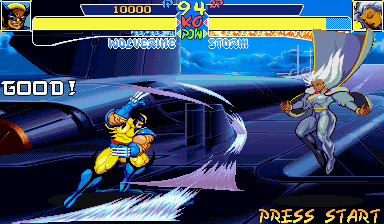
Combat moves at a deliberately high tempo. Super Jumps send characters far above the usual fighting-game height, making aerial positioning and air-to-air attacks central to many exchanges. Players can follow an opponent into the air, extend hits into air combos, or use throws to create further attack opportunities. Fallen fighters may roll forward or backward on recovery, adding a positional decision after a knockdown. Several projectiles can be aimed at different angles, so a ranged move can cover more than a straight line. These systems make the game more than a sequence of grounded exchanges and encourage players to use the full vertical space of an arena.
Its X-Power gauge builds through combat and supports more powerful options. At higher levels, a player can spend meter on an X-Ability or commit a larger amount to a Hyper X attack. Meter also matters for defensive techniques, including escaping the end of a throw sequence or countering a throw. Before a match, players may select manual or automatic blocking; automatic blocking lowers the barrier to entry but restricts some actions. This balance of accessible basic attacks and meter-based offense and defense gives the arcade game room for both immediate play and deeper match strategy.
X-Men: Children of the Atom also uses stages with multiple levels: parts of the floor can give way, dropping the fighters into a lower section instead of ending the action at a fixed boundary. That visual spectacle, its super-jump movement, and its emphasis on extended aerial offense helped establish ideas Capcom would revisit in later Marvel fighting games. The original arcade release was followed by Sega Saturn, MS-DOS, and PlayStation conversions, but this entry is specifically the U.S. CPS-II arcade revision, preserving the cabinet game's two-player format and original arcade design.
Gallery

Details
- Developer
- Capcom
- Publisher
- Capcom
- Genre
- Fighting
- Players
- 1-2
- Release Date
- January 1, 1994
- System
- Arcade